Order = importance. Tier 1 (must know) at the top, Tier 3 (rare) at the bottom. Within each tier: Section C long Qs first, then Practicals. Section A shorts sit inside Tier 1 — always asked. Type your answer, click Reveal marking-scheme answer to self-mark. Use the left panel to jump anywhere. Auto-saves locally.
Tiers reflect a deep audit of all 8 available Section C papers (2016-18, 2021-25). T1 (7-8/8): Ecology · Photosynthesis & Respiration · Plant Repro · Human Repro · Genetics · DNA · Bacteria · Q16/Q17 Mixed. T2 (5-6/8): Nervous · Excretion. T3 (2-3/8): Plant Response · Tissues · Digestion. 2016 was an outlier (no genetics/DNA/microbiology in Sec C) — three T1 topics are 7/8 because of that one year alone.
Bedrock topics — every audited Section C paper had at least one. If you only have time for half the bank, do these. (Genetics / DNA / Bacteria all missed only 2016, an outlier year with no genetics or microbiology in Sec C.)
Ecology
15.   (a)    Explain the following three ecological terms:
             (i)   Biosphere
             (ii)  Niche
             (iii) Competition                                                                  (9)
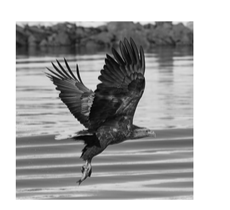
      (b)    White-tailed sea eagles were once widespread on the island of Ireland, but
             numbers diminished as a result of hunting by humans. One hundred
             white-tailed eagle chicks were brought from Norway and released into
             Killarney National Park in County Kerry as part of a rewilding project.
             However, experts say the birds still face many challenges in terms of
             repopulation. These include poisonings, bird flu and even wind turbines.
             White-tailed sea eagles have well-developed and powerful flexor muscles in
             their legs and large sharp talons (claws) to capture prey. They hunt marine
             and freshwater fish (such as salmon), seabirds (such as gulls), hares and
             other small mammals.
                          Adapted from White-tailed eagles breed…., breakingnews.ie 27 Sept 2024

             (i)   Distinguish between the terms, predator and prey.
             (ii)  Name an adaptation useful for the survival of the white-tailed sea eagle.
             (iii) Name one human activity that impacts on the population of
                   white-tailed sea eagles.
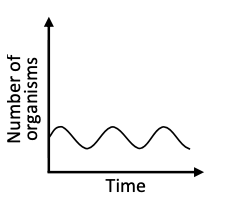
             (iv)  1.  The graph shows the periodic changes in the number of white-tailed
                       sea eagles over time in a habitat. Copy the graph into your
                       answerbook. Then, using a dashed line (- - - -), draw a graph to
                       show how the number of any one of its prey would vary over the
                       same time period.
                   2.  Give a detailed explanation of the graph that you have drawn for
                       the prey species.
             (v)   Explain why food chains, such as those involving the white-tailed sea
                   eagle, are limited in length.                                                (27)
      (c)    (i)   The following processes occur in the nitrogen cycle. Outline what is
                   occurring during each process.
                   1.  Nitrogen fixation
                   2.  Decomposition
                   3.  Nitrification
                   4.  Denitrification
             (ii)  Pollution can affect the nitrogen cycle. What is pollution?
             (iii) Name and state the effect of one pollutant from one of the following
                   areas: agriculture or industry or domestic.
             (iv)  Describe how the pollutant you have named in part (iii) above may be
                   controlled.                                                                  (24)
▸ Reveal marking-scheme answer
Question 15                                                                                     60
 (a) Explain the following three ecological terms:
       (i)   Biosphere
             Part of the Earth where life exists                                                  3
       (ii) Niche
             (Functional) role of an organism                                                     3
       (iii) Competition
             Struggle between organisms for a limited resource                                    3
 (b) (i)     Distinguish between the terms, predator and prey.
             Predator:     an organism that kills and eats another organism                       3
             Prey:         an organism that is killed and eaten by another organism               3
       (ii) Name an adaptation useful for the survival of the white-tailed sea eagle.
             Powerful (or flexor) muscles or large (or sharp) talons……….                          3
       (iii) Name one human activity that impacts on the population of white-tailed sea eagles.
             Poisoning or wind turbine or releasing chicks……….                                    3
       (iv) 1. Then, using a dashed line (- - - -), draw a graph to show how the number of
               any one of its prey would vary over the same time period.
                  Dashed line higher peaks than predator                                          3
                  Dashed line out of sync with predator                                           3
             2. Give a detailed explanation of the graph that you have drawn for the prey
                species.
                  Line:      Increases due to lower predator numbers or decreases due to
                             higher predator numbers                                              2
                  Number: Higher number due to food availability or reference to size (prey
                          are usually smaller in size)                                            2
                  Time:      Delay in increase (in prey numbers) due to time taken to breed       2
       (v) Explain why food chains, such as those involving the white-tailed eagle, are limited
           in length.
             Large loss in energy between trophic levels                                          3
 7           +3

 (c) (i)     Outline what is occurring during each process.
             1. Nitrogen fixation
                  Nitrogen gas or atmospheric nitrogen converted to ammonia or ammonium or
                  nitrite or nitrate                                                             3
             2. Decomposition
                  Breakdown of (dead) organic matter (into usable compounds)                     3
             3. Nitrification
                  Conversion of ammonium (or ammonia or urea) into nitrates (or nitrites)        3
             4. Denitrification
                  Conversion of ammonia or ammonium or nitrite or nitrate or into nitrogen gas
                  or atmospheric nitrogen                                                        3
       (ii) What is pollution?
             Harmful addition to the environment                                                 3
       (iii) Name and state the effect of one pollutant from one of the following areas:
             agriculture or industry or domestic.
             Name:         correctly named pollutant                                             3
             Effect:       correct matching effect                                               3
       (iv) Describe how the pollutant you have named in part (iii) above may be controlled.
Correct matching control measure described 312. (a) Define each of the following terms: ecology; biosphere; conservation. (9)
(b) The graph shows the fluctuating numbers of prey Prey
over time in a habitat.
(i) Copy the graph into your answerbook. Numbers of
Then, using a dashed line (- - - -), show how
the population of the prey’s main predator organisms X
species varies over the same time period.
(ii) Give a detailed explanation of the graph that
Time
you have drawn for the predator species.
(iii) If a disease affected the predator at time X, what would you expect to happen to
the graph showing the prey? Explain your answer.
(iv) Give a role for predation in the overall scheme of nature.
(v) Human population numbers do not follow a similar pattern to the one shown in
the graph. Suggest two reasons for this. (27)
(c) The diagram below shows a food web from a marine ecosystem.
Study the food web and answer the questions that follow.
Peregrine
falcon Orca whale
Seal
Seagull
Octopus
Salmon Herring
Hermit
Zooplankton crab
Shrimp
Seaweed
Phytoplankton
(i) Give one example of each of the following from the food web shown above:
1. A producer
2. A secondary consumer
3. A top consumer (top carnivore)
(ii) What is meant by the term producer?
(iii) Write out a complete food chain from this food web.
(iv) How many trophic levels are in the food chain you wrote in part (c) (iii) above?
(v) What is meant by the term trophic?
(vi) Explain why food chains have a limited number of trophic levels.
(vii) Name the type of diagram an ecologist may draw to indicate the relative sizes of
the populations at different trophic levels. (24)
▸ Reveal marking-scheme answer
Question 12                                                                                        60

                                               3(3)
  (a) Define each of the following terms: ecology; biosphere; conservation.
        Ecology:            The study of (interactions between) organisms and their environment       3
        Biosphere:          Where life can exist on Earth                                             3
        Conservation:       Management (or preservation or protection) of organisms (or species
                            or their habitats or environments or ecosystems)                          3

                                                  5(2)
  (b) (i)      Show how the population of the predator species varies over the same time period.
               Dashed line lower peaks than prey                                                      2
               Dashed line out of sync compared to prey.                                              2
       (ii)    Give a detailed explanation of the graph that you have drawn…
               Line:       Increases due to food (prey) availability or decreases due to lack of
                           food (prey)                                                                2
               Number: Lower number due to loss of energy or reference to size (predators
                       usually larger in size).                                                       2
               Time:       Delay in increase (in predator numbers) due to time taken to breed.        2

                                                     3(3)
       (iii)   If a disease affected the predator…what would you expect to happen to the graph?
               Prey (population) increases                                                            3
               Explain your answer.
               Less predators or greater chance of survival                                           3
       (iv)    Give a role for predation in the overall scheme of nature.
               Population control or described                                                        3
                                                2(4)
       (v)     Suggest two reasons human population numbers do not follow a similar pattern.
               Healthcare / food supply / lack of predators / other correct                Any two   2(4)

  5           +3       +2

                                                   6(3)
  (c) (i)      Give one example of each of the following from the food web shown:
               1.   A producer
                    Phytoplankton or seaweed                                                        3
               2.   A secondary consumer
                    Salmon or herring or octopus                                                    3
               3.   A top consumer (top carnivore)
                    Peregrine falcon or orca whale                                                  3
       (ii)    What is meant by the term producer?
               Organism that makes its own food.                                                    3
       (iii)   Write out a complete food chain from this food web.
               Any correct food chain from the food web.                                            3
       (iv)    How many trophic levels are in the food chain you wrote above?
               5                                                                                    3

                                                     3(2)
       (v)     What is meant by the term trophic?
               Feeding or nutrition                                                                 2
       (vi)    Explain why food chains have a limited number of trophic levels.
               Large amount of energy is lost between (trophic) levels or little energy passed on   2
       (vii) Name the type of diagram an ecologist may draw…
               Pyramid of numbers or ecological pyramid                                             2

6 +311. (a) Explain each of the following terms as used in ecology:
(i) Ecosystem
(ii) Habitat
(iii) Niche (9)
(b) Read the passage below and answer the questions that follow.
Ash dieback is a serious disease of ash trees caused by the invasive pathogen
Hymenoscyphus fraxineus, which originates in Asia and was brought to Europe in the
early 1990s.
Ash dieback was first detected in the Republic of Ireland in October 2012 on plants
imported from continental Europe. The disease is now prevalent throughout most of
the island of Ireland and is likely to cause the death of the majority of the ash trees
over the next two decades. This will also have an effect on organisms that feed on ash
(such as moths) and other animals along the food chain (such as birds, e.g. the robin).
Teagasc, the Irish agriculture development authority, is aiming to establish a gene
bank composed of genotypes of ash trees that are tolerant or resistant to the deadly
pathogen with the future aim of producing planting stocks for forests and hedgerows
in Ireland.
Adapted from Ash Dieback Disease, www.teagasc.ie
(i) Name the type of ecological relationship that exists between ash trees and the
pathogen that causes ash dieback.
(ii) From the passage, or otherwise, state a way that ecologists could ensure the
survival of ash trees in Ireland.
(iii) Write down a food chain (with at least three trophic levels) based on the
information given in the passage above.
(iv) Sketch a pyramid of numbers based on the food chain you gave in part (b) (iii)
above.
(v) Suggest two possible effects on the ecosystem if all ash trees in Ireland died.
(vi) 1. Name the type of ecological relationship that exists between the robin and
the moth.
2. Explain the importance of this type of ecological relationship in nature.
(27)
(c) Describe the main events of each of the following:
(i) The nitrogen cycle
(ii) The carbon cycle. (24)
▸ Reveal marking-scheme answer
Question 11 60
3(3)
(a) Explain each of the following terms as used in ecology:
(i) Ecosystem
Organisms and their environment 3
(ii) Habitat
Place where an organism lives 3
(iii) Niche
Role of an organism 3
Number of correct responses 1 2 3
3 Q11 (a) (i) – (iii)
Mark 3 6 9
9(3)
(b) (i) Name the type of ecological relationship between ash and the pathogen.
Parasitism 3
(ii) State a way that ecologists could ensure the survival of ash trees in Ireland.
Establish a gene bank of resistant (or tolerant) trees or thinning or diversifying
species or other correct way 3
(iii) Write down a food chain based on the information given in the passage.
Ash Moth Robin 3
(iv) Sketch a pyramid of numbers based on the food chain
Robin
Moth Correct order with Ash on the bottom 3
Ash Partially upright pyramid drawn 3
(v) Suggest two possible effects on the ecosystem if all ash trees in Ireland died.
Moth (or other consumers of ash) population falls / robin (or other consumer
of moths) population falls / other plant populations increase / soil erosion / any
correct environmental effect Any two 2(3)
(vi) 1. Name the type of ecological relationship that exists between the robin and the moth.
Predation or predator-prey 3
2. Explain the importance of this type of ecological relationship in nature.
Population control or described 3
Number of correct responses 1 2 3 4 5 6 7 8 9
9 Q11 (b) (i) – (vi)
Mark 3 6 9 12 15 18 21 24 27
8(3)
(c) Describe the main events of each of the following:
(i) The nitrogen cycle
Nitrogen (gas) to usable compounds / plant protein to animal protein / waste
releasing N compounds / decomposition releases N compounds / ammonium to
nitrite / nitrite to nitrate / nitrates to plant protein / nitrogen compounds to
nitrogen gas / any one named process Any four 4(3)
(ii) The carbon cycle
Carbon dioxide is fixed into plant carbohydrate (or sugars) / plant carbohydrate
to animal carbohydrate / living organisms releases carbon dioxide / decay of
organisms releases carbon dioxide / combustion of fossil fuels releases carbon
dioxide / any one named process Any four 4(3)
Number of correct responses 1 2 3 4 5 6 7 8
8 Q11 (c) (i) – (ii)
Mark 3 6 9 12 15 18 21 2412. (a) Explain the following three ecological terms: biosphere; niche; symbiosis. (9)
(b) Read the following passage and answer the questions that follow.
Dragonflies are a deadly group of Irish predators.
They chase down gnats with dazzling aerobatics
and have a high strike rate due to their huge
compound eyes.
Dragonflies hunt close to river banks and other
waterways. The water quality has to be very good
for most species. They also require vegetation for
protection and laying eggs. Dragonflies spend most of their lives as nymphs (young,
immature dragonflies) in waterways. These are small opportunistic, ambush
predators. They feed mostly on small invertebrates (e.g. water fleas).
It can take between one and three years for nymphs to fully mature into adult
dragonflies. Adults only survive for a few weeks as they fall prey to birds (e.g.
swallows).
The National Biodiversity Data Centre are running a survey of dragonflies where
volunteers are being asked to identify dragonflies and survey their habitats.
(Adapted from “Irish dragonflies: supreme killing machines”, The Irish Times, 5 September 2019)
(i) Suggest one reason why dragonflies are such successful predators.
(ii) Give two benefits for dragonfly populations living near freshwater vegetation.
(iii) Suggest a benefit of the adult and the nymph having different food sources.
(iv) What type of ecological relationship exists between swallows and dragonflies?
(v) Suggest one possible effect on the dragonfly population for each of the following:
1. a disease affecting the swallows
2. cutting of vegetation (e.g. reeds) along the river banks.
(vi) Suggest one reason why volunteers are being asked to identify dragonflies.
(vii) What might a volunteer use to help them identify a dragonfly? (27)
(c) (i) Outline the main events of the carbon cycle.
(ii) Explain why the carbon cycle is critical to life on Earth.
Global warming is occurring at an unprecented rate.
This is as a result of pollution of the atmosphere with greenhouse gases.
(iii) Explain the underlined term.
(iv) Waste management is important in controlling pollution.
Give one example of waste management from agriculture or fisheries or forestry.
(v) Other than global warming or pollution, give two factors that can have an effect
on the human population. (24)
▸ Reveal marking-scheme answer
Question 12                                                                                                                                          60
 (a) Explain the following three ecological terms:
     Biosphere: Part of the earth where life can exist.                                                                                                3
     Niche:       Role of the organism (or plant or animal)                                                                                            3
     Symbiosis: Relationship between species involving benefit (or described)                                                                          3
                                                    Number of correct responses                1     2        3
 3                                     Q12 (a)
                                                               Mark                            3     6        9
 (b) (i)      Suggest one reason why dragonflies are such successful predators.
              Huge eyes or compound eyes or dazzling aerobatics or opportunistic or ambush or
              other correct                                                                                                                            3
      (ii)    Give two benefits for dragonfly populations living near freshwater vegetation.
              Protection                                                                                                                               3
              Laying eggs                                                                                                                              3
      (iii)   Suggest a benefit of the adult and the nymph having different food sources.
              Not in competition (for same resource) or greater chance of survival                                                                     3
      (iv)    What type of ecological relationship exists between birds and dragonflies?
              Predator-prey or predation                                                                                                               3
      (v)     Suggest one possible effect on the dragonfly population of:
              1. a disease affecting swallows:       Increases                                                                                         3
              2. cutting of vegetation on riverbank: Decreases                                                                                         3
      (vi)    Suggest one reason why volunteers are being asked to identify dragonflies.
              Conservation or monitor numbers or biodiversity or protect from extinction or
              monitor effect of climate change or monitor water quality                                                                                3
      (vii)   What might a volunteer use to help them identify a dragonfly?
              Key or compare pictures or charts                                                                                                        3
                                     Number of correct responses      1        2       3       4         5         6         7         8         9
 9            Q12 (b) (i) – (vii)
                                                Mark                  3        6       9       12        15        18        21        24        27

 (c) (i)      Outline the main events of the carbon cycle.
              Brief note on role of: Photosynthesis / respiration / decay or decomposition /
              combustion / carbon sinks / any other valid point                        Any three 3(3)
      (ii)    Explain why the carbon cycle is critical to life on Earth.
              For C to be reused by organisms or finite amount of C or so C won’t run out or to
              balance carbon dioxide levels or (photosynthesis is) basis of food chains                                                                3
      (iii)   Explain the term ‘pollution’.
              Any harmful addition to environment                                                                                                      3
      (iv)    Give one example of waste management from agriculture or fisheries or forestry.
              Any valid example                                                                                                                        3
      (v)     Other than global warming or pollution, give two factors that can have an effect on human
              population
              War / famine / contraception / disease / any valid example                             Any two                                          2(3)
                                       Number of correct responses         1       2       3        4         5         6         7         8
 8               Q12 (c) (i) – (v)
Mark 3 6 9 12 15 18 21 2411. (a) (i) Draw a pyramid of numbers from the following food chain:
Cowslips Moth Bat Mites
(ii) Give one limitation of the use of pyramids of numbers in ecology. (9)
(b) After mating in the autumn, Irish bats hibernate through the winter then stir into life
again the following spring. In early summer the gravid (pregnant) females establish
maternity roosts in old buildings, attic spaces, under bridges and in other suitably
undisturbed locations, where they give birth to and rear their young. Bat populations,
in general, are in decline as roosting sites are lost to development and increased use of
pesticides is both poisoning bats and robbing them of their insect prey.
A single pipistrelle or soprano pipistrelle – our smallest and most common nocturnal
bat species, will eat a staggering 3,500 or so midges, mosquitoes, moths and other
small insects every night. Without the bats we’d be plagued by much bigger swarms of
biting insects on balmy summer evenings.
(Adapted from “Batty about Irish bats!” www.irelandswildlife.com, 2012)
(i) Suggest one advantage of females giving birth in early summer and not in spring.
(ii) Name and explain one human activity that impacts on Irish bat populations.
(iii) A bat and an insect are involved in a predator‐prey relationship.
Sketch and fully label a predator‐prey relationship graph to show how the
populations of these two species fluctuate.
(iv) Name one type of adaptation necessary for organisms to survive.
(v) From the text, or otherwise, give two adaptations that bats possess.
(27)
(c) (i) What is meant by the conservation of species?
(ii) Name and describe one conservation practice from agriculture or fisheries or
forestry.
(iii) Ecologists monitor or survey animal population numbers on a regular basis.
1. Suggest one advantage of carrying out these surveys.
2. Describe the steps taken to estimate the population of a named animal
species in the ecosystem you have studied.
(24)
▸ Reveal marking-scheme answer
Question 11                                                                                                         60
  (a) (i)        Draw a pyramid of numbers:

                                      or                    or
                 Correct organism at each trophic level                            Cowslips must be at the bottom     3
        (ii)     Give one limitation with the use of pyramid of numbers:
                 Does not take size (or mass) of organisms into account or difficult to draw to
                 scale or may be inverted or size of some populations cannot be estimated                             3
                                                     Number of correct responses     1   2    3
                                  Q11 (a) (i - ii)
                                                                Mark                 3   6    9

  (b) (i)        Suggest one advantage of females giving birth in early summer and not in spring:
                 More (insects) food (for bats to feed offspring) or warmer or longer gestation
                 period or other relevant point                                                                       3
        (ii)     Name and explain one human activity that impacts on Irish bat populations:
                 Name:      Development (building or disruption) or (use of) pesticides or other
                            reasonable suggestion or building bat boxes or other named
                            conservation practice                                                                     3
                 Explain:
                 Development:  (Decreases (or reduces) bat population due to) less roosting (or
                               nesting) sites or too noisy or any valid impact or
                 Pesticides:   (Decreases (or reduces) bat population due to) poisoning of bats or
                               (due to) poisoning of prey (or less food) or any valid impact or
                 Conservation: (Increases bat population due to) conservation activity explained                      3
        (iii)    Sketch and label a predator-prey relationship graph:
                 Axes:      Time on horizontal axis and Population (number) on vertical axis                          3
                 Graph:     Two curves with indication of a repeating cycle                                           3
                            Bat (predator) showing lower peaks and predator curve showing time lag                    3
        (iv)     Name one type of adaptation necessary for organisms to survive:
                 Structural or behavioural or competitive                                                             3
        (v)      Give two adaptations that bats possess:
                 Hibernate / nocturnal / sleep upside down / varied diet / can fly / use
                 echolocation / light (or slender) bones / webbed limbs / endotherm / have fur /
                 any valid example                                                       Any two                     2(3)

                                  Number of correct responses      1    2    3     4     5    6    7    8    9
                Q11 (b) (i - v)
                                             Mark                  3    6    9     12    15   18   21   24   27

  (c) (i)       What is meant by the conservation of species?
                Management (or preservation or protection) of organisms (or their habitats or
                environments or ecosystems)                                                                           3
        (ii)    Name and describe one conservation practice from agriculture or fisheries or forestry:
                Agriculture: Mixed farming or crop rotation or biological controls or spreading slurry
                             (or fertiliser) correctly or correct use of herbicides (or pesticides) or
                              gene banks
                or
                Fisheries:    Large mesh size or quotas or re-stocking or returning young
                or
                Forestry:     Re-planting or broadleaf-conifer mix
                or
                Any valid example                                                                                     3
                Practice correctly described or expansion point given                                                 3
        (iii)   1. Suggest one advantage of carrying out surveys on animal populations:
                   Monitor (or investigate) changes or biodiversity or human impact or to prevent
                   (protect) species from extinction                                                                  3
                2. Describe the steps taken to estimate the population of a named animal species:
                   Named animal                                               Animal must match method below          3
                   For moving animals:
                   Captured (or how captured) /
                   marked (or how marked) /
                   released back into the same place /
                   recaptured (or how recaptured) /
                   counted /
                   formula (or calculation) described
                   or
                   Steps for sessile or slow-moving animals:
                   Quadrat /
                   random (or how random) /
                   counted /
                   repeated (several times) /
                   recorded numbers (or area) /
                   calculated population (density)                                                       Any three   3(3)
                                     Number of correct responses    1    2     3   4    5     6     7     8
                 Q11 (c) (i - iii)
                                                Mark                3    6     9   12   15    18    21    24
Photosynthesis & Respiration
13.   (a)    Metabolic reactions can be classified as anabolic or catabolic.
             (i)   Explain why photosynthesis is an example of an anabolic reaction.
             (ii)  Write a balanced chemical equation to represent photosynthesis.              (9)
      (b)    During photosynthesis chlorophyll absorbs light energy.
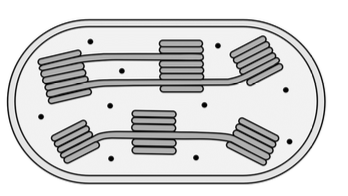
             (i)   Name the cell organelle shown in the diagram in which chlorophyll is
                   located.
             (ii)  Name the energised particles released by chlorophyll.
             (iii) These particles can enter one of two pathways which are known as
                   pathway 1 and pathway 2. State the difference between each of these
                   two pathways in terms of energised particle movement only.
             (iv)  Two products of the light-dependent stage enter the light-independent
                   stage. Name the two products and describe each of their roles.
             (v)   Name the two products of the light-independent stage that are
                   regenerated and used in the light-dependent stage.                          (27)
      (c)    Enzymes control metabolic reactions, such as respiration and photosynthesis.
             (i)   Briefly describe enzymes under the following headings:
                   1.  Biochemical nature
                   2.  Shape.
             (ii)  Based on the biochemical nature of enzymes, name the cell component
                   where enzymes are made.
             (iii) Enzymes can be denatured. Explain the underlined term and state one
                   way in which an enzyme can be denatured.
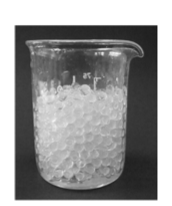
             (iv)  Enzymes can be immobilised, an example of which is shown in the image.
                   Describe a method of enzyme immobilisation.                                 (24)
▸ Reveal marking-scheme answer
Question 13 60
(a) (i) Explain why photosynthesis is an example of an anabolic reaction.
It involves the building up of large molecules using small molecules or requires
energy 3
(ii) Write a balanced chemical equation to represent photosynthesis.
6CO2 + 6H2O C6H12O6 + 6O2 First point: formulae; second point: balancing 2(3)
(b) (i) Name the cell organelle shown in the diagram in which chlorophyll is located.
*Chloroplast 3
(ii) Name the energised particles released by chlorophyll.
*Electrons 3
(iii) State the difference between each of these two pathways in terms of energised
particle movement only.
In pathway 1 electron returns to chlorophyll and in pathway 2 electron does not
return to chlorophyll or a different electron returns to chlorophyll 3
(iv) Two products of the light-dependent stage enter the light-independent stage.
Name the two products and describe each of their roles.
Name 1: *ATP or adenosine triphosphate 3
Role: Supplies energy (for the production of glucose) 3
Name 2: *NADPH 3
Role: Supplies electrons and protons (for the production of glucose) 3
(v) Name the two products of the light-independent stage that are regenerated and
used in the light-dependent stage.
*ADP (+P) or adenosine diphosphate 3
*NADP+ 3
(c) (i) Briefly describe enzymes under the following headings:
1. Biochemical nature
*Protein 3
2. Shape
Folded or described 3
(ii) Based on the biochemical nature of enzymes, name the cell component where
enzymes are made.
*Ribosome 3
(iii) Explain the underlined term and state one way in which an enzyme can be
denatured.
(An enzyme) that has lost its shape or is no longer functional 3
By pH changes or extreme heat or by agitation………. 3
(iv) Describe a method of enzyme immobilisation.
Two correct and relevant named chemicals 3
First correct physical procedural step described 3
Second correct physical procedural step described 313. (a) Photosynthesis and respiration are metabolic reactions.
(i) Explain the term metabolism.
(ii) Distinguish between the terms anabolic and catabolic. (9)
(b) The image shows a transverse section (TS) through a
cell organelle involved in aerobic respiration.
(i) Identify the cell organelle shown in the image.
(ii) Write out the balanced chemical equation for
aerobic respiration.
(iii) Aerobic respiration involves two stages
(stage 1 and stage 2).
1. What is the name given to stage 1?
2. Describe the events in stage 1.
3. Stage 2 involves the Krebs cycle and the electron transport chain.
Describe the role of the energy carrier NAD in stage 2. (27)
(c) The image shows leaf cells under the light Organelles
microscope.
The cell organelles indicated on the image are
responsible for photosynthesis, which occurs in two
stages – the light stage and the light-independent
stage. During the light stage, energised electrons
enter two pathways known as pathway 1 and
pathway 2.
(i) Name these cell organelles which are
responsible for photosynthesis.
(ii) Where do the energised electrons come from?
(iii) Briefly describe what happens to these energised electrons in pathway 1.
(iv) What is another name for the light-independent stage?
(v) Compounds of the general formula Cx(H2O)y are formed during the light-
independent stage of photosynthesis.
1. What name is given to the group of compounds described by this general
formula?
2. Name the simple molecule from which a plant obtains the protons (H+ ions)
used to make these compounds.
3. Name another simple molecule from which plants obtain the carbon (C)
used to make these compounds. (24)
▸ Reveal marking-scheme answer
Question 13 60
3(3)
(a) (i) Explain the term metabolism.
(All) chemical reactions in a cell (or organism). 3
(ii) Distinguish between the terms anabolic and catabolic.
Anabolic: building up large molecules from small molecules or (a reaction) using
energy 3
Catabolic: breaking down large molecules to small molecules or (a reaction)
releasing energy 3
9(3)
(b) (i) Identify the cell organelle shown in the image.
*Mitochondrion 3
(ii) Write out the balanced chemical equation for aerobic respiration.
C6H12O6 + 6O2 6CO2 + 6H2O
First point: formulae; second point: balancing 2(3)
(iii) 1. What is the name given to stage 1?
*Glycolysis 3
2. Describe the events in stage 1.
Glucose is broken down into (2) pyruvic acid / energy released / ATP is
produced from ADP and P / NADH is formed / from NAD(+) and electrons and
protons Any three 3(3)
3. Describe the role of the energy carrier NAD in stage 2.
Picks up electrons (e–) and protons (or H+ or hydrogen ions) / to form NADH /
these (electrons and protons) combine with O2 / to make water
Any two 2(3)
8(3)
(c) (i) Name these organelles which are responsible for photosynthesis.
*Chloroplasts 3
(ii) Where do the energised electrons come from?
*Chlorophyll 3
(iii) Briefly describe what happens to these energised electrons in pathway 1.
Picked up by (electron) acceptor or transferred from carrier to carrier / energy
released / ATP produced from ADP and P / (electron) returns to chlorophyll
Any two 2(3)
(iv) What is another name for the light-independent stage?
*Dark 3
(v) 1. What name is given to the group of compounds….?
*Carbohydrates 3
2. Name the simple molecule from which a plant obtains the protons (H+)….
*Water (H2O) 3
3. Name another simple molecule from which plants obtain the carbon (C)….
*Carbon dioxide (CO2) 312. (a) (i) Explain the term metabolism.
(ii) Is the reaction shown below an anabolic reaction or a catabolic reaction?
Explain your answer.
A B + C + Energy
(9)
(b) Aerobic respiration is a metabolic reaction that occurs in two stages in living cells.
(i) Copy the diagram of the cell into your Nucleus
answerbook and indicate clearly the
specific locations of stage 1 and stage 2.
(ii) What is the name given to stage 1?
(iii) Stage 1 ends with the formation of a
three-carbon compound.
Name this compound.
(iv) This three-carbon compound is converted
into acetyl coenzyme A, which passes into
a series of reactions called Krebs cycle
where electrons are removed.
Describe in detail what happens to these
electrons after they are removed.
(v) ATP is produced during respiration.
Copy the following word equation into your answerbook and complete the
missing parts of the equation.
ADP + ______ + Energy ATP + ______
(27)
(c) Enzymes are important in all metabolic reactions.
(i) What is an enzyme?
(ii) Describe in detail the active site theory of enzyme action.
(iii) Describe what happens to an enzyme if it is overheated.
(iv) Give one example of a catabolic enzyme and one example of an anabolic
enzyme.
(24)
▸ Reveal marking-scheme answer
Question 12 60
3(3)
(a) (i) Explain the term metabolism.
(All) chemical reactions in an organism (or in a cell) 3
(ii) Is the reaction shown below an anabolic or catabolic?
*Catabolic 3
Explain your answer.
Large molecule broken down into smaller molecules or energy released 3
Number of correct responses 1 2 3
3 Q12 (a) (i) – (ii)
Mark 3 6 9
9(3)
(b) (i) Copy the diagram of the cell and indicate clearly the specific locations of stage 1 and stage 2.
Stage 2 3
Nucleus
Stage 1 3
(ii) What is the name given to stage 1?
*Glycolysis 3
(iii) Stage 1 ends with the formation of a three-carbon compound. Name this compound.
*Pyruvate or pyruvic acid 3
(iv) Describe in detail what happens to these electrons after they are removed.
Pass to NAD(+) / to make NADH / pass to electron transport chain / lose energy /
pass to oxygen / and to protons (H+ or hydrogen ions) / to make water Any three 3(3)
(v) Complete the missing parts of the equation.
ADP + P + Energy ATP + H2O 2(3)
Number of correct responses 1 2 3 4 5 6 7 8 9
9 Q12 (b) (i) – (v)
Mark 3 6 9 12 15 18 21 24 27
8(3)
(c) (i) What is an enzyme?
Protein (or biological) catalyst 3
(ii) Describe in detail the active site theory of enzyme action.
Complementary shape to substrate / active site changes shape or induced fit / to
accommodate substrate / enzyme substrate complex is formed / product
formed / enzyme unchanged or active site changes back to original shape or
enzyme can be reused Any four 4(3)
(iii) Describe what happens to an enzyme if it is overheated.
Loses shape or loses function or becomes denatured 3
(iv) Give one example of a catabolic enzyme and one example of an anabolic enzyme.
Catabolic enzyme: Amylase or any correct example 3
Anabolic enzyme: Polymerase or any correct example 3
Number of correct responses 1 2 3 4 5 6 7 8
8 Q12 (c) (i) – (iv)
Mark 3 6 9 12 15 18 21 2414. (a) (i) In which cell organelle does photosynthesis occur?
(ii) Name the pigment essential for photosynthesis.
(iii) Describe one way in which horticulturists can increase plant yields in
greenhouses.
(9)
(b) The process of photosynthesis occurs over two stages as shown below.
Study the diagram carefully and answer the questions that follow.
H2O Gas
NADP+
Light energy
Molecule Y
Stage 1 Stage 2
ADP + P
ATP
Molecule X Molecule Z
(i) Water is split during stage 1 using the energy in light.
What is the name given to this process?
(ii) Identify molecule X, produced as a by-product of the splitting of water.
(iii) Identify molecule Y.
(iv) Describe how molecule Y is produced.
(v) Name stage 2 shown in the diagram above.
(vi) What does ATP stand for?
(vii) What is the role of ATP in stage 2 of photosynthesis as shown in the diagram
above?
(viii) Identify molecule Z, the end product of stage 2.
(27)
(c) Interphase and mitosis occur during the cell cycle.
The process of mitosis occurs over four phases (prophase, metaphase, anaphase and
telophase).
(i) Describe two events that occur during prophase.
(ii) Describe one event that occurs during metaphase.
(iii) Draw a large labelled diagram of a cell with a diploid number of four at anaphase
of mitosis.
(iv) At the end of mitosis, the cell divides.
Describe how cell division occurs in an animal cell and in a plant cell.
(24)
▸ Reveal marking-scheme answer
Question 14                                                                                                               60
 (a) (i)      In which cell organelle does photosynthesis occur?
              *Chloroplast                                                                                                  3
      (ii)    Name the pigment essential for photosynthesis.
              *Chlorophyll                                                                                                  3
      (iii)   Describe one way in which horticulturists can increase plant yields in greenhouses.
              Heat to (or keep at) optimum temperature or more light (or described) or use a
              range of colours of light or more CO2 (or described) or hydroponics (or described)
              or any valid non-photosynthetic reason                                                                        3
                                                           Number of correct responses   1    2    3
 3                                   Q14 (a) (i) – (iii)
                                                                      Mark               3    6    9

 (b) (i)      Water is split during stage 1 using the energy in light. What is the name given to this process?
              *Photolysis                                                                                                   3
      (ii)    Identify molecule X, produced as a by-product of the splitting of water.
              *Oxygen (or O2)                                                                                               3
      (iii)   Identify molecule Y.
              *NADPH                                                                                                        3
      (iv)    Describe how molecule Y is produced.
              Added (or picked up) electrons (e–)                                                                           3
              Added (or picked up) proton (hydrogen ion or H+)                                                              3
      (v)     Name stage 2 shown in the diagram.
              *Light independent stage (or dark stage or Calvin Cycle)                                                      3
      (vi)    What does ATP stand for?
              *Adenosine triphosphate                                                                                       3
      (vii) What is the role of ATP in stage 2 of photosynthesis as shown in the diagram?
             To transfer energy or to carry energy or to release energy                                                     3
      (viii) Identify molecule Z, the end product of stage 2.
             Glucose (or formula)                                                                                           3

                                       Number of correct responses        1    2    3    4    5        6    7    8    9
 9            Q14 (b) (i) – (viii)
                                                  Mark                    3    6    9    12   15       18   21   24   27

 (c) (i)  Describe two events that happen during prophase.
          Nuclear membrane breaks down (dissolves or disappears) / chromosomes
          become shorter (or visible or thicker) or chromatin condenses / chromosomes
          (or chromatids) become double stranded / spindle forms                  Any two 2(3)
     (ii) Describe one event that occurs during metaphase.
          Chromosome along equator (middle) or spindles attach to chromosome (or
          centromere)                                                                      3

                                                        Number of correct responses      1       2   3
 3                              Q14 (c) (i) – (ii)
                                                                   Mark                  3       6   9

      (iii)   Draw a labelled diagram of a cell with a diploid number of four at anaphase of mitosis.
              Diagram: Eight chromosomes                                                                              3
                           Chromosomes being pulled apart                                                             3

                                                             Number of correct responses         1   2
 2                               Q14 (c) (iii) Diagram:
                                                                        Mark                     3   6

              Labels:      chromosome / spindle / equator / poles / centromere                           Any three   3(1)

                                                           Number of correct responses       1   2   3
 3                              Q14 (c) (iii) Labels:
                                                                      Mark                   1   2   3

      (iv)    Describe how cell division occurs in:
              An animal cell:    Cleavage furrow forms or described                                                   3
              A plant cell:      Cell plate forms or described                                                        3

                                                         Number of correct responses     1       2
 2                                    Q14 (c) (iv)
Mark 3 613. (a) (i) Define metabolism.
(ii) Write a balanced chemical equation for aerobic respiration. (9)
(b) The diagram outlines some of the main steps that may occur during respiration of a
6‐carbon sugar.
6‐carbon sugar
V V
Stage 1
3‐carbon molecule 3‐carbon molecule
(if O2 not used) (if O2 used)
Human muscle cells Enters an organelle W
Z 2‐carbon molecule X
Y
(i) What name is given to stage 1 as shown on the diagram?
(ii) Identify molecule V which is released during stage 1.
(iii) Describe how molecule V is made.
(iv) Name the 3‐carbon molecule formed in stage 1.
(v) Identify organelle W.
(vi) Name the 2‐carbon molecule X.
(vii) Name the series of events represented by Y.
(viii) What substance is represented by the letter Z in the diagram?
(ix) Using your knowledge of respiration, compare the amount of energy released
when oxygen is used and not used. (27)
(c) Chlorophyll is a green pigment found in plants. It is a mixture of a number of different
chemicals.
(i) Name the cell organelle which contains chlorophyll.
(ii) What is the function of chlorophyll in plants?
(iii) Suggest why it is an advantage that chlorophyll contains a number of chemicals
rather than just one.
(iv) Outline the events of the dark stage of photosynthesis.
(v) Explain how the dark stage is necessary for the continuation of the light stage.
(vi) Using your knowledge of chlorophyll and photosynthesis, describe one way to
increase plant production in a greenhouse. (24)
▸ Reveal marking-scheme answer
Question 13 60
(a) (i) Define metabolism:
All the chemical reactions in a cell (or organism or in the body) 3
(ii) Write a balanced chemical equation for aerobic respiration:
C6H12O6 + 6O2 6CO2 + 6H2O
All chemical formulae correct 3
Correctly balanced 3
Number of correct responses 1 2 3
Q13 (a) (i - ii)
Mark 3 6 9
(b) (i) Give the name of stage 1:
*Glycolysis 3
(ii) Identify molecule V:
ATP (adenosine triphosphate) or NADH 3
(iii) Explain how this molecule V is made:
If ATP: ADP + P (+ energy) or adenosine diphosphate combines with phosphate
(+ energy)
If NADH: NAD+ + H+ + (2)e– or NAD+ picks up a proton and (2) electrons 3
(iv) Name the 3-carbon molecule formed in stage 1:
*Pyruvic acid (or pyruvate) 3
(v) Identify organelle W:
*Mitochondrion 3
(vi) Name the 2-carbon molecule X:
*Acetyl (co-enzyme A) 3
(vii) Name the series of events represented by Y:
*Krebs’ cycle 3
(viii) What substance is represented by the letter Z in the diagram?
*Lactic acid (or lactate) 3
(ix) Amount of energy released when oxygen is used and not used:
When O2 is used: high energy or high levels of ATP (released)
and
when O2 is not used: low energy or low levels of ATP (released) 3
Number of correct responses 1 2 3 4 5 6 7 8 9
Q13 (b) (i - ix)
Mark 3 6 9 12 15 18 21 24 27
(c) (i) Name the cell organelle which contains chlorophyll:
*Chloroplast 3
(ii) What is the function of chlorophyll in plants?
To absorb (or trap) light (energy) 3
(iii) Suggest why it is an advantage that chlorophyll contains a number of chemicals:
Absorb (or trap) more energy or absorb (or trap) a greater range of light (or
colours or wavelengths) 3
(iv) Outline the events of the dark stage of photosynthesis:
Energy from ATP /
NADPH releases electrons (or e–) /
NADPH releases protons (or H+ ions) /
CO2 combines with electrons (or e–) or CO2 is reduced/
CO2 combines with protons (or H+ ions) /
to form glucose (or carbohydrate) Any three 3(3)
(v) Explain how the dark stage is necessary for the continuation of the light stage:
Product(s) (or named product(s)) of dark stage is used in the light stage 3
(vi) Describe one way to increase plant production in a greenhouse:
Heat to (or keep at) optimum temperature or increase the (artificial) lighting
or described or use a range colours of lights or increase the (artificial) CO2 or
described 3
Number of correct responses 1 2 3 4 5 6 7 8
Q13 (c) (i - vi)
Mark 3 6 9 12 15 18 21 24Plant Reproduction
11.   (a)    (i)     What is meant by the term pollination?
             (ii)    Distinguish between self-pollination and cross-pollination by writing a sentence
                     on each type of pollination.                                                   (9)

      (b)    The diagram shows a wind-pollinated flower.
             (i)     Name the parts of the flower
                     labelled A, B and C.
                                                             A
             (ii)    Give one adaptation of this                          C
                     flower (visible or otherwise)
                     that shows it is wind-pollinated.
             (iii)   In which of the labelled parts is
                     pollen formed?
             (iv)    Describe the main events of
                     pollen grain development.
                                                                 B
             (v)     Two fertilisations occur during
                     sexual reproduction in
                     flowering plants.
                     Describe what happens during both of these fertilisations.                     (27)

      (c)    Seeds can have either one or two cotyledons, and can therefore be classified as
             monocotyledonous (monocot) or dicotyledonous (dicot).
             (i)     1.    What is a cotyledon?
                     2.    Give one function of the cotyledon.
             (ii)    Other parts of a seed include the testa, plumule and radicle.
                     Give one function for each part.
             (iii)   Fruit formation often follows seed formation.
                     Dispersal of fruit and seeds then occurs.
                     1.    Give any two methods of fruit and seed dispersal.
                     2.    Give one reason why fruit and seed dispersal are of benefit to plants.   (24)
▸ Reveal marking-scheme answer
Question 11                                                                                              60

                                                 3(3)
 (a) (i)     What is meant by the term pollination?
             Transfer of pollen from anther to stigma                                                      3
       (ii) Distinguish between self-pollination and cross-pollination…
             Self: (Pollination) within the same plant.                                                    3
             Cross: (Pollination) between different plants.                                                3

                                                  3(1)
 (b) (i)     Name the parts of the flower labelled A, B and C.
             A:    *Anther                                                                                 1
             B:    *Filament                                                                               1
             C:    *Stigma                                                                                 1

                                                  8(3)
       (ii) Give one adaptation of this flower that shows it is wind-pollinated.
             Large (or long) stamen or large (or feathery) stigmas or stamen exposed or stigma
             exposed or small or light pollen                                                              3
       (iii) In which of the labelled parts is pollen formed?
             *A or anther                                                                                  3
       (iv) Describe the main events of pollen grain development.
             Diploid (2n) (microspore) mother cell / divides by meiosis / forms tetrad (or four)
             of haploid (n) cells / (nucleus of) each divides by mitosis / forms two nuclei / a
             generative nucleus / a tube nucleus                                          Any four 4(3)
       (v) Describe what happens during both of these fertilisations.
             1st fertilisation: one (male) nucleus fuses with the egg (cell) or forms a diploid zygote     3
             2nd fertilisation: one (male) nucleus fuses with the two polar nuclei or forms a triploid
                                endosperm                                                                  3

 3         +8

                                                     8(3)
 (c) (i) 1. What is a cotyledon?
                A seed leaf                                                                      3
            2. Give one function of the cotyledon.
                Store food or supplies nutrients to embryo or absorbs food from endosperm        3
       (ii) Give one function for each part.
             Testa:        Protects the seed                                                     3
             Plumule: Develops into the (young) shoot                                            3
             Radicle:      Develops into the (young) root                                        3
       (iii) 1. Give any two methods of fruit and seed dispersal.
                Animal / wind / water / self                                            Any two 2(3)
            2. Give one reason why fruit and seed dispersal are of benefit to plants.
                Allows plant to colonise new habitats or increases chance of survival or
                prevents (reduces) competition with the parent plant or avoids overcrowding
or other correct 315. (a) Organisms can respond to changes in their external and internal environment in
different ways including through homeostasis.
(i) Explain the underlined term.
(ii) Name one anatomical and one chemical way plants can protect themselves.
(9)
(b) The diagram is of a flower.
A
B
C
D
(i) Name the structures labelled A, B and C.
(ii) Is this flower insect or wind‐pollinated?
(iii) Using the diagram, give two reasons to support your answer at part (ii) above.
(iv) What is the role of each of the parts labelled A and D?
(v) This flower can exhibit self‐pollination.
Give one disadvantage of self‐pollination.
(vi) Seed and fruit development follow successful fertilisation.
1. Which labelled part develops into the fruit?
2. Give one way seedless fruits may develop.
(27)
(c) Germination in seeds follows dispersal and a period of dormancy.
(i) Explain each of the underlined terms.
(ii) Outline how dormancy in seeds benefits plant species.
(iii) Give two roles of water in the process of germination.
(iv) Identify two possible food stores in seeds.
(24)
▸ Reveal marking-scheme answer
Question 15                                                                                                                    60
  (a) (i)  Explain homeostasis:
           Maintaining a constant (or stable) internal environment                                                               3
      (ii) Name one anatomical and one chemical way plants can protect themselves:
           Anatomical: Thorns or stinging hairs or cuticle or any valid example                                                  3
           Chemical: Heat shock proteins or stress proteins or growth regulators (tropism)
                       or unpalatable substances or sting or any valid example                                                   3
                                                         Number of correct responses          1       2       3
                                     Q15 (a) (i - ii)
                                                                    Mark                      3       6       9

  (b) (i)       Name the structures:
                A: *Anther                                                                                                       1
                B: *Filament                                                                                                     1
                C: *Ovary                                                                                                        1
                                                        Number of correct responses       1       2       3
                                      Q15 (b) (i)
                                                                   Mark                   1       2       3

        (ii)    Is this flower insect or wind-pollinated?
                *Wind                                                                                                            3
        (iii)   Using the diagram, give two reasons to support your answer at part (ii):
                Large stigma (or anther) / feathery stigma / stigma (or anthers) outside (the
                flower) / long style (or long filament) Letter labels from diagram acceptable Any two 2(3)
        (iv)    What are the roles of A and D?
                A: Produce pollen or release pollen                                                                              3
                D: Trap (or catch) pollen                                                                                        3
        (v)     Give one disadvantage of self-pollination:
                Less (genetic) variation or offspring will be more susceptible to disease                                        3
        (vi)    1. Which labelled part develops into the fruit?
                    *C (or ovary)                                                                                                3
                2. Give one way seedless fruit may develop:
                    Spray with growth regulators (auxin) or selective breeding (or described)                                    3

                                       Number of correct responses        1    2      3       4           5       6    7    8
                 Q15 (b) (ii - vi)
                                                  Mark                    3    6      9       12          15      18   21   24

  (c) (i)       Germination:
                Growth of seed (or embryo) into a (new) plant (or named parts of plant)                         3
                Dispersal:
                Carrying (or scattering) of seed away from the parent plant (or described)                      3
                Dormancy:
                Period of no growth (or reduced growth or low metabolism or inactivity)                         3
        (ii)    Outline how dormancy in seeds benefits the plant species:
                (Seeds) germinate when conditions are suitable or allows time for (greater)
                dispersal or survive unsuitable conditions or allows embryo time to mature                      3
        (iii)   Give two roles of water in the process of germination:
                Soften (or split) testa (seed coat) /
                activate enzymes (or plant growth regulators) /
                increase (or activate) metabolism (or described)/
                transport nutrients /
                dissolve nutrients /
                dissipate inhibitors                                                                 Any two   2(3)
        (iv)    Identify two possible food stores in seeds:
                Cotyledon (or seed leaf)                                                                        3
                Endosperm                                                                                       3

                                    Number of correct responses     1    2   3   4    5    6    7    8
                 Q15 (c) (i - iv)
                                               Mark                 3    6   9   12   15   18   21   24
Human Reproduction
15.   (a)    (i)     What is meant by the term secondary sexual characteristics?
             (ii)    Give two examples of secondary sexual characteristics present in males.        (9)

16.   (i)    Draw a large diagram of the human male reproductive system, labelling the
             following parts:
                                sperm        prostate
                    testis                                 epididymis       penis       scrotum
                                 duct          gland
             (ii) Give one function for each of the following parts:
                   1.    Prostate gland
                   2.    Epididymis
             (iii) The diagram shows a human sperm cell.
                   1.    How many chromosomes are found
                         in the nucleus of a typical human
                         sperm cell?
                   2.    Copy out the diagram of the human
                         sperm cell into your answerbook and
                         indicate on it the location of the mitochondria.
                   3.    In relation to the structure of the sperm cell, or otherwise, suggest one
                         possible cause of male infertility.                                       (27)

      (c)    The graphs show the levels of female reproductive hormones (A and B) in the blood at
             various stages during one typical menstrual cycle. These hormones are released by the
             female reproductive system.

                       Levels in the blood
                                                                                  A
                                                                                  B

                                             1   5    14
                                                     Days
             (i)   How long is the typical menstrual cycle in a human female?
             (ii)  Name each of the hormones A and B.
             (iii) There are low levels of hormone A and hormone B during the first few days of
                   the menstrual cycle. Describe one effect on the female reproductive system of
                   the low levels of hormones A and B.
             (iv) Explain why hormone A levels increase after approximately day 5.
             (v) What event occurs around day 14 of the menstrual cycle?
             (vi) The event you named in part (c) (v) above is caused by a surge in a hormone
                   released from the pituitary. Name this hormone.
             (vii) Explain why hormone B levels increase in the days after day 14.            (24)
▸ Reveal marking-scheme answer
Question 15                                                                                          60
                                                  3(3)
 (a)   (i)     What is meant by the term secondary sexual characteristics?
               Features that distinguish male from female other than sex organs or features
               that emerge at puberty                                                           3
       (ii)    Give two examples of a secondary sexual characteristics present in males.
               Deep voice / enlarged muscles / wide shoulders / body hair (or named) /
               enlargement of penis / other correct                                    Any two 2(3)
                                                      Number of correct responses 1 2 3
  3                              Q15 (a) (i) – (ii)
                                                                Mark              3 6 9

                                                2(3)
 (b)   (i)     Labelled diagram of male reproductive system.
               Diagram: Penis, testis, urethra and sperm duct
                                                             (Any one missing only 3 marks)           3+3
                                                        Number of correct responses 1     2
  2                           Q15 (b) (i) Diagram:
                                                                  Mark              3     6

                                                           6(1)
               Labels:         Testis / sperm duct / prostate gland / epididymis / penis / scrotum    6(1)
                                                Number of correct responses 1    2   3   4    5   6
  6                 Q15 (b) (i) Labels:
                                                          Mark              1    2   3   4    5   6

                                                   5(3)
       (ii)    Give one function for each of the following parts:
               Prostate gland: To produce seminal fluid or described                            3
               Epididymis:     To store sperm or to allow sperm mature or to transport
                               sperm from testes to sperm duct                                  3
       (iii)   1. How many chromosomes are found in the nucleus of a typical human sperm cell?
                   *23                                                                          3
               2. Copy out the diagram of the sperm cell and indicate on it the location of the
                   mitochondria.
                    Mitochondria

               3.   Suggest one possible cause of male infertility.
                    Low sperm count or low sperm mobility or low testosterone levels or
                    blockage                                                                           3
                                                 Number of correct responses 1   2   3   4 5
  5                      Q15 (b) (ii) – (iii)
                                                           Mark              3   6   9   12 15

                                              8(3)
 (c)   (i)   How long is the typical menstrual cycle in a human female?
             28 – 31 days                                                (Accept one month)   3
       (ii) Name each of the hormones A and B.
             A: *Oestrogen                                                                    3
             B: *Progesterone                                                                 3
       (iii) Describe one effect on the female reproductive system of the low levels of
             hormones A and B.
             Menstruation or FSH produced or new follicle starts developing                   3
       (iv) Explain why hormone A levels increase after approximately day 5.
             Follicle secretes (more) oestrogen or FSH stimulates production of oestrogen     3
       (v) What event occurs around day 14 of the menstrual cycle?
             Ovulation or release of egg (from the ovary)                                     3
       (vi) The event you named above is caused by a surge in a pituitary hormone.
             Name this hormone.
             *LH (or luteinising hormone)                                                     3
       (vii) Explain why hormone B levels increase in the days after day 14.
             Corpus luteum secretes progesterone or LH stimulates production of
             progesterone                                                                     3
                                     Number of correct responses 1   2   3   4 5 6 7 8
 8             Q15 (c) (i) – (vii)
                                               Mark              3   6   9   12 15 18 21 24
Genetics
12.   (a)    (i)   Explain the term mutation.
             (ii)  Give two causes of mutations.                                                (9)
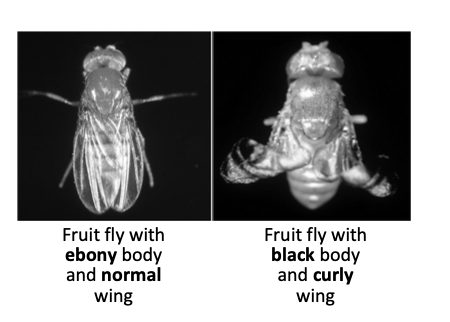
      (b)    In fruit flies, the genes for body colour and wing type are located on
             different chromosomes.
             The allele for ebony body (E) is dominant over the allele for black body (e)
             and the allele for normal wing (N) is dominant over the allele for curly
             wing (n).
             (i)   Distinguish between the terms, gene and allele.
             (ii)  1.  Using the letters mentioned above, give the genotype of a fruit fly
                       with ebony body and normal wing, heterozygous for both
                       characteristics.
                   2.  Give the genotype of a fruit fly with a black body and curly wings.
                   3.  Give all the possible genotypes and matching phenotypes of the
                       offspring of a cross between the two flies described in (ii) 1. and
                       2. above.
             (iii) What term is used for genes found on the same chromosome?                   (27)
      (c)    (i)   DNA contains a pattern of bases which stores hereditary information
                   inside the cell. What do the letters DNA stand for?
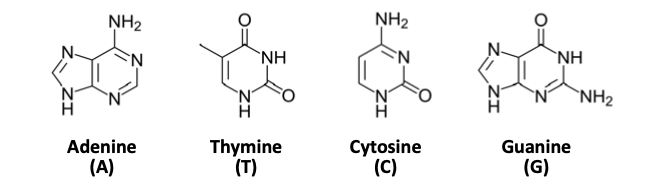
             (ii)  Adenine, thymine, cytosine and guanine are the four DNA bases shown
                   in the diagram. State which two are purines and which two are
                   pyrimidines.
             (iii) Human cells contain both DNA and RNA. State any one structural
                   difference between DNA and RNA.
             (iv)  DNA profiling can be used to identify DNA left behind at a crime scene.
                   Describe the four main steps in creating a DNA profile.                     (24)
▸ Reveal marking-scheme answer
Question 12                                                                                       60
  (a) (i)      Explain the term mutation.
               Change in the structure (or sequence) of DNA (or of a chromosome)                    3
        (ii)   Give two causes of mutations.
               Radiation / chemicals / viruses……….                                         Any two 2(3)
  (b) (i)      Distinguish between the terms, gene and allele.
               Gene: region of a chromosome (or DNA) that contains (genetic) code for (the
                     production of) a protein.                                                      3
               Allele: form of a gene                                                               3
        (ii)   1.   Using the letters mentioned above, give the genotype of a fruit fly with
                    ebony body and normal wing, heterozygous for both characteristics.
                    *EeNn                                                                           3
               2.   Give the genotype for a fruit fly with a black body and curly wings.
                    *eenn                                                                           3
               3.   Give all the possible genotypes and matching phenotypes of the offspring of
                    a cross between the two flies described in (ii) 1. and 2. above.
                    *EeNn and ebony, normal                                                         3
                    *Eenn and ebony, curly                                                          3
                    *eeNn and black, normal                                                         3
                    *eenn and black, curly                                                          3
                    If phenotype not matched to correct genotype then 2 marks for each
                    correct genotype
        (iii) What term is used for genes found on the same chromosome?
               *Linked                                                                              3
  9         or (4          +5    ) or (3       +6        ) or (2      +7       ) or (1         +8    )

  (c) (i)      What do the letters DNA stand for?
               *Deoxyribonucleic acid                                         3
        (ii)   State which two are purines and which two are pyrimidines.
               Purines:       *Adenine (or A) and *guanine (or G)             3
               Pyrimidines:   *Cytosine (or C) and *thymine (or T)            3
        (iii) State any one structural difference between DNA and RNA.
               DNA is double stranded and RNA is single stranded
               or
               DNA has the sugar, deoxyribose and RNA has the sugar, ribose
               or
               DNA has thymine and RNA has uracil                             3
        (iv) Describe the four main steps in creating a DNA profile.
               Cells are broken down to release DNA                           3
               DNA is cut into fragments using enzymes                        3
               The (DNA) fragments are separated based on size                3
A pattern of fragments is analysed 315. (a) (i) What is meant by the term species?
(ii) Give two causes of variation within a species. (9)
(b) In snapdragon plants, the allele for tallness is dominant over the allele for dwarfness.
However, the allele for red flower shows incomplete dominance with the allele for
white flower. Pink flower is the phenotype that results in the heterozygous condition.
The two genes are not linked.
(i) Explain the underlined terms.
(ii) A homozygous tall, red snapdragon plant is crossed with a dwarf, pink
snapdragon plant.
Using suitable letters, give the genotypes of both plants in the above cross.
(iii) Using a Punnett square, or otherwise, show the possible genotypes and
matching phenotypes of the offspring of the cross described above.
(iv) What percentage of the offspring of the cross have pink flowers? (27)
(c) Two famous biologists independently developed the theory of evolution by natural
selection.
(i) Name these two famous biologists.
(ii) What is meant by the term evolution?
(iii) Describe the main points of the theory of natural selection.
(iv) Give one piece of evidence that supports the theory of natural selection. (24)
▸ Reveal marking-scheme answer
Question 15                                                                                          60

                                                     3(3)
  (a) (i)       What is meant by the term species?
                Group of organisms that can reproduce together (or interbreed) to produce
                fertile offspring.
        (ii)    Give two causes of variation within a species.
                Mutation / sexual reproduction / other correct                             Any two 2(3)

                                                     9(3)
  (b) (i)       Explain the underlined terms.
                Allele:         form of a gene                                                         3
                Heterozygous: two different alleles (of a gene)                                        3
        (ii)    Give the genotypes of both plants in the cross above
                *TTRR                                                                                  3
                *ttRr                                       Allow alternative letters for Rr e.g. RW   3
        (iii)   Show the possible genotypes and phenotypes of the offspring of the cross…
                Genotype:      *TtRR                                                                   3
                Phenotype:     *Tall and Red flowered                                                  3
                Genotype:      *TtRr                                                                   3
                Phenotype:     *Tall and Pink flowered                                                 3
        (iv)    What percentage of the offspring of the cross have pink flowers?

                *50%                                                                                   3

                                                    8(3)
  (c) (i)       Name the two famous biologists.
                *(Charles) Darwin                                                                3
                *(Alfred Russell) Wallace                                                        3
        (ii)    What is meant by the term evolution?
                Genetic (inheritable) changes in a population (or species)                       3
                over a period of time or in response to a change in the environment              3
        (iii)   Describe the main points of the theory of natural selection.
                High reproductive rates (or overbreeding) /
                competition (or struggle for survival) /
                better adapted survive (or survival of the fittest) /
                the survivors reproduce (or breed) /
                others die out /
                the genes of the most successful are passed on (to the next generation) /
                organisms with beneficial characteristics will dominate               Any three 3(3)
        (iv)    Give one source of evidence that supports the theory of natural selection.
Fossils or comparative anatomy or comparative embryology or other correct 313. (a) (i) Which famous scientist is regarded as the father of genetics?
(ii) State the Law of Segregation. (9)
(b) Haemochromatosis is an inherited condition where iron levels in the body slowly build
up over many years. Classic hereditary haemochromatosis is caused by a gene
mutation whereby two recessive alleles are inherited.
(i) Explain each of the underlined terms.
(ii) Give one possible cause of gene mutations.
(iii) Name another type of mutation and give a condition caused by this type of
mutation.
(iv) The letter H can be used to represent the dominant allele and the letter h can be
used to represent the recessive haemochromatosis allele.
Using a Punnett square, or a genetic cross, explain how it is possible for two
parents, both without haemochromatosis, to have a child who suffers from the
condition.
(v) If the parents have a child without haemochromatosis, how might they check to
see if their child was a carrier? (27)
(c) Haemophilia is caused by a recessive allele (gene mutation) that inhibits the blood’s
ability to clot. This allele is only found on the X chromosome. The following pedigree
chart shows an example of the inheritance of this condition between parents and
children.
1 2
Key
Parents Non-sufferer female
Heterozygous female
Non-sufferer male
Haemophiliac male
3 4 5 6 7
(i) What term is used to describe an allele present on the X chromosome?
(ii) The letter N can be used to represent the dominant allele and the letter n can be
used to represent the recessive haemophilia allele.
Draw two fully labelled chromosome diagrams (one for each parent) showing the
positions of each allele. Indicate clearly which is female and which is male.
(iii) The pedigree chart above shows that two of their male children (persons 4 and 6)
suffer from haemophilia. Show, using a Punnett square or otherwise, how it is
possible for the parents to have a male child who does not suffer from
haemophilia.
(iv) Explain clearly why it would be almost impossible for person 7 to be the parent
of a child with haemophilia. (24)
▸ Reveal marking-scheme answer
Question 13                                                                                                   60

                                                         3(3)
 (a)   (i)     Which famous scientist is regarded as the father of genetics?
               (Gregor) Mendel                                                                        3
       (ii)    State the Law of Segregation.
               Each trait is controlled by a pair of factors / these factors separate during the
               formation of gametes / each gamete contains only one factor for each trait
                                                                                             Any two 2(3)
                                                Number of correct responses    1       2       3
  3                        Q13 (a) (i) – (ii)
                                                           Mark                3       6       9

                                                         9(3)
 (b)   (i)     Explain each of the underlined terms (‘gene’ and ‘recessive’).
               Gene:      Piece of DNA (or chromosome) that codes for a protein or unit of
                          inheritance                                                                          3
               Recessive: Allele masked by the dominant allele or explained                                    3
       (ii)    Give one possible cause of gene mutations.
               Chemicals or radiation or named example                                                         3
       (iii)   Name another type of genetic mutation and give a condition caused by this type
               of mutation.
               Name: *Chromosome                                                                     3
               Give: Down’s syndrome (or other correctly named condition)                            3
       (iv)    Explain how it is possible for two unaffected parents to have a child who suffers from
               the condition.
               Parents:    Hh x Hh                                                                   3
               Allele passed on from both parents (in gametes): h                                    3
               Offspring: hh and sufferer indicated                                                  3
       (v)     How might they check to see if their child was a carrier?
               Genetic screening or described                                                        3
                                   Number of correct responses 1      2   3   4    5       6       7   8   9
  9            Q13 (b) (i) – (v)
                                                Mark              3   6   9   12 15 18 21 24 27

                                                     8(3)
 (c)   (i)     What term is used to describe an allele present on the X chromosome?
               Sex linked or X-linked                                                                  3
       (ii)    Draw two fully labelled chromosome diagrams showing the positions of each allele:
               Chromosome diagrams showing XX and XY                                                   3
               Correct alleles and loci for each parent                                                3
               Male and/or female correctly indicated                                                  3
       (iii)   Show how it is possible for the parents to have a male child who does not suffer from
               haemophilia.
               Gametes from Parent 1: XN                                                               3
               Gametes from Parent 2: Y–                                                               3
               Genotype of son:             XYN–       genotype indicated as a non-sufferer            3
       (iv)    Explain why it would be almost impossible for person 7 to be the parent of a child with
               haemophilia.
               Person 7 does not have the recessive allele or described                                3
                                    Number of correct responses 1    2   3    4   5    6   7    8
  8            Q13 (c) (i) – (iv)
Mark 3 6 9 12 15 18 21 2412. (a) (i) State two agents that can cause mutations.
(ii) Identify one characteristic of mutant alleles in a population.
(9)
(b) There is variation in seed shape and seed colour in pea plants.
Round (R) seed is dominant to wrinkled seed and yellow (Y) seed is dominant to green
seed. These genes are not linked.
(i) Write the genotype of a plant heterozygous for both traits.
(ii) What are the possible gametes produced by this plant at part (i) above?
(iii) How does the production of these gametes at part (ii) above demonstrate
Mendel’s second law (independent assortment)?
(iv) The plant at part (i) above was crossed with a plant homozygous recessive for
both seed shape and seed colour.
Show using a Punnet square how the following results were obtained.
115 plants with round yellow seeds 115 plants with wrinkled yellow seeds
114 plants with round green seeds 116 plants with wrinkled green seeds
(v) Identify the genotypes of the offspring that introduce variation in the cross at
part (iv) above.
(27)
(c) The haemophilia gene (n) is sex‐linked and recessive. There is currently no cure for
haemophilia but recently in trials, genetic engineering has been used to transfer a
‘working copy’ of the human gene to affected people.
(i) Explain the three underlined terms.
(ii) Outline what happens in each of the following steps of genetic engineering:
1. Isolation
2. Cutting
3. Gene expression.
(iii) Give one application of genetic engineering in animals other than gene therapy
for haemophilia.
(iv) Give one application of genetic engineering in plants.
(24)
▸ Reveal marking-scheme answer
Question 12                                                                                                                         60
  (a) (i)        State two agents that can be responsible for mutation rates:
                 Chemicals or named chemical / radiation or UV or X-ray / biological agent (or
                 named)                                                                    Any two                                    2(3)
        (ii)     Identify one characteristic of mutant alleles in a population:
                 Random occurrence or low frequency or disadvantageous or advantageous                                                 3
                                                         Number of correct responses            1        2    3
                                      Q12 (a) (i - ii)
                                                                    Mark                        3        6    9

  (b) (i)        Write the genotype of a plant heterozygous for both traits:
                 *RrYy                                                                                                                 3
        (ii)     What are the possible gametes produced by this plant?
                 *RY / *Ry / *rY / *ry                                 Any two = 3 marks; final 2 for further 3 marks                 2(3)
        (iii)    How do these gametes demonstrate Mendel’s second law?
                 R or r can combine with either Y or y, and vice versa or either allele (member) of
                 a pair can combine with either allele of another pair (at gamete formation)                                           3
        (iv)     Show using a Punnet square how these results were obtained:
                 Punnet square                                                                                                         3
                 Gametes of the other parent: *ry                                                                                      3
                 Genotypes of offspring: *RrYy : Rryy : rrYy : rryy                                      Must be in a 1:1:1:1 ratio    3
        (v)      Identify the genotypes of the offspring that introduce variation:
                 *Rryy                                                                                                                 3
                 *rrYy                                                                                                                 3
                                      Number of correct responses      1       2       3       4     5        6     7     8     9
                Q12 (b) (i - iv)
                                                 Mark                  3       6       9       12    15       18    21    24    27

  (c) (i)        Explain the meaning of:
                 Gene:                       Unit of inheritance or piece of DNA that codes for a protein                              3
                 Sex-linked:                 Gene located on the sex (or X or Y) chromosome                                            3
                 Genetic engineering:        (Artificial) manipulation (or alteration) of genes                                        3
        (ii)     Outline what happens in each of the following steps of genetic engineering:
                 1. Isolation:       Removing (a piece of) DNA (or gene or plasmid) from a cell                                        3
                 2. Cutting:         DNA (or plasmid) is cut using (restriction) enzymes or gene is
                                     cut out using (restriction) enzymes                                                               3
                 3. Gene expression: Production of protein                                                                             3
        (iii)    Give one application in animals:
                 Any valid example                                                                                                     3
        (iv)     Give one application in plants:
                 Any valid example                                                                                                     3

                                        Number of correct responses        1       2       3        4        5     6     7     8
                   Q12 (c) (i - iv)
                                                   Mark                    3       6       9        12       15    18    21    24
DNA & Genetic Engineering
13.   (a)    Nucleic acids are composed of subunits called nucleotides.
             Draw and label the structure of any one nucleotide.                                          (9)
      (b)    The diagram illustrates some of the events of protein synthesis.

                                                                                              Cell
                                                                                              membrane

                                                                             Chromosome
                                                          Gene
                                                                                Organelle J
                                       Process K

                                                         Molecule L

                                                                                   Protein
             Cytosol
                                            Molecule L                  M

             (i)     What is the name of process K that results in the formation of molecule L?
             (ii)    Name molecule L.
             (iii)   Part of the sequence of nitrogenous bases in the gene is as follows:
                                       Base sequence: A C G T G C T G A
                     Using this sequence, write out in order the complementary sequence of bases
                     found in molecule L.
             (iv)    Give the name of the opening through which molecule L leaves organelle J.
             (v)     Molecule L arrives at structure M in the cytosol as shown.
                     1.    Identify structure M.
                     2.    Name the main molecule from which structure M is made.
             (vi)    Describe the events that occur at structure M, which allow the production of a
                     functioning protein.                                                         (27)
      (c)    In squash plants, the allele for white fruit (F) is dominant to the allele for yellow fruit (f).
             The allele for disc-shaped fruit (D) is dominant to the allele for spherical-shaped fruit (d).
             The genes that control fruit colour and fruit shape are located on different
             chromosomes.
             A squash plant, homozygous dominant for both fruit colour and shape, was crossed
             with a squash plant homozygous recessive for both.
             (i)     Explain the underlined terms.
             (ii)    Draw two chromosome diagrams (one for each parent) showing the position of
                     each allele on homologous chromosomes. Clearly indicate which is homozygous
                     dominant and which is homozygous recessive.
             (iii)   Using a Punnet square, or otherwise, describe the result of this cross. (24)
▸ Reveal marking-scheme answer
Question 13                                                                                                                            60
 (a) (i)      Draw and label the structure of any one nucleotide.
              Drawing                                                                                                                 6, 3, 0
                                                             Number of correct responses              1       2
 2                                     Q13 (a) Diagram:
                                                                        Mark                          3       6
              Phosphate (or P)                                                                                                          1
              Deoxyribose or ribose                                                                                                     1
              Base or any one named base or letter                                                                                      1
                                                          Number of correct responses            1        2    3
 3                                  Q13 (a) Labels:
                                                                     Mark                        1        2    3
 (b) (i)      What is the name of process K that results in the formation of molecule L?
              *Transcription                                                                                                            3
      (ii)    Name molecule L.
              *mRNA or *messenger RNA                                                                                                   3
      (iii)   Write out the complementary sequence of bases of ACGTGCTGA
              UGCACGACU                                                          (all must be correct for 3)                            3
      (iv)    Give the name of the opening through which molecule L leaves the organelle J.
              *Nuclear pore                                                                                                             3
      (v)     1. Identify structure M.
                  *Ribosome                                                                                                             3
              2. Name the main molecule from which structure M is made.
                  *rRNA or *Ribosomal RNA                                                                                               3
      (vi)    Describe the events that occur at structure M, which allow the production of a functioning protein.
              tRNA brings amino acids to ribosome / tRNA binds to mRNA / with matching
              codon (triplet) or anticodon / sequence of amino acids assembles or peptide
              bond forms / folding / start or stop codon                            Any three                                          3(3)
                                       Number of correct responses      1       2       3       4     5        6     7     8     9
 9             Q13 (b) (i) – (vi)
                                                  Mark                  3       6       9       12    15       18    21    24    27
 (c) (i)      Explain the terms:
              Allele:      A version (variant) of a gene or (alternative) form of a gene                                                3
              Homozygous: (When) identical alleles are present (for a trait)                                                            3
      (ii)    Draw two chromosome diagrams (one for each parent).
              Chromosome diagrams shows 2 pairs of homologous chromosomes for each
              parent.    (Chromosomes for first parent must match chromosomes for second parent)                                        3
              1 parent clearly FFDD or ffdd                                                                                             3
              Loci of the alleles for each parent            (must be correct and matching)                                             3
              (Homozygous) recessive and (homozygous) dominant correctly indicated.                                                     3
      (iii)   Using a Punnet square, or otherwise, describe the result of this cross.
              *FfDd                                                                                                                     3
              *White and disc-shaped fruit                                                                                              3
                                         Number of correct responses        1       2       3        4        5     6     7     8
 8               Q13 (c) (i) – (iii)
                                                    Mark                    3       6       9        12       15    18    21    24
Bacteria (Monera)
14.   (a)    (i)     In relation to micro-organisms such as bacteria and fungi, describe their
                     distribution in nature.
             (ii)    Explain the terms asepsis and sterility as applied to micro-organisms.          (9)

      (b)    Answer the following questions in relation to bacteria.
             (i)     Draw the structure of a bacterial cell and label any three parts.
             (ii)    Are bacteria prokaryotic or eukaryotic? Justify your answer.
             (iii)   Bacteria reproduce asexually. Name and describe this process.
             (iv)    Some bacteria are pathogenic. Explain the term pathogenic.
             (v)     Antibiotics are used to treat pathogenic bacterial infections, but are often
                     misused.
                     Give a possible effect of the misuse of antibiotics.                           (27)

      (c)    Viruses are shown in the image.
             (i)     Explain the difficulty in describing viruses as
                     living organisms.
             (ii)    Name the two biochemical components
                     that make up all viruses.
             (iii)   Describe the process of viral replication.
             (iv)    Some viruses can be harmful and some can
                     be beneficial.
                     1.    Give one example of a harmful virus.
                     2.    Give one way in which viruses can be beneficial.                         (24)
▸ Reveal marking-scheme answer
Question 14                                                                                      60

                                                  3(3)
  (a) (i)       In relation to microorganisms…describe their distribution in nature.
                They can survive in all habitats or they are found everywhere                       3
        (ii)    Explain the terms asepsis and sterility….
                Asepsis:     Absence of pathogens                                                   3
                Sterility:   Absence of all (micro)organisms                                        3

                                                     1(3)
  (b) (i)       Draw the structure of a bacterial cell and label any three parts.
                Diagram:     Cell wall and cell membrane and DNA                                    3

                                                     3(1)
                Label:       Cell wall / cell membrane / cytosol / ribosome / plasmid / flagellum /
                             capsule / chromosome or DNA / other correct                 Any three 3(1)

                                                    7(3)
        (ii)    Are bacteria prokaryotic or eukaryotic? Justify your answer.
                *Prokaryotic                                                                        3
                Justify:       (Cell) without nucleus or (a cell) without membrane-bound
                               organelles (or examples)                                             3
        (iii)   Bacteria reproduce asexually. Name and describe this process.
                Name:          *Binary fission                                                      3
                Description: DNA replicates / DNA moves to the both ends (of the cell) / cell
                             elongates / cell divides in two or identical cells formed. Any two 2(3)
        (iv)    Explain the term pathogenic.
                Disease causing                                                                     3
        (v)     Give a possible effect of the misuse of antibiotics.
                (Antibiotic) resistance or described or other correct                               3

  3       +8

                                                        8(3)
  (c) (i)       Explain the difficulty in describing viruses as living organisms.
                Non-cellular or no metabolism or other correct                                       3
        (ii)    Name the two biochemical components that make up all viruses.
                Protein                                                                              3
                Nucleic acid (or DNA or RNA)                                                         3
        (iii)   Describe the process of viral replication.
                (Virus) attaches or DNA (or nucleic acid) enters / (viral) DNA replication and
                protein synthesis / using host cell organelles / viruses assembled / viruses
                released.                                                                 Any three 3(3)
        (iv)    1. Give one example of a harmful virus.
                     Common cold virus or coronavirus or HIV or hepatitis virus or other correct     3
                2.   Give one way in which viruses can be beneficial.
                     Can be used (as a vector) in genetic engineering or vaccine production or any
other valid answer 311. (a) (i) Give one precaution scientists use when working with microorganisms in the
laboratory.
(ii) Explain the terms asepsis and sterility as applied to living organisms.
(9)
(b) (i) Draw a large labelled diagram of a typical bacterial cell.
(ii) Many species of bacteria can form endospores.
Describe the main events of endospore formation.
(iii) Harmful bacteria can cause disease in humans.
1. Give any two examples of harmful bacteria.
2. Bacterial infections can be treated with antibiotics.
What is an antibiotic?
3. State one possible reason why antibiotic resistance has arisen in bacteria.
(27)
(c) Food processing is carried out in a bioreactor using microorganisms, such as bacteria
and some fungi.
It can be carried out as batch or continuous flow food processing.
(i) Give two factors that affect the growth of microorganisms, such as bacteria.
(ii) Explain how either of the factors you named at part (c) (i) above affects growth.
(iii) Distinguish between batch and continuous flow food processing by writing a
brief sentence on each type.
(iv) Sketch a plot of a microorganism growth curve.
Label the axes and label the curve with the five phases shown below.
Note: the list below is not in the correct order.
stationary survival log decline lag
(24)
▸ Reveal marking-scheme answer
Question 11                                                                                                               60
(a) (i)       Give one precaution scientists use when working with microorganisms in the laboratory.
              Wipe surface with disinfectant (or antiseptic or alcohol or named) or minimal
              opening of plates or seal plates or flame (or sterilise) equipment or wear gloves
              or use hand sanitiser or wash hands with soap or keep Bunsen lit (nearby) or
              dispose of correctly or any other correct precaution (i.e. PPE)                                              3
      (ii)    Explain the terms applied to living organisms.
              Asepsis:     free of pathogens                                                                               3
              Sterility:   free of microorganisms                                                                          3
                                                        Number of correct responses    1       2        3
3                                  Q11 (a) (i) – (ii)
                                                                   Mark                3       6        9
(b) (i)       Drawing of a typical bacterial cell:
              Cell wall + cell membrane + indication of nucleic acid                                                       3
                                                             Number of correct responses            1
1                                    Q11 (b) (i) Drawing:
                                                                        Mark                        3
              Labels:
              Cell wall / cell membrane / cytoplasm / chromosome / plasmid / flagella /
              capsule or slime layer                                                  Any three 3(1)
                                                         Number of correct responses       1       2        3
3                                Q11 (b) (i) Labels:
                                                                    Mark                   1       2        3
      (ii)    Describe the main events of endospore formation.
              DNA replicates / moves to ends of cell / shrinkage (or water loss) of cytoplasm
              (or cell) / thick wall forms (or described) / inside original cell / encloses DNA
              (strand) / (cell) rounds up                                                    Any three 3(3)
      (iii)   1. Give any two examples of harmful bacteria.
                  Any two correctly named bacteria or named bacterial diseases                                            2(3)
              2. Bacterial infections can be treated with antibiotics. What is an antibiotic?
                  A chemical that kills (or inhibits growth of) bacteria                                                   3
              3. State one possible reason why antibiotic resistance has arisen in bacteria.
                  Overuse (misuse) or mutation in bacteria                                                                 3
                                           Number of correct responses     1    2      3       4        5       6    7
7                   Q11 (b) (ii) – (iii)
                                                      Mark                 3    6      9       12       15      18   21

 (c) (i)      Give two factors that affect the growth of microorganisms.
              Temperature / oxygen concentration / pH / external solute concentration or
              water availability / pressure / food availability / presence of antibiotics /
              presence of waste products                                                    Any two 2(3)
      (ii)    Explain how one these factors affect growth.
              Matching explanation (accept enzyme activity as explanation for temperature,
              pH, water availability, etc)                                                                        3
      (iii)   Distinguish between:
              Batch:  organisms go through all phases of the growth curve (or named phases)
                      or fixed amount of nutrients added at start or bioreactor emptied at end.                   3
              Continuous flow: organisms maintained in one (log or stationary) growth phase or
                                nutrients constantly added or products constantly removed.                        3
      (iv)    Sketch plot of a growth curve. Label the axes and label the curve with the five phases.
              Sketch:       All five phases visible on curve                                                      3
              Axes labels: x-axis: Time and y-axis: Population or Number of organisms                             3
              Curve labels: Correctly labelled with all five phases in the correct order                          3
                                      Number of correct responses     1    2     3   4     5    6       7    8
 8               Q11 (c) (i) – (iv)
                                                 Mark                 3    6     9   12    15   18      21   24
Q16 Mixed (4-part choice)
16.   Answer any two of (a), (b), (c), (d).                                              (30, 30)

      (a)    The diagram shows Rhizopus.
             (i)   Name the structures A, B and C.
             (ii)  Give one function of structure C.
             (iii) Name the method of nutrition used by Rhizopus.
             (iv)  Rhizopus can reproduce sexually and asexually.
                   1.  The Rhizopus shown in the diagram is reproducing asexually.
                       What evidence is there in the diagram to support this statement?
                   2.  Describe the process of sexual reproduction in Rhizopus.
             (v)   Name a beneficial use and a harmful effect of fungi.
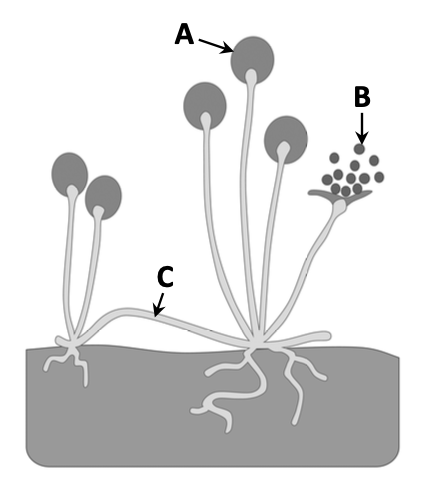
      (b)    The diagram shows gases X and Y and their main directions of movement at
             the site of gas exchange in the lungs.
             (i)   Name the structures A and B, and the type of blood cell labelled C, that
                   transports a gas around the body.
             (ii)  Give one way structure B is adapted for its function in gas exchange.
             (iii) 1.  Oxygen and carbon dioxide are two gases that are exchanged between
                       structures A and B. Match each gas to the letters X and Y, based on
                       their main directions of movement.
                   2.  What term describes the movement of these gases?
             (iv)  Name two muscles that are directly involved in inhalation.
             (v)   Describe the changes that occur in the chest during exhalation.
             (vi)  Give one treatment for one of the following breathing disorders:
                   bronchitis or asthma.
                   In your answer, state clearly to which disorder you are referring.
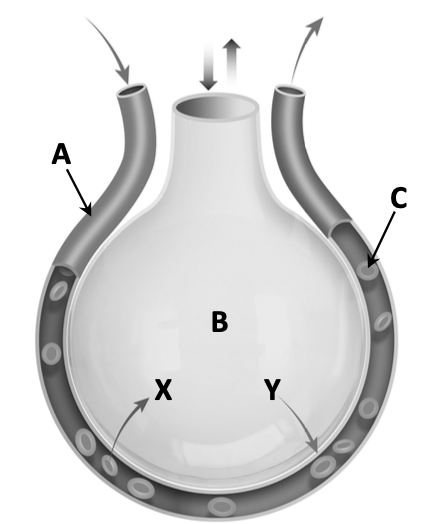
      (c)    The cell cycle involves interphase and mitosis.
             (i)   What is interphase?
             (ii)  Name a cell activity that occurs during interphase.
             (iii) The diagram shows a stage of mitosis.
                   1.  Name the stage shown.
                   2.  What is the diploid number of this cell?
                   3.  Draw a series of labelled diagrams of this cell as it would appear
                       during the other three stages of mitosis.
             (iv)  Meiosis is another type of cell division. Give two ways in which meiosis
                   is different to mitosis.
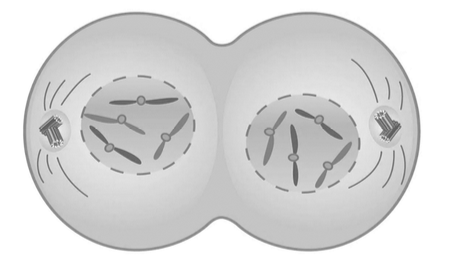
      (d)    (i)   Lymphocytes, such as the one shown in the diagram, mature in the
                   lymphatic system, which is part of the human defence system.
                   1.  Name two organs of the lymphatic system.
                   2.  Other than maturation of lymphocytes, give two functions of the
                       lymphatic system.
             (ii)  Lymphocytes play a role in the specific defence system. State the precise
                   location in the body where lymphocytes are produced.
             (iii) Name two types of lymphocyte and describe the role of each.
             (iv)  Explain the term vaccination.
17.   Answer any two of (a), (b), (c), (d).                                              (30, 30)

      (a)    (i)   Using the diagram as an aid, answer the following questions:
                   1.  The human circulatory system has two circuits. Name both circuits.
                   2.  Which of these circuits receives blood from the left ventricle?
                   3.  Name the blood vessel that is carrying blood highest in oxygen.
                   4.  Name the blood vessel that is carrying blood highest in nutrients.
             (ii)  State the precise function of the following in the heart:
                   1.  Sino-atrial (SA) node     2.  Septum
             (iii) What term is used to describe the period of time during which the heart
                   muscle is contracting?
             (iv)  Give two structural differences between arteries and veins.
      (b)    The diagrams show some types of joints of the human skeleton.
             (i)   Name any three types of joint found in the human skeleton and give a
                   matching precise location for each type.
             (ii)  Antagonistic muscle pairs are associated with the skeleton.
                   Name any one antagonistic muscle pair and describe how it functions
                   in creating movement.
             (iii) Sketch the internal structure of a long bone and label at least three parts.
      (c)    Homeostasis is an important process in living organisms.
             (i)   Explain the underlined term.
             (ii)  ADH (anti-diuretic hormone) is an important hormone in homeostasis.
                   Name the endocrine gland that secretes ADH.
             (iii) Name one specific part of the nephron (functional unit of the kidney)
                   that ADH affects.
             (iv)  What effect does increased ADH have on the volume of urine produced by
                   the kidneys?

             The graphs (X and Y) show the relationship between blood volume and ADH
             levels in an athlete's body over the same period of time. The athlete is
             exercising vigourously.

             (v)   Using the information given in the description above and from analysing
                   the graphs, answer the following questions.
                   1.  State the relationship between blood volume and ADH levels in this case.
                   2.  Suggest how the athlete might increase their blood volume back to
                       normal.
                   3.  Copy graph Y into your answerbook and continue the line to show
                       how ADH levels would change if the athlete brought their blood
                       volume back to normal after exercising.

             The skin of the athlete is also involved in homeostasis during vigourous exercise.
             (vi)  State two ways the skin can help the athlete's homeostasis.
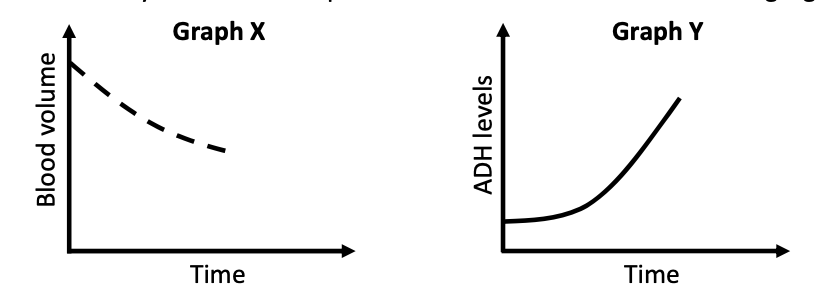
      (d)    (i)   Draw the structure of the human male reproductive system and label at
                   least three parts. On your diagram, write the letters X, Y and Z to
                   indicate where each of the following occurs:
                   1.  Sperm production (X)     2.  Sperm storage (Y)     3.  Seminal fluid production (Z)
             (ii)  The image shows an electron micrograph of a sperm cell. Name parts A
                   and B and give one role for each part.
             (iii) What is the approximate survival time for sperm cells following copulation?
             (iv)  Where does fertilisation usually occur in the female?
             (v)   Give one cause of infertility and describe a corrective measure.
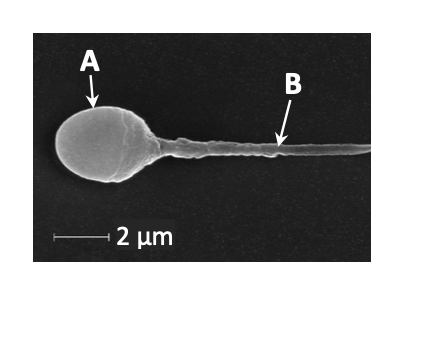
▸ Reveal marking-scheme answer
Question 16 Any two of (a), (b), (c), (d) 30, 30
Question 16 (a) 30
(i) Name the structures A, B and C.
A: *Sporangium 1
B: *Spore 1
C: *Stolon 1
(ii) Give one function of structure C.
Spread the fungus 3
(iii) Name the method of nutrition used by Rhizopus.
Saprophytic or heterotrophic 3
(iv) 1. The Rhizopus shown in the diagram is reproducing asexually.
What evidence is there in the diagram to support this statement?
Spores (are being released) or presence of sporangium or sporangiophore 3
2. Describe the process of sexual reproduction in Rhizopus.
+ and – strains grow close together /
swellings form (opposite each other) /
progametangia are formed /
gametangium formed /
fertilisations of haploid nuclei occur /
diploid nuclei formed /
zygospore formed /
survives adverse conditions /
germinates by meiosis when suitable conditions are present Any four 4(3)
(v) Name a beneficial use and a harmful effect of fungi.
Correct beneficial effect named 3
Correct harmful effect named 3
3 +9
Question 16 (b) 30
(i) Name the structures A and B, and the type of blood cell labelled C, that transports a
gas around the body.
A: *Capillary 1
B: *Alveolus 1
C: *Red (blood cell) 1
(ii) Give one way structure B is adapted for its function in gas exchange.
Moist (internal) surface or thin walled or covered in capillaries or large surface area 3
(iii) 1. Match each gas to the letters X and Y, based on their main directions of
movement.
X: *Carbon dioxide (or CO2) and Y: *Oxygen (or O2) 3
2. What term describes the movement of these gases?
*Diffusion 3
(iv) Name two muscles that are directly involved in inhalation.
*Intercostals 3
*Diaphragm 3
(v) Describe the changes that occur in the chest during exhalation.
Muscles or named relax /
rib cage moves down and inwards /
diaphragm moves up /
volume decreases /
(air) pressure increases /
air moves out (of the lungs) Any three 3(3)
(vi) Give one treatment for one of the following breathing disorders: bronchitis or asthma.
In your answer, state clearly to which disorder you are referring.
Correct matching treatment 3
3 +9
Question 16 (c) 30
(i) What is interphase?
State of non-division in a cell 3
(ii) Name a cell activity that occurs during interphase.
Respiration or photosynthesis or protein synthesis………. 3
(iii) The diagram shows a stage of mitosis.
1. Name the stage shown.
*Telophase 3
2. What is the diploid number of this cell?
*4 3
3. Draw a series of labelled diagrams of this cell as it would appear during the other
three stages of mitosis.
Diagram of prophase: Nuclear membrane disappearing and chromosomes
visible 3
Diagram of metaphase: Four duplicated chromosomes are lined up on the
equator of the cell and spindle fibres are shown 3
Diagram of anaphase: Four chromosomes pulled to each pole by spindle 3
Any three correct labels on the any of the three diagrams 3(1)
(iv) Give two ways in which meiosis is different to mitosis.
Meiosis halves the chromosome number and mitosis maintains the chromosome
number /
Meiosis produces 4 cells and mitosis produces 2 cells /
Meiosis produces genetically different cells and mitosis produces genetically identical
cells Any two 2(3)
9 +3
Question 16 (d) 30
(i) 1. Name two organs of the lymphatic system.
Lymph vessel / lymph node / thymus / adenoid / tonsil / spleen Any two 2(3)
2. Other than maturation of lymphocytes, give two functions of the lymphatic system.
Return (excess tissue) fluid to the blood /
transport fats /
fight infection………. Any two 2(3)
(ii) State the precise location in the body where lymphocytes are produced?
*Bone marrow 3
(iii) Name two types of lymphocyte and describe the role of each.
Name of lymphocyte 1 3
Correct matching role of lymphocyte 1 3
Name of lymphocyte 2 3
Correct matching role of lymphocyte 2 3
(iv) Explain the term vaccination.
Administration of an attenuated pathogen (or antigen) (that stimulates active
immunity) 3
Question 17 Any two of (a), (b), (c), (d) 30, 30
Question 17 (a) 30
(i) Using the diagram as an aid, answer the following questions.
1. Name both circuits.
*Pulmonary 3
*Systemic 3
2. Which of these circuits receives blood from the left ventricle?
*Systemic 3
3. Name the blood vessel that is carrying blood highest in oxygen.
*Pulmonary vein 3
4. Name the blood vessel that is carrying blood highest in nutrients.
*Hepatic portal vein 3
(ii) State the precise function of the following in the heart:
1. Sino-atrial (SA) node
Sends impulse to the atria (to cause contraction) or sends impulse to AV node or
controls the rate of contractions (of atria) or pacemaker 3
2. Septum
Separates oxygenated and deoxygenated bloods or separates blood in the left
side from the right side 3
(iii) What term is used to describe the period of time during which the heart muscle is
contracting?
*Systole 3
(iv) Give two structural differences between arteries and veins.
Arteries have thick walls and veins have thin walls /
arteries have no valves and veins have valves /
arteries have a narrow lumen and veins have a wide lumen Any two 2(3)
Question 17 (b) 30
(i) Name any three types of joint found in the human skeleton and give a matching
precise location for each type.
Three correctly named joint types 3(2)
Matching locations stated correctly 3(2)
(ii) Name any one antagonistic muscle pair and describe how it functions in creating
movement.
Correctly named antagonistic muscle pair 3
First movement: when one (named) muscle contracts and the joint moves in a
particular direction 3
Second movement: when the other (named) muscle contracts and the joint moves
in the opposite direction to the first movement 3
(iii) Sketch the internal structure of a long bone and label at least three parts.
Diagram: Epiphysis and diaphysis and medullary cavity [Any one missing = 3] 6, 3, 0
Labels: Medullary cavity / cartilage / compact bone / spongy bone / epiphysis /
diaphysis………. Any three 3(1)
6 +5 +3
Question 17 (c) 30
(i) Explain the underlined term.
(Homeostasis is) the maintenance of a constant internal environment 3
(ii) Name the endocrine gland that secretes ADH.
*Pituitary 3
(iii) Name one specific part of the nephron (functional unit of the kidney) that ADH
affects.
Distal convoluted tubule or collecting duct 3
(iv) What effect does increased ADH have on the volume of urine produced by the kidneys?
Lowers (the volume) 3
(v) 1. State the relationship between blood volume and ADH levels in this case.
Blood volume decreases and ADH levels increases. 3
2. Suggest how the athlete might increase their blood volume back to normal.
Intake fluids 3
3. Copy graph Y into your answerbook and continue the line to show how ADH
levels would change if the athlete brought their blood volume back to normal
after exercising.
Line reducing 3
Line levels off at the same level as the start 3
(vi) State two ways the skin can help the athlete’s homeostasis.
Sweating / vasodilation / vasoconstriction / piloerection Any two 2(3)
Question 17 (d) 30
(i) Draw the structure of the male reproductive system and label at least three parts.
Diagram: Penis and testes and sperm duct and urethra [Any one missing = 3] 6, 3, 0
Labels: Penis / testes / urethra / sperm duct / epididymis / prostate / seminal
vesicles / scrotum………. Any three 3(1)
On your diagram, write the letters, X, Y and Z to indicate the specific locations
where each of the following occurs:
1. Sperm production (X)
X located in the testes 1
2. Sperm storage (Y)
Y located in the epididymis 1
3. Seminal fluid production (Z)
Z located on the prostate or seminal vesicles 1
(ii) Name parts A and B and give one role for each part.
A: Head 1
Function of A: Holds the nucleus (or DNA or genes) 2
B: Tail 1
Function of B: Movement 2
(iii) What is the approximate survival time for sperm cells following copulation?
Up to 7 days 3
(iv) Where does fertilisation usually occur in the female?
*Fallopian tube 3
(v) Give one cause of infertility and describe a corrective measure.
Correct cause given 3
Corrective measure given 3
6 +8 +216. Answer any two of (a), (b), (c), (d). (30, 30)
(a) The diagram shows the human male reproductive system.
Answer the questions that follow.
A
(i) 1. Give the names of tubes A and B and the
name of gland C.
2. Give one function for each structure labelled
A, B and C. C
(ii) In which part of the male reproductive system does
meiosis occur? B
(iii) Which part of the male reproductive system is
directly involved in copulation?
(iv) Give one cause of male infertility and a corrective measure.
(v) Give any two methods of contraception.
(b) The diagram shows an outline of the human
female body.
Three important endocrine glands are indicated
X
by the letters X, Y and Z.
(i) Name glands X, Y and Z. Y
(ii) Name one hormone secreted by each gland
and give one function for each named Kidney
hormone.
(iii) For any named human (male or female)
hormone, give:
1. a symptom of its deficiency.
2. a symptom of its excess.
3. a corrective measure for either its
deficiency or excess.
Z
(iv) Briefly describe the feedback mechanism of
any one human hormone.
(c) The photograph shows a plant growing
towards light.
(i) What name is given to the growth
response of plants to light?
(ii) How does this growth response
benefit plants?
(iii) Name any other type of growth
response in plants.
(iv) Growth regulators are important in
plants.
Explain the term growth regulator.
(v) Describe the mechanism of any one plant growth response to an external
stimulus.
(vi) Give one example of the use of plant growth regulators, e.g. by horticulturists.
(vii) Plants have adaptations that help in protection.
Give any two methods plants use to protect themselves.
(d) Answer the following questions in relation to the human defence system.
(i) The human defence system can be categorised as the general defence system
and the specific defence system (immune system).
1. Name any two methods used by the general defence system.
2. Name any one organ that is specific to the immune system.
(ii) The organs of the immune system have lymphocytes that take part in an antigen-
antibody response.
1. Distinguish between the terms antigen and antibody by writing a sentence
on each term.
2. T cells are one type of lymphocyte involved in the antigen-antibody
response.
Name the other type of lymphocyte.
3. There are four types of T cells in the human immune system.
Name any two types and give one function for each named type.
17. Answer any two of (a), (b), (c), (d). (30, 30)
(a) The graph below shows how the rate of activity of two human digestive
enzymes (A and B) changes with pH.
A B
Enzyme activity
0 1 2 3 4 5 6 7 8 9 10
pH
(i) 1. What is the optimal pH of enzyme A?
2. What is the optimal pH of enzyme B?
(ii) Which of these enzymes (A or B) is most likely to be found in the stomach?
Justify your answer.
(iii) Describe the active site theory of enzyme action to explain enzyme function and
specificity.
(iv) Amylase, lipase and protease are three enzymes found in the human digestive
system.
Amylase acts on starch, lipase acts on lipids, and protease acts on proteins.
Give the product(s) of each enzyme.
(b) Fungi can be classified into saprophytic and parasitic forms.
(i) Explain the terms saprophytic and parasitic.
(ii) Rhizopus is an example of a fungus.
Draw a large labelled diagram of Rhizopus during asexual reproduction.
Indicate clearly on your diagram which part is involved in asexual reproduction.
(iii) Answer the following in relation to the life cycle of Rhizopus:
1. Sexual reproduction in Rhizopus results in the formation of a thick-walled,
dormant structure that can survive a long time in unsuitable conditions.
What is the name of this structure?
2. What happens to the structure you named in part (b) (iii) 1. above if
suitable conditions return?
(iv) Fungi can be beneficial.
Give any two examples of beneficial fungi.
(c) Answer the following questions in relation to the kidneys and urine formation.
(i) The kidneys are important in maintaining a constant internal environment within
the body.
What term describes the maintenance of a constant internal environment within
the body?
(ii) The nephron is the functional unit of the kidney.
Draw a large labelled diagram of the human nephron and its associated blood
supply.
(iii) Give one way in which the composition of blood is different to the composition
of glomerular filtrate.
(iv) Large amounts of water are reabsorbed into the blood during urine formation.
1. Name any two parts of the nephron that reabsorb water.
2. Name any two other substances that are reabsorbed during urine
formation.
(d) The image shows a stage of mitosis in an onion cell.
Mitosis is a stage of the cell cycle.
(i) What name is given to the stage of the cell cycle when
the cell is in a state of non-division?
(ii) Give any two cell activities that occur during the state
of non-division.
(iii) 1. What name is given to the stage of mitosis shown
in the image?
2. Explain how you know it is this stage.
(iv) What stage of mitosis occurs immediately before the
stage you named in (d) (iii) 1. above?
(v) Sketch a diagram of a cell with a diploid number of 4 (i.e. 2n = 4) that is at the
stage of mitosis you named at part (d) (iv) above.
(vi) What is the function of mitosis in multicellular organisms such as the onion?
(vii) What name is given to the group of disorders where a cell loses control of
mitosis and the number of cell divisions?
There is no examination material on this page
Do not hand this up.
This document will not be returned to the
Copyright notice
copyright owner, and which may have been adapted, for the purpose of assessment, without the authors’ prior
consent. This examination paper has been prepared in accordance with Section 53(5) of the Copyright and
Related Rights Act, 2000. Any subsequent use for a purpose other than the intended purpose is not authorised.
The Commission does not accept liability for any infringement of third-party rights arising from unauthorised
distribution or use of this examination paper.
Leaving Certificate – Higher Level
Biology Section C
Tuesday 11 June
Afternoon 2:00 - 5:00
▸ Reveal marking-scheme answer
Question 16 Any two of (a), (b), (c), (d) 30, 30
Question 16 (a) 30
6(1)
(i) 1. Give the names of tubes A and B and the name of gland C.
A: *Urethra 1
B: *Sperm duct (or vas deferens) 1
C: *Prostate (gland) 1
2. Give one function for each structure labelled A, B and C.
A: Release semen or release urine 1
B: Carries sperm from testes to urethra (or penis) 1
C: Produces seminal fluid 1
6(4)
(ii) In which part of the male reproductive system does meiosis occur?
*Testes 4
(iii) Which part of the male reproductive system is directly involved in copulation.
*Penis 4
(iv) Give one cause of male infertility and a corrective measure.
Cause: Low sperm count or low sperm mobility or low testosterone levels or
blockage or other correct 4
Corrective measure: IVF or other correct 4
(v) Give any two methods of contraception.
Mechanical / surgical / natural / chemical / named examples Any two 2(4)
6 +6
Question 16 (b) 30
12(2)
(i) Name glands X, Y and Z.
X: *Thyroid 2
Y: *Adrenal 2
Z: *Ovary 2
(ii) Name one hormone secreted by each gland and give one function for each.
Thyroid: Hormone: Thyroxine or other correct 2
Function: Controls the rate of metabolism or other correct Must match 2
Adrenal: Hormone: Adrenaline or other correct 2
Function: Fight or flight response or other correct Must match 2
Ovary: Hormone: Oestrogen or other correct 2
Function: Secondary sexual characteristics or other correct Must match 2
(iii) 1. For any named human (male or female) hormone, give:
a symptom of its deficiency.
Deficiency symptom to match hormone named 2
2. a symptom of its excess.
Excess symptom to match hormone named 2
3. a corrective measure for either its deficiency or excess.
Corrective measure to match either symptom 2
2(3)
(iv) Briefly describe the feedback mechanism of any one human hormone.
The concentration (or secretion) of one (named) hormone 3
Inhibits or stimulates the concentration (or secretion) of another (named) hormone
or itself 3
12 +2
Question 16 (c) 30
10(3)
(i) What name is given to the growth response of plants to light?
*Phototropism 3
(ii) How does this growth response benefit plants?
Get more light or more photosynthesis or more food produced or described 3
(iii) Name any other type of growth response in plants.
Geotropism or thigmotropism or chemotropism or hydrotropism 3
(iv) Explain the term growth regulator.
Chemical that controls (or influences) growth (in plants) 3
(v) Describe the mechanism of any one plant growth response to an external stimulus.
Where regulator produced /
Movement of regulator /
Unequal distribution of growth regulator /
How growth affected /
Result on growth Any three 3(3)
(vi) Give one example of the use of plant growth regulators, e.g. by horticulturists.
Seedless fruits or rooting powder or tissue culturing or fruit ripening or (selective)
herbicide or other correct 3
(vii) Give any two methods plants use to protect themselves.
Bark / cuticle / guard cells / thorns / chemicals / other correct Any two 2(3)
Question 16 (d) 30
10(3)
(i) 1. Name any two methods used by the general defence system.
Barrier (e.g. skin) / phagocytosis/ chemicals (e.g. sebum, sweat, interferon) /
fever / (stomach) acid / tears / blood clotting / other correct Any two 2(3)
2. Name any one organ that is specific to the immune system.
Spleen or thymus or lymph node or tonsils or other correct 3
(ii) 1. Distinguish between the terms antigen and antibody.
Antigen: chemical (or molecule) that stimulates the production of antibodies 3
Antibody: protein produced in response to an antigen or protein produced by
lymphocytes or protein which inactivates an antigen 3
2. Name the other type of lymphocyte.
*B 3
3. Name any two types (of T cell) and give one function for each named type.
Suppressor (or regulatory) / helper / killer (cytotoxic) / memory Any two 2(3)
Matching functions Any two 2(3)
Question 17 Any two of (a), (b), (c), (d) 30, 30
Question 17 (a) 30
2(4)
(i) 1. What is the optimal pH of enzyme A?
*2 4
2. What is the optimal pH of enzyme B?
*7 4
1(4)
(ii) Which enzyme (A or B) is most likely to be found in the stomach? Justify your answer.
Enzyme: *A 4
1(3)
Justify: pH in the stomach is low or acidic environment in the stomach 3
3(3)
(iii) Describe the active site theory of enzyme action…
Active site has a complementary shape to only one substrate / active site changes
shape (or induced fit) to accommodate substrate / enzyme substrate complex is
formed / product formed / enzyme unchanged or active site changes back to original
shape or enzyme can be reused Any three 3(3)
3(2)
(iv) Give the product(s) of each enzyme.
Amylase: *Maltose 2
Lipase: *Glycerol and fatty acids 2
Protease: *Amino acids or peptides 2
3 +4 +3
Question 17 (b) 30
2(3)
(i) Explain the terms saprophytic and parasitic.
Saprophytic: (organism that) feeds on dead organic matter 3
Parasitic: (organism that) feeds on another living organism causing it harm 3
2(3)
(ii) Draw a large labelled diagram of Rhizopus during asexual reproduction.
Diagram: sporangiophore and sporangium 3
stolon or rhizoid 3
3(1)
Labels: stolon / rhizoid / sporangiophore / sporangium / spore / hypha / mycelium /
apophysis / columella / other correct Any three 3(1)
1(3)
Indicate clearly on your diagram which part is involved in asexual reproduction.
Spores or sporangium indicated 3
4(3)
(iii) 1. What is the name of this structure?
*Zygospore 3
2. What happens to the structure you named above if suitable conditions return?
Germinates or described 3
(iv) Give any two examples of beneficial fungi.
Named edible mushrooms / yeast / other correct named Any two 2(3)
3 +9
Question 17 (c) 30
1(3)
(i) What term describes in maintenance of a constant internal environment within the body?
*Homeostasis 3
2(3)
(ii) Draw a large labelled diagram of the human nephron and its associated blood supply.
Diagram: Bowman’s capsule and (proximal or distal) convoluted tubule and loop of
Henle 3
Glomerulus or other blood supply 3
6(1)
Labels: Any six correct labels e.g. glomerulus / Bowman’s capsule / proximal
convoluted tubule / loop of Henle / distal convoluted tubule / collecting
duct / afferent arteriole / efferent arteriole / renal venule / renal arteriole /
capillary Any six 6(1)
5(3)
(iii) Give one way in which the composition of blood is different to the composition of
glomerular filtrate.
Blood contains blood cells, glomerular filtrate does not or
Blood contains (large, plasma) proteins, glomerular filtrate does not or
Other correctly described difference 3
(iv) 1. Name any two parts of the nephron that reabsorb water.
Proximal convoluted tubule / loop of Henle / distal convoluted tubule / collecting
duct Any two 2(3)
2. Name any two other substances that are reabsorbed during urine formation.
Glucose / amino acids / minerals / salts / ions / other correct Any two 2(3)
6 +8
Question 17 (d) 30
10(3)
(i) What is the name given to the stage when the cell is in a state of non-division?
*Interphase 3
(ii) Give any two cell activities that occur during the state of non-division.
Photosynthesis / respiration / DNA replication / protein synthesis / other correct
Any two 2(3)
(iii) 1. What name is given to the stage of mitosis shown in the image?
*Anaphase 3
2. Explain how you know it is this stage.
Chromosomes are being pulled apart or spindles contracting (shortening) 3
(iv) What stage of mitosis occurs immediately before the stage you named above?
*Metaphase 3
(v) Sketch a simple cell with a diploid number of 4 that is at the stage you named above.
Diagram: Cell with 4 duplicated chromosomes on the equator of the cell 3
Spindle fibres from chromosomes to the ends (poles) of the cell 3
(vi) What is the function of mitosis in multicellular organisms such as the onion?
Growth or repair (of tissue) 3
(vii) What name is given to the group of disorders….?
*Cancer 3
BLANK PAGE
BLANK PAGE16. (i) Draw a large diagram of the human male reproductive system, labelling the
following parts:
sperm prostate
testis epididymis penis scrotum
duct gland
(ii) Give one function for each of the following parts:
1. Prostate gland
2. Epididymis
(iii) The diagram shows a human sperm cell.
1. How many chromosomes are found
in the nucleus of a typical human
sperm cell?
2. Copy out the diagram of the human
sperm cell into your answerbook and
indicate on it the location of the mitochondria.
3. In relation to the structure of the sperm cell, or otherwise, suggest one
possible cause of male infertility. (27)
(c) The graphs show the levels of female reproductive hormones (A and B) in the blood at
various stages during one typical menstrual cycle. These hormones are released by the
female reproductive system.
Levels in the blood
A
B
1 5 14
Days
(i) How long is the typical menstrual cycle in a human female?
(ii) Name each of the hormones A and B.
(iii) There are low levels of hormone A and hormone B during the first few days of
the menstrual cycle. Describe one effect on the female reproductive system of
the low levels of hormones A and B.
(iv) Explain why hormone A levels increase after approximately day 5.
(v) What event occurs around day 14 of the menstrual cycle?
(vi) The event you named in part (c) (v) above is caused by a surge in a hormone
released from the pituitary. Name this hormone.
(vii) Explain why hormone B levels increase in the days after day 14. (24)
16. Answer any two of (a), (b), (c), (d). (30, 30)
(a) The graph shows the changes in mass of plant tissue when placed in solutions of
different sugar concentrations.
Percentage (%) change
in mass
-5 0 2 4 6 8 10 12
-10
-15
Sugar concentration (g/100 cm3)
(i) Name the substance that causes the change in mass of the plant tissue.
(ii) What term is given to the movement in and out of the plant tissue of the
substance you named in part (a) (i) above?
(iii) At what sugar concentration is there no change in the mass of the plant tissue?
(iv) Explain in detail why there is no change in mass at the sugar concentration you
have given in part (a) (iii) above.
(v) 1. What term is used to describe the condition of the plant cells that have
been soaked in the 0 g/100 cm3 sugar solution?
2. Explain how plant cells maintain the condition you named in part (a) (v) 1.
above.
(vi) Explain in detail why the mass of the plant cells reduces in the 12 g/100 cm3
sugar solution.
(vii) What do you think would happen to an animal cell in the 0 g/100 cm3 sugar
solution?
(b) Genetic engineering is an important biological technique.
(i) What is meant by the term genetic engineering?
(ii) Describe the process of genetic engineering up to the point of expression of the
gene of interest.
(iii) The final part of genetic engineering,
gene expression, involves the formation Protein
of a protein. Protein synthesis occurs on Ribosome
ribosomes, as shown in the diagram.
Ribosomes are composed of rRNA
subunits.
Name the other two types of RNA
involved in protein synthesis.
(iv) State one application of genetic engineering for each of the following:
1. Animals
2. Microorganisms
3. Plants.
(c) Viruses are found in all habitats in nature. X
(i) The diagram shows a typical
spherical-shaped virus. Y
Name the structures X and Y.
(ii) Explain the difficulty in describing
viruses as living.
(iii) Name two harmful viruses.
(iv) Give one way in which viruses can
be beneficial to humans.
The human body can defend itself against viruses using two defence systems: the
general defence system and the specific defence system.
(v) Give two ways in which the general defence system works to defend against
viruses and two ways in which the specific defence system defends against
viruses.
(d) The photographs show some edible mushrooms (image A) and some poisonous
mushrooms (image B). Mushrooms belong to kingdom Fungi.
A B
(i) Suggest one way in which you could distinguish between edible and poisonous
mushrooms.
(ii) Name any one example of an edible mushroom.
(iii) Name any one example of a poisonous mushroom.
Another member of kingdom Fungi is Rhizopus (or common bread mould).
(iv) Draw a diagram showing the basic structure of Rhizopus, labelling the following
parts: stolon, rhizoid, sporangium.
(v) Give one function for each of the following parts:
1. Stolon
2. Rhizoid
3. Sporangium
(vi) Name the mode of nutrition used by Rhizopus.
17. Answer any two of (a), (b), (c), (d). (30, 30)
(a) (i) Give one difference between endocrine and exocrine
glands.
(ii) Name a gland that has both an endocrine function and an
exocrine function. Name its endocrine product and its
exocrine product.
(iii) Copy the outline of the human body into your
answerbook.
Draw in each of the following endocrine glands labelling
them in their correct locations:
1. Pituitary gland
2. Thyroid gland
3. Adrenal glands
(iv) For each of the following endocrine glands, name a
hormone it secretes and give its corresponding function:
thyroid; adrenals
(b) The diagram shows two separate neurons in close contact. Chemical A is produced by
one of the neurons to allow the transfer of nerve impulses.
A
B
(i) What term describes the region where two neurons come into close contact?
(ii) What is the name given to the gap between two neurons, indicated by the letter
B in the diagram?
(iii) What is the general name given to the chemical A in the diagram?
(iv) Where in a neuron is chemical A made?
(v) Describe in detail how nerve impulses travel between two neurons in close
contact.
(vi) Interneurons are one type of neuron found within the central nervous system.
Give the names of the other two types of neuron found in the human nervous
system.
(vii) Describe one possible treatment for either of the following nervous system
disorders: paralysis or Parkinson’s disease.
(c) Answer the following questions in relation to your knowledge of the human circulatory
and breathing systems.
(i) In each of the following, name the vein that best matches the description:
1. Carries blood richest in oxygen.
2. Carries blood between the intestine and the liver.
3. Carries blood lowest in metabolic wastes.
4. Carries blood into the right atrium of the heart.
(ii) In your answerbook, sketch the structure of an alveolus and its associated blood
supply.
On your diagram, clearly indicate the
overall directions in which oxygen and X Y
carbon dioxide are moving.
(iii) The diagrams (X and Y) show the two
stages of breathing with the arrows
representing the body movements
involved in breathing.
1. State which diagram (X or Y)
represents inhalation.
2. Explain in detail how you know
inhalation is occurring in this
diagram.
(d) The diagram shows part of a plant organ composed of various tissues.
A Vascular
tissue
B
C
(i) Identify the plant organ.
(ii) Name tissues A and B and the structure labelled C.
(iii) Give one function for each part A, B and C.
(iv) Give one function of vascular tissue in plants.
(v) Name the two types of vascular tissue present in plants.
(vi) Draw and label a longitudinal section (L.S.) of either type of vascular tissue you
named in part (d) (v) above.
Do not hand this question paper up.
This document will not be returned to the
Do not hand this question paper up.
This document will not be returned to the
Copyright notice
owner, and which may have been adapted, for the purpose of assessment, without the authors’ prior consent.
This examination paper has been prepared in accordance with Section 53(5) of the Copyright and Related Rights Act,
2000. Any subsequent use for a purpose other than the intended purpose is not authorised. The Commission does
not accept liability for any infringement of third-party rights arising from unauthorised distribution or use of this
examination paper.
Leaving Certificate – Higher Level
Biology Section C
Tuesday 13 June
Afternoon 2:00 - 5:00
▸ Reveal marking-scheme answer
Question 16 Any two of (a), (b), (c), (d) 30, 30
Question 16 (a) 30
10(3)
(i) Name the substance that causes the change in mass of the plant tissue.
*Water 3
(ii) What term is given to the movement in and out of the plant tissue of the named substance?
*Osmosis 3
(iii) At what sugar concentration is there no change in the mass of the plant tissue?
*4 g/100cm3 3
(iv) Explain in detail why there is no change in mass at the named sugar concentration.
*Movement of water into the cells equals the movement of water out of the cells 3
*Due to the sugar concentration inside the cells (cytoplasm) being the same as the
sugar concentration outside the cells. 3
(v) 1. What term is used to describe the condition of the cells that have been soaked in the 2
g/100cm3 solution?
*Turgid 3
2. Explain how plant cells maintain the condition you named above.
(Presence of) the cell wall or (presence of) the vacuole or by taking in as much water
as they lose. 3
(vi) Explain in detail why the mass of the plant cells reduces in the 12 g/100cm3 sugar
solution.
Water has moved out of the cells (by osmosis) 3
(Water moves) from a region of high water concentration (inside the cell) to a region
of low water concentration (outside the cell) or due to the high sugar concentration
outside the cells when compared to inside the cells. 3
(vii) What do you think would happen to an animal cell in the 0 g/100cm sugar solution?
Increase in size or swell or burst 3
Number of correct responses 1 2 3 4 5 6 7 8 9 10
10 Q16 (a) (i) – (vii)
Mark 3 6 9 12 15 18 21 24 27 30
Question 16 (b) 30
10(3)
(i) What is meant by the term genetic engineering?
(Artificial) manipulation of a gene (or of DNA) or alteration of a gene (or of DNA) 3
(ii) Describe the process of genetic engineering up to the point of expression of the gene
of interest.
Isolation of DNA (from cells) / cutting of gene (from chromosome) / using restriction
enzymes / ligation of gene with vector or host DNA / introduction of base sequence
changes to host cell or transformation of host cell occurs or recombinant DNA enters
host cell / transformed cells grown (in nutrient medium). Any four 4(3)
(iii) Name the two other types of RNA involved in protein synthesis.
Messenger RNA (mRNA) 3
Transfer RNA (tRNA) 3
(iv) State one application of genetic engineering for each of the following:
1. Animals: Any correct application given 3
2. Microorganisms: Any correct application given 3
3. Plants: Any correct application given 3
Number of correct responses 1 2 3 4 5 6 7 8 9 10
10 Q16 (b) (i) – (iv)
Mark 3 6 9 12 15 18 21 24 27 30
Question 16 (c) 30
10(3)
(i) Name structures X and Y.
X: Protein (coat) or capsid 3
Y: Nucleic acid or DNA or RNA 3
(ii) Explain the difficulty in describing viruses as living.
Non-cellular or no metabolism 3
(iii) Name two harmful viruses.
Common cold virus or coronavirus or HIV or hepatitis virus or other correct 2(3)
(iv) Give one way in which viruses can be beneficial to humans.
Can be used (as a vector) in genetic engineering or can be (potentially) used to treat
bacterial infection or vaccine production or any other valid answer 3
(v) Give two ways in which the general defence system works to defend against viruses
and two ways in which the specific defence system defends against viruses.
General: Skin acts as a barrier / mucus traps pathogens / phagocytes engulf (viral)-
infected cells / infected cells release chemicals / white blood cells release
chemicals that coordinate the immune response to a pathogen / stomach
acid kills pathogens / tears keeps eyes free of pathogens / blood clotting
prevents entry of pathogens / fever stops pathogen enzymes working
properly / other correct answer Any two 2(3)
Specific: (B cells) produce antibodies (against the virus) / memory cells recognise
virus / T cells coordinate the immune response / killer T cells kill (viral)
infected cells / regulatory (or suppressor T cells) control the immune
response / other correct answer Any two 2(3)
Number of correct responses 1 2 3 4 5 6 7 8 9 10
10 Q16 (c) (i) – (v)
Mark 3 6 9 12 15 18 21 24 27 30
Question 16 (d) 30
3(3)
(i) Suggest one way in which you could distinguish between edible and poisonous mushrooms.
Using a key or other correct method 3
(ii) Name any one example of an edible mushroom.
Field or Chestnut or other correct 3
(iii) Name any one example of a poisonous mushroom.
Death cap or destroying angel or other correct 3
Number of correct responses 1 2 3
3 Q16 (d) (i) – (iii)
Mark 3 6 9
2(3)
(iv) Diagram of Rhizopus: stolon and rhizoid and sporangiophore and sporangium
(Any one missing only 3 marks) 3+3
Number of correct responses 1 2
2 Q16 (d) (iv) Diagram:
Mark 3 6
3(1)
Labels: stolon / rhizoid / sporangium 3(1)
Number of correct responses 1 2 3
3 Q16 (d) (iv) Labels:
Mark 1 2 3
4(3)
(v) Give one function for each of the following parts.
Stolon: spread (out) or growth or reproduction or colonisation 3
Rhizoid: anchorage or secretion or absorption (of nutrients) 3
Sporangium: asexual reproduction or to produce (release) spores 3
(vi) Name the mode of nutrition used by Rhizopus.
Saprophytic or heterotrophic or decomposition 3
Number of correct responses 1 2 3 4
4 Q16 (d) (v) – (vi)
Mark 3 6 9 12
Question 17 Any two of (a), (b), (c), (d) 30, 30
Question 17 (a) 30
4(3)
(i) Give one difference between endocrine and exocrine glands.
Endocrine glands do not have ducts and exocrine glands do have ducts
or
Endocrine glands secrete products into the blood and exocrine glands secrete
products into ducts 3
(ii) Name a gland that has both an endocrine function and an exocrine function.
Name its endocrine product and its exocrine product.
Name: Any correct gland (e.g. pancreas or testes or kidney or other correct) 3
Endocrine product: Correct matching product 3
Exocrine product: Correct matching product 3
Number of correct responses 1 2 3 4
4 Q17 (a) (i) – (ii)
Mark 3 6 9 12
3(2)
(iii) Draw in and label the location for each of the listed endocrine glands:
Pituitary gland
Adrenal glands Thyroid gland
3(2)
Number of correct responses 1 2 3
3 Q17 (a) (iii)
Mark 2 4 6
4(3)
(iv) For each of the following endocrine glands, name a hormone it secretes and give its
corresponding function.
Thyroid: Name of hormone: thyroxine 3
Function: (stimulates) metabolism 3
Adrenals: Name of hormone: adrenaline 3
Function: ‘fight or flight’ (response) or other correct function 3
Number of correct responses 1 2 3 4
4 Q17 (a) (iv)
Mark 3 6 9 12
Question 17 (b) 30
10(3)
(i) What term describes the region where two neurons come into close contact?
*Synapse 3
(ii) What is the name given to the gap between two neurons, indicated by the letter B in
the diagram?
*(Synaptic) cleft 3
(iii) What is the general name given to the chemical A in the diagram?
*Neurotransmitter 3
(iv) Where in a neuron is chemical A made?
*Cell body 3
(v) Describe in detail how nerve impulses travel between two neurons in close contact.
Impulse arrives (at axon terminal) / neurotransmitter (or chemical A or named
neurotransmitter) released / diffuses across gap / binds to receptors (on neuron) /
impulse starts in (next neuron) / enzymes break down neurotransmitter or
neurotransmitter recycled (or reabsorbed) / correct mention of presynaptic or
postsynaptic Any three 3(3)
(vi) Give the names of the other two types of neuron found in the human nervous system.
Sensory 3
Motor 3
(vii) Describe one possible treatment for either paralysis or Parkinson’s disease.
Physiotherapy or surgery or other correct 3
Number of correct responses 1 2 3 4 5 6 7 8 9 10
10 Q17 (b) (i) – (vii)
Mark 3 6 9 12 15 18 21 24 27 30
Question 17 (c) 30
10(3)
(i) In each of the following, name the vein that best matches the description:
1. Carries blood richest in oxygen: *Pulmonary (vein) 3
2. Carries blood between the intestine and the liver. *Hepatic portal (vein) 3
3. Carries blood lowest in metabolic wastes: *Renal (vein) 3
4. Carries blood into the right atrium of the heart: *Vena cava 3
(ii) Sketch the structure of an alveolus and its associated blood supply.
Sketch: Alveolus and capillary 3
On your sketch, clearly indicate the overall directions in which oxygen and carbon dioxide
are moving.
Oxygen from alveolus to blood. 3
Carbon dioxide from blood to alveolus. 3
(iii) 1. State which diagram (X or Y) represents inhalation.
*X 3
2. Explain in detail how you know inhalation is occurring in this diagram.
Ribs are moving outwards (and upward) / volume (of chest) increasing / diaphragm is
moving downwards Any two 2(3)
Number of correct responses 1 2 3 4 5 6 7 8 9 10
10 Q17 (c) (i) – (iii)
Mark 3 6 9 12 15 18 21 24 27 30
Question 17 (d) 30
(i) Identify the plant organ.
*Root 3
Number of correct responses 1
1 Q17 (d) (i)
Mark 3
3(1)
(ii) Name tissues A and B and the structure labelled C.
A: Dermal 1
B: Ground 1
C: Root Hair 1
Number of correct responses 1 2 3
3 Q17 (d) (ii) Labels:
Mark 1 2 3
6(3)
(iii) Give one function for each part, A, B and C.
A: Protection 3
B: Storage or support 3
C: Absorption 3
(iv) Give one function of vascular tissue in plants.
Transport or support 3
(v) Name the two types of vascular tissue present in plants
Xylem 3
Phloem 3
Number of correct responses 1 2 3 4 5 6
6 Q17 (d) (iii) – (v)
Mark 3 6 9 12 15 18
(vi) Draw and label a longitudinal section (L.S.) of either type of vascular tissue.
Drawing: Xylem: Continuous vessel (or tracheid) with either lignin or pits
or
Phloem: Tube with sieve plates and companion cell 3
Number of correct responses 1
1 Q17 (d) (vi) Diagram:
Mark 3
3(1)
Labels: Xylem: pits / lignin / wall / lumen Any three
or
Phloem: sieve plate / sieve tube / companion cell / cytoplasm
Any three 3(1)
Number of correct responses 1 2 3
3 Q17 (d) (vi) Labels:
Mark 1 2 3
BLANK PAGE
BLANK PAGE16. Answer any two of (a), (b), (c), (d). (30, 30)
(a) (i) The human nervous system is divided into two parts.
Name each of these parts.
(ii) Draw a large diagram of a neuron and label the following parts:
dendrites; axon; myelin sheath.
(iii) Distinguish between the function of an interneuron and a sensory neuron by
writing a brief sentence on each.
(iv) How is a nerve impulse conducted along a neuron?
(v) Name the gap that exists between two neurons in close contact.
(vi) Give one possible cause for either paralysis or Parkinson’s disease.
In your answer, state clearly to which nervous system disorder you are referring.
(b) The diagram shows the internal structure of the human eye.
Iris
Retina
P Q
Blind spot
R Pupil
(i) Name the parts of the eye labelled P, Q and R.
(ii) Name the two types of light receptor cells in the retina and give one function of
each type.
(iii) Explain why damage to the part labelled R could result in blindness.
(iv) The iris and pupil are affected by light intensity.
Sketch two diagrams of the front of the eye to show:
1. the iris and pupil in bright light
2. the iris and pupil in dim light.
(v) Describe one corrective measure for one of the following:
long sightedness or short sightedness or a named hearing defect.
In your answer, state clearly to which disorder you are referring.
(vi) Vision and hearing are two of the five senses in humans.
Name one of the other senses and name an organ associated with this sense.
(c) A joint in the human skeleton is where two bones meet.
Most joints are synovial (free moving). There are a number of types depending on the
movement they allow. A synovial joint is shown in the diagram.
Compact
bone
A
B
Spongy
bone
(i) Name one type of synovial joint and give one location in the body where it is
found.
(ii) Name the structure A that connect two bones in a joint.
(iii) Name and give one function of the part labelled B.
(iv) Name the structure that connects muscles to bones.
(v) Give one function of compact bone.
(vi) Spongy bone contains bony bars and plates separated by irregular spaces.
Name the tissue that fills these spaces and give one function of this tissue.
(vii) Give one possible cause for either arthritis or osteoporosis.
In your answer, state clearly to which musculoskeletal disorder you are referring.
(d) Answer the following questions from your knowledge of sexual reproduction in
flowering plants.
(i) State the collective term used to describe the anther and filament of the flower.
(ii) Pollen grains are produced in the anther.
Outline the main events in the development of pollen grains in the anther.
(iii) What is meant by the term pollination?
(iv) Name two methods by which pollination can occur.
(v) Describe the main events that occur immediately after pollination.
17. Answer any two of (a), (b), (c), (d). (30, 30)
(a) The photographs are of the two scientists
credited with the co-development of the
theory of evolution by natural selection.
One of the points put forward by the theory of
natural selecton is:
There is variation among members of a
species and these variations are inherited.
Variations are differences among members of the same species. Mutations and
meiosis contribute to these variations.
(i) Name the two scientists credited with developing the theory of evolution by
natural selection.
(ii) Explain the three underlined terms.
(iii) Explain how meiosis contributes to variation.
(iv) Describe three points put forward in the theory of natural selection, other than
the one described in the passage above.
(v) Give one piece of evidence that supports the theory of natural selection.
(b) Answer the following questions based on human reproduction.
(i) The placenta forms from tissues of the mother and the embryo.
Give two roles of the placenta.
(ii) Give an outline description of the birth process, including the role of hormones.
(iii) State one method of birth control.
(iv) Name the hormone responsible for milk production.
(v) State two biological benefits of breastfeeding.
(c) Answer the following questions from your knowledge of reproduction in flowering
plants.
(i) State the location where food is usually stored in a:
1. monocoytledonous seed
2. dicotyledonous seed
(ii) Describe how seeds contribute to the formation of fruit.
(iii) Name one part of a flower from which a fruit may develop.
(iv) Outline one role of genetics in fruit production.
(v) Dispersal is where seeds are transferred away from the parent plant.
Give two advantages of seed dispersal.
(vi) Germination is the regrowth of a plant embryo.
Describe the role of each of the following in germination:
1. Digestion
2. Respiration
(vii) Many flowering plants can reproduce asexually.
Give one example of asexual reproduction in flowering plants.
(d) Diagrams X, Y and Z below show the heart during periods of the heart cycle.
Study these diagrams carefully and answer the questions that follow.
X Y Z
(i) Name the period of the heart cycle when the cardiac muscle of the heart is:
1. Contracting
2. Not contracting
(ii) In which diagram, X or Y or Z, are the ventricles contracting?
Explain how you know the ventricles are contracting.
(iii) State the location of the sinoatrial (SA) node in the heart.
(iv) There is a two-circuit circulatory system in humans.
Name the circuit to which:
1. the right ventricle pumps blood.
2. the left ventricle pumps blood.
(v) Each heartbeat creates two audible sounds. What causes these sounds?
(vi) What is the function of the coronary (cardiac) artery?
(vii) Describe the effect on the circulatory system of either one of the following:
smoking or exercise.
Do not hand this question paper up.
This document will not be returned to the
Do not hand this question paper up.
This document will not be returned to the
Copyright notice
copyright owner, and which may have been adapted, for the purpose of assessment, without the authors’ prior
consent. This examination paper has been prepared in accordance with Section 53(5) of the Copyright and
Related Rights Act, 2000. Any subsequent use for a purpose other than the intended purpose is not authorised.
The Commission does not accept liability for any infringement of third-party rights arising from unauthorised
distribution or use of this examination paper.
Leaving Certificate – Higher Level
Biology Section C
Tuesday 14 June
Afternoon 2:00 - 5:00
▸ Reveal marking-scheme answer
Question 16 Any two of (a), (b), (c), (d) 30, 30
Question 16 (a) 30
(i) Name each of these parts of the human nervous system.
Central nervous system (CNS) 3
Peripheral nervous system (PNS) 3
Number of correct responses 1 2
2 Q16 (a) (i)
Mark 3 6
(ii) Drawing of a neuron:
Cell body + dendrites + axon visible (any one missing = 3) 6, 3, 0
Number of correct responses 1 2
2 Q16 (a) (ii) Drawing:
Mark 3 6
Labels:
Dendrites 1
Axon 1
Myelin sheath 1
Number of correct responses 1 2 3
3 Q16 (a) (ii) Labels:
Mark 1 2 3
(iii) Distinguish between the function of an interneuron and a sensory neuron.
Interneuron: Transmit impulse within the CNS (or from sensory to motor neuron) 3
Sensory neuron: Transmit impulse (from sense organ) to CNS 3
(iv) How is a nerve impulse conducted along a neuron?
(Movement of) ions (or example) 3
(v) Name the gap that exists between two neurons in close contact.
*Synaptic cleft 3
(vi) Give one possible cause for either:
Paralysis: Parkinson’s disease:
Injury (damage) to spinal cord or Decrease in dopamine levels or decrease in
stroke or multiple sclerosis or other or serotonin levels or genetic or drug-induced
valid cause or aging or other valid cause
Cause must match name disorder 3
Number of correct responses 1 2 3 4 5
5 Q16 (a) (iii) – (vi)
Mark 3 6 9 12 15
Question 16 (b) 30
(i) Name the parts of the eye labelled P, Q and R.
P: *Lens 1
Q: *Cornea 1
R: *Optic nerve 1
Number of correct responses 1 2 3
3 Q16 (b) (i) Labels:
Mark 1 2 3
(ii) Name the two types of light receptor in the retina.
*Rods 3
*Cones 3
Give one function of each type.
Rods: vision in dim light or black & white vision 3
Cones: vision in bright light or colour vision 3
(iii) Explain why damage to the part labelled R could result in blindness.
No impulse (or message) will be sent to the brain (to be interpreted) 3
(iv) Sketch two diagrams of the front of the eye to show:
1. Iris and pupil in bright light: Pupil small 3
2. Iris and pupil in dim light: Pupil large 3
(v) Describe corrective measures for one of the following:
Long sightedness: Short sightedness: Hearing defect: Valid named defect
and
Convex lens or Concave lens or Corrective measure: any valid answer 3
(vi) Name one other sense and name an organ associated with this sense (other than vision and hearing).
Touch and skin or smell and nose or taste and tongue 3
Number of correct responses 1 2 3 4 5 6 7 8 9
9 Q16 (b) (ii) – (vi)
Mark 3 6 9 12 15 18 21 24 27
Question 16 (c) 30
(i) Name one type of synovial joint and give one location in the body where it is found.
Type: Hinge or Ball and socket 3
Location: Knee or elbow or Hip or shoulder (must match type) 3
(allow pivot / gliding / sliding with correct location)
(ii) Name the structure A that connect two bones in a joint.
*Ligament 3
(iii) Name part B:
*Cartilage 3
Give one function of part B.
Shock absorber or protects bone or reduces friction 3
(iv) Name the structure that connects muscles to bones.
*Tendon 3
(v) Give one function of compact bone.
Strength or rigidity or shape or structure or support 3
(vi) Name the tissue that fills these spaces in spongy bone.
*(Bone) marrow 3
Give one function of this tissue.
Makes blood cells or stores fat 3
(vii) Give one possible cause for either arthritis or osteoporosis.
Arthritis: Osteoporosis:
Wear and tear (or injury) or genetic or Hormonal or dietary or genetic 3
(must mention which condition)
Number of correct responses 1 2 3 4 5 6 7 8 9 10
10 Q16 (c) (i) – (vii)
Mark 3 6 9 12 15 18 21 24 27 30
Question 16 (d) 30
(i) State the collective term used to describe the anther and filament of the flower.
*Stamen 3
(ii) Outline the main events in the development of pollen grains.
Diploid / microspore mother cell / (divides by) meiosis / to produce four haploid
(nuclei or cells) or tetrad formed / (divides by) mitosis / pollen grain with two
(haploid) nuclei / the generative nucleus / the tube nucleus. Any three 3(3)
(iii) What is meant by the term ‘pollination’?
Transfer of pollen from the anther to the stigma 3
(iv) Name two methods by which pollination can occur.
Wind / insect (animal) / water / self Any two 2(3)
(v) Describe the main events that occur immediately after pollination.
Pollen grain germinates (develops) / produces (pollen) tube / The tube nucleus
digests through the style (pollen tube grows through the style) / reaches the ovary /
generative nucleus divides by mitosis / to form two (haploid) male nuclei (gametes) /
enter the embryo sac (megaspore) / one (haploid) male nucleus fuses with the
(haploid) egg to form the diploid zygote / the second (haploid) male nucleus fuses
with the two haploid polar nuclei to form a triploid endosperm. Any three 3(3)
Number of correct responses 1 2 3 4 5 6 7 8 9 10
10 Q16 (d) (i) – (v)
Mark 3 6 9 12 15 18 21 24 27 30
Question 17 Any two of (a), (b), (c), (d) 30, 30
Question 17 (a) 30
(i) Name the two scientists credited with developing the theory of evolution by natural selection.
Darwin 3
Wallace 3
(ii) Explain the three underlined terms.
Evolution: Genetic changes in populations in response to environmental conditions. 3
Species: (Group of) organisms capable of reproducing (or breeding) to produce
fertile offspring. 3
Inherited: (Passed from parents) to offspring using genes. 3
(iii) Explain how meiosis contributes to variation.
It rearranges genetic material (or described) or it produces non-identical cells
(accept crossing over) 3
(iv) Describe three points put forward in the theory of natural selection, other than the one described.
High reproductive rates / competition (or a struggle for survival) / those with the
more adaptive characteristics survive (or survival of the fittest) / the others are
eliminated (or die out) / the survivors reproduce (or breed) / the genes of the most
successful are passed on to the next generation / populations becomes better
adapted to their environment with each generation. Any three 3(3)
(v) Give one piece of evidence that supports the theory of natural selection.
Fossils or comparative embryology or comparative anatomy or other correct answer 3
Number of correct responses 1 2 3 4 5 6 7 8 9 10
10 Q17 (a) (i) – (v)
Mark 3 6 9 12 15 18 21 24 27 30
Question 17 (b) 30
(i) Give two roles of the placenta.
Movement of food from mother to foetus or movement of wastes from foetus to
mother / endocrine gland or production of hormones (or named) / prevent bloods (of
foetus and mother) from mixing Any two 2(3)
(ii) Give an outline description of the birth process, including the role of hormones.
Change in level of (named) hormone 3
Mucus plug falls out (or ‘the show’) / amniotic fluid expelled (waters break) / labour
or uterine contractions / cervix dilates / baby is pushed out / afterbirth (delivery of
placenta) / umbilical cord is cut Any three 3(3)
(iii) State one method of birth control.
Condom or the (contraceptive) pill or IUD or natural or mechanical or chemical or
hormonal or surgical or any valid example 3
(iv) Name the hormone responsible for milk production.
*Prolactin 3
(v) State two biological benefits of breastfeeding.
Balanced supply of nutrients / supplies antibodies (passive immunity) / correct
temperature / any correct benefit Any two 2(3)
Number of correct responses 1 2 3 4 5 6 7 8 9 10
10 Q17 (b) (i) – (v)
Mark 3 6 9 12 15 18 21 24 27 30
Question 17 (c) 30
(i) State the location where food is usually stored in a:
Monocotyledonous seed: *Endosperm 3
Dicotyledonous seed: Cotyledon (accept seed leaf) 3
(ii) Describe how seeds contribute to the formation of fruit.
Produce growth regulators or named 3
(iii) Name one part of a flower from which a fruit may develop.
Ovary (accept receptacle) 3
(iv) Outline one role of genetics in fruit production.
Seedless fruits or more advantageous traits (or described) 3
(v) Give two advantages of seed dispersal.
Reduces competition / reduces overcrowding / allows plants to colonise new areas /
better chance of survival Any two 2(3)
(vi) Describe the roles of the following in germination:
Digestion: Produce soluble nutrients or make nutrients available 3
Respiration: Release of energy from food 3
(vii) Give one example of asexual reproduction in flowering plants.
Any named example 3
Number of correct responses 1 2 3 4 5 6 7 8 9 10
10 Q17 (c) (i) – (vii)
Mark 3 6 9 12 15 18 21 24 27 30
Question 17 (d) 30
(i) Name the period of the heart cycle when the cardiac muscle of the heart is:
1. Contracting: *Systole 3
2. Not contracting: *Diastole 3
(ii) In which diagram, X, Y or Z, are the ventricles contracting?
*Z 3
Explain how you know the ventricles are contracting
(Ventricle) volumes are reduced or semilunar valves are open or AV valves (or bicuspid
or tricuspid) are closed or blood is flowing into arteries (or out of heart) 3
(iii) State the location of the sinoatrial (SA) in the heart.
(Wall of) right atrium 3
(iv) There is a two-circuit circulatory system in humans. Name the circuit to which:
1. The right ventricle pumps blood: *Pulmonary (circuit) 3
2. The left ventricle pumps blood: *Systemic (circuit) 3
(v) What causes these sounds?
Valves closing 3
(vi) What is the function of the coronary (cardiac) artery?
To supply heart (cardiac) muscle (or tissue or cells) with blood 3
(vii) Describe the effect on the circulatory system of either one of the following:
Smoking Exercise
Increase heart rate or increase blood Increase heart rate or strengthens
or
pressure or any valid effect heart muscle or any valid effect 3
Number of correct responses 1 2 3 4 5 6 7 8 9 10
10 Q17 (d) (i) – (vii)
Mark 3 6 9 12 15 18 21 24 27 30
BLANK PAGE
BLANK PAGE16. Answer any two of (a), (b), (c), (d). (30, 30)
(a) The diagram shows some parts of the longitudinal section (L.S.) of human skin. The
skin is important in excretion and temperature regulation.
A B
C
(i) Which labelled structure is involved in vasoconstriction?
(ii) Describe in detail the role of vasoconstriction in temperature regulation.
(iii) Which labelled structure is involved in piloerection?
(iv) Which labelled structure is involved in both excretion and temperature
regulation?
(v) Name the excretory product produced by the structure stated at part (iv) above.
(vi) Humans can generate their own heat and regulate their own body temperature.
What name is given to such organisms?
(vii) Name two other systems in which the skin has a role.
(b) (i) Draw a large diagram of the reproductive system of the human male.
Label the following parts:
Sperm Prostate
Testis Urethra Penis Scrotum
duct gland
(ii) Describe the differences between the human male and female type of gamete
using the following headings:
1. Relative numbers of each produced
2. Frequency of production of gametes
3. Relative size.
(iii) What is meant by secondary sexual characteristics?
(iv) Name the hormone responsible for the development of male secondary sexual
characteristics.
(v) Give one cause of male infertility.
(c) SARS‐CoV‐2 is a novel coronavirus which led to a global COVID‐19 pandemic in 2020. A
race to produce a vaccine began. The vaccine causes an immune response where
antibodies are produced.
(i) Mucous membrane linings produce mucus which can help as a physical barrier
against the entry of viruses.
Name two places in the body where mucus membrane linings are found.
(ii) Give the precise location in the body where lymphocytes are produced.
(iii) Identify the specific type of lymphocyte that produces antibodies.
(iv) Identify one type of white blood cell, other than lymphocytes, that is involved in
an immune response.
(v) The graph below shows the antibody production after a person receives a
vaccine (A) and after the same person becomes infected with the virus (B).
Relative
antibody
concentration A B
Time (days)
1. Using the information from the graph, compare the antibody response
after receiving the vaccine at A with the antibody response after becoming
infected with the virus at B.
2. Suggest a reason for your answer at part 1. above.
(vi) Identify the part of the virus that is recognised by antibodies.
(vii) Explain why antibiotics are not prescribed to cure COVID‐19.
(d) (i) Name the structures located at the end of the breathing tract involved in
gaseous exchange.
(ii) State two adaptations of the structures named at part (i) above, to increase the
efficiency of gaseous exchange.
(iii) Identify the gas, soluble in blood plasma, which controls the rate of breathing.
(iv) Identify the region of the human brain which detects the gas you have named at
part (iii) above.
(v) How does the breathing system respond to a high level of the gas named at
part (iii) above?
(vi) Describe in detail the process of inhalation.
17. Answer any two of (a), (b), (c), (d). (30, 30)
(a) The diagram shows an organism you have studied.
A
Spores
B
Rhizoid
(i) Name the organism shown in the diagram and the kingdom to which it belongs.
(ii) Name the part labelled A.
(iii) State the mode of nutrition used by this organism.
(iv) Discuss the importance in nature of the type of nutrition named at part (iii) above.
(v) Name the horizontal hyphae labelled B and state their role.
(vi) Spores and rhizoids are labelled in the diagram. Give one function of each.
(vii) Describe one environmental condition which may stimulate sexual reproduction
in this organism.
(b) The diagram below shows a unicellular organism.
B A
Euglena
Nucleus C
(i) Name the unicellular organism shown in the diagram and the kingdom to which
it belongs.
(ii) Suggest a typical habitat for this organism.
(iii) The organism labelled Euglena, is a prey species of the larger organism.
Name structure A forming around this prey.
(iv) Give one function for structure A named at part (iii) above, other than engulfing
prey.
(v) Name the structure labelled B and state its function.
(vi) Name the structure labelled C.
(vii) Describe two ways in which the cell of this organism differs to a typical bacterial cell.
(c) The diagram shows a cross section of the spinal cord along with some neurons from
the peripheral nervous system.
X
Neuron B
Receptor
Effector Neuron A
Neuron C
(i) Name the tissue labelled X which covers and protects the spinal cord.
(ii) What is a reflex action?
(iii) Give one example of a reflex action in the human body.
(iv) Give one advantage of a reflex action.
(v) Using the labels from the diagram, describe in detail how a reflex action works.
(vi) Give two ways in which a nervous response differs from a hormonal response.
(d) A scientist used a light microscope to view images A and B of the same red onion
epidermal cells in two solutions of different concentrations.
The dark grey shaded areas show the vacuoles filled with solution.
A B
Epidermal cells in solution A Epidermal cells in solution B
(i) Name the condition which describes the cells shown in A.
(ii) Describe how the cells in A maintain this shape.
(iii) Suggest how solution B differs from solution A.
(iv) Name and describe in detail the process which has occurred to the cells in B.
(v) How could these cells in B be restored to the condition shown in A?
(vi) Describe how a knowledge of the process shown in the cells in solution B can be
applied to food production.
(vii) When preparing plant cells for viewing using the microscope
1. Outline how a scientist uses a coverslip.
2. Explain why a coverslip is used.
Do not hand this question paper up
Leaving Certificate – Higher Level
BIOLOGY
Tuesday 15 June
Afternoon 2:00 – 5:00
Do not hand this question paper up
Copyright notice
owner, and which may have been adapted, for the purposes of assessment, without the authors’ prior consent. This
examination paper has been prepared in accordance with Section 53(5) of the Copyright and Related Rights Act, 2000.
Any subsequent use for a purpose other than the intended purpose is not authorised. The Commission does not
accept liability for any infringement of third‐party rights arising from unauthorised distribution or use of this
examination paper.
▸ Reveal marking-scheme answer
Question 16 Any two of (a), (b), (c), (d) 30, 30
Question 16 (a) 30
(i) Which labelled structure is involved in vasoconstriction?
*B (or arteriole) 3
(ii) Explain the role of vasoconstriction in temperature regulation:
In cold conditions / arterioles (or blood vessels) narrow / less blood flow to skin / less
heat lost or more heat retained Any three 3(3)
(iii) Which labelled structure is involved in piloerection?
*A (or hair) 3
(iv) Which labelled structure is involved in both excretion and temperature regulation?
*C (or sweat gland) 3
(v) Name the excretory product produced by the part named at (iv):
Sweat (or two named components) 3
(vi) Name given to organisms that can generate their own heat:
*Endotherm 3
(vii) Name two other systems in which the skin has a role:
Nervous (or sensory) 3
Defence (or immune) 3
Number of correct responses 1 2 3 4 5 6 7 8 9 10
Q16 (a) (i - vii)
Mark 3 6 9 12 15 18 21 24 27 30
Question 16 (b) 30
(i) Diagram: Penis and urethra and sperm duct and testis All four 3 + 3
Any one missing only 3 marks
Number of correct responses 1 2
Q16 (b) (i) Drawing
Mark 3 6
Labels: Testis / sperm duct / prostate gland / urethra / penis / scrotum 6(1)
Number of correct responses 1 2 3 4 5 6
Q16 (b) (i) Labels
Mark 1 2 3 4 5 6
(ii) Give the differences between the human male and female gametes using the following headings:
1. Relative A low number of female gametes (or eggs) and a high number of male
numbers: gametes (or sperm) 3
2. Frequency of Monthly (or from puberty to menopause) in females and continuously
production: (or described) (or from puberty onwards) in males 3
3. Relative size: Large in females (or egg is large) and small in males (or sperm are small) 3
(iii) What is meant by secondary sexual characteristics?
Features that distinguish male from female other than sex organs or features that
distinguish the sexes but are not essential for reproduction or features that emerge at
puberty 3
(iv) Name the hormone responsible for male secondary sexual characteristics:
*Testosterone 3
(v) Give one cause of male infertility:
Low sperm count or low sperm motility or hormonal 3
Number of correct responses 1 2 3 4 5 6
Q16 (b) (ii - v)
Mark 3 6 9 12 15 18
Question 16 (c) 30
(i) Name two places in the body where mucous membrane linings are found:
Respiratory tract / digestive tract / reproductive tract / any correct examples Any two 2(3)
(ii) Give precise location where lymphocytes are produced:
*(Red) bone marrow 3
(iii) Identify the particular type of white blood cell that produces antibodies:
*B (lymphocytes) 3
(iv) Identify one other type of white blood cell:
Monocyte or macrophage or phagocyte (phagocytic) or other correctly named WBC 3
(v) 1. Compare the antibody response after vaccine (A) and infection (B):
(Antibody response) is slow after vaccine (or A) and fast after infection (or B) 3
Number (of antibodies) produced is low after vaccine (or A) and high after
infection (or B) 3
2. Suggest a reason for this:
After A, 1st time infected (or described) or no memory cells (present)
or
After B, memory cells present 3
(vi) Identify the part of the virus that is recognised by antibodies:
Protein (coat) or capsid or antigen 3
(vii) Explain why an antibiotic is not prescribed to cure COVID-19:
Antibiotics have no effect against viruses or antibiotics only kill bacteria 3
Number of correct responses 1 2 3 4 5 6 7 8 9 10
Q16 (c) (i - vii)
Mark 3 6 9 12 15 18 21 24 27 30
Question 16 (d) 30
(i) Name the structures involved in gaseous exchange:
*Alveoli 3
(ii) State two adaptations of these structures to increase the efficiency of gaseous exchange:
Large surface area / rich (blood) capillary supply / moist surface / membranes
(or walls) are thin or walls one cell thick Any two 2(3)
(iii) Identify the gas that controls the rate of breathing:
*Carbon dioxide (CO2) 3
(iv) Identify the region of the human brain that detects the gas you have named at (iii) above:
*Medulla oblongata 3
(v) How does the breathing system respond to a high level of the gas named at (ii) above?
Increases rate or increases depth (of breathing) 3
(vi) Process of inhalation:
Brain sends impulse (message) to muscles /
intercostal muscles and diaphragm contract /
ribcage moves up and out /
diaphragm moves down /
volume of thoracic cavity (or chest) increases /
pressure inside (thoracic cavity or chest) decreases /
air moves in Any four 4(3)
Number of correct responses 1 2 3 4 5 6 7 8 9 10
Q16 (d) (i - vi)
Mark 3 6 9 12 15 18 21 24 27 30
Question 17 Any two of (a), (b), (c), (d) 30, 30
Question 17 (a) 30
(i) Name: Rhizopus or bread mould 3
Kingdom: *Fungus (fungi) 3
(ii) Name the parts labelled A:
*Sporangiophore 3
(iii) State the mode of nutrition used by this organism:
*Saprophytic or *heterotrophic 3
(iv) Discuss the importance of this type of nutrition in nature:
Decomposer or recycles minerals or described 3
(v) Name the horizontal hyphae labelled B and state their role:
Name: *Stolons 3
State: Spreading the fungus or asexual reproduction 3
(vi) Give one function of:
Spores: (Asexual) reproduction or dispersal 3
Rhizoids: Absorption or anchorage or secretion 3
(vii) Describe one environmental condition which may stimulate sexual reproduction:
Drought or unsuitable temperature or named adverse condition 3
Number of correct responses 1 2 3 4 5 6 7 8 9 10
Q17 (a) (i - vii)
Mark 3 6 9 12 15 18 21 24 27 30
Question 17 (b) 30
(i) Name: *Amoeba 3
Kingdom: *Protist(a) (or Protoctista) 3
(ii) Suggest a typical habitat for this organism:
(Fresh) water or example (pond, lake, etc.) 3
(iii) Name structure A:
*Pseudopod 3
(iv) Give one function for this structure, other than engulfing prey:
*Movement 3
(v) Name the structure labelled B:
*Contractile vacuole 3
Function of part B:
Osmoregulation or get rid of excess water (or explained) 3
(vi) Name structure C:
*Food vacuole 3
(vii) Describe two ways the cell of this organism differs to a bacterial cell:
Amoeba is eukaryotic and bacteria are prokaryotic /
Amoeba has a nucleus and bacteria do not /
Bacteria may have plasmids and Amoeba does not /
Bacteria may have flagella and Amoeba does not /
Amoeba has pseudopods and bacteria do not /
Amoeba has contractile vacuoles and bacteria do not /
Amoeba is a large cell and bacteria are small cells /
Bacteria have a cell wall and Amoeba does not /
Bacteria can have capsule and Amoeba does not Any two 2(3)
Number of correct responses 1 2 3 4 5 6 7 8 9 10
Q17 (b) (i - vii)
Mark 3 6 9 12 15 18 21 24 27 30
Question 17 (c) 30
(i) Name the tissue labelled X:
X: *Meninges 3
(ii) What is a reflex action?
Automatic (or involuntary) response to a stimulus 3
(iii) Give an example of a reflex action in the human body:
Blinking or iris response to light or knee jerk or grasp or startle or any correct example 3
(iv) Give one advantage of a reflex action:
Protection or fast or involuntary 3
(v) Describe how a reflex action works:
Stimulus (or named) detected by receptor /
impulse (or message) set up (at receptor) /
impulse (or message) sent along B (or sensory neuron) /
(passes) to C (or interneuron) /
in CNS (or grey matter) /
(passes) to A (or motor neuron) /
to the effector /
effector reacts Any four 4(3)
(vi) Give two ways in which a nervous response differs from a hormonal response:
Nervous response is fast and hormonal response is slow / nervous response is
electrical and hormonal response is chemical / nervous response is short-lived and
hormonal response is prolonged Any two 2(3)
Number of correct responses 1 2 3 4 5 6 7 8 9 10
Q17 (c) (i - vi)
Mark 3 6 9 12 15 18 21 24 27 30
Question 17 (d) 30
(i) Name of the condition of cells in A:
*Turgid 3
(ii) Describe how the cells in image A maintain their current shape:
Turgor pressure or explained or cell wall 3
(iii) Suggest how solution B differs from solution A:
Solution B has more solute (or example) (than A) or solution B is more concentrated
(than A) 3
(iv) Name of process that occurred to cells in B: Osmosis 3
Describe: Water moved from high water concentration to low water concentration 3
Across the selectively permeable membrane or from the inside of the cell to
the outside 3
(v) How could these cells be restored to the condition A?
Place in water (with little or no solutes) 3
(vi) How can knowledge of the process shown in image B be applied to food production?
Can kill bacteria (or fungi or microorganisms) (on food) or food can be preserved or
(food) can have a longer shelf-life 3
(vii) 1. Outline how the scientist uses a coverslip:
Lowered slowly or lowered at an angle or lowered with a needle 3
2. Explain why a coverslip is used:
Prevent specimen from drying out or to protect the (objective) lens or to hold
specimen in place 3
Number of correct responses 1 2 3 4 5 6 7 8 9 10
Q17 (d) (i - vii)
Mark 3 6 9 12 15 18 21 24 27 30
BLANK PAGE
BLANK PAGEHighest-yield practicals — appeared in at least 5 of the last 8 Section B papers. If you only have time for 6 practicals, do these.
Ecology · top of every Section B
PRACTICAL: Conduct a quantitative survey of plants (and/or animals) in a selected ecosystem.

Describe the full procedure. Include:
  (i)   Aim
  (ii)  Apparatus
  (iii) Method (numbered steps)
  (iv)  How you calculate the result (% cover or % frequency)
  (v)   How you avoid bias / improve reliability
  (vi)  Sources of error
▸ Reveal marking-scheme answer
AIM
Carry out a quantitative study of a named plant species in a selected ecosystem.

APPARATUS
Quadrat OR line transect OR belt transect (with correct use of equipment).

METHOD
1.  Name the plant species.
2.  Use a quadrat (or line/belt transect) — correct use of equipment.
3.  Place randomly (to avoid bias).
4.  Count organisms / record presence.
5.  Repeat several times for reliability.
6.  Calculate as percentage cover OR percentage frequency.

RESULT
Population density expressed as % cover or % frequency of the named species.

CONTROL / PRECAUTION
Random sampling avoids bias; repeat several times for reliability.

SOURCES OF ERROR
Non-random / biased sampling · misidentification · miscounting · sample size too small · unsuitable quadrat size.
PRACTICAL: Conduct a qualitative survey (identification of species) of plants and animals in a selected ecosystem.

Describe how you would carry it out. Include:
  (i)   Aim
  (ii)  Apparatus (at least two named collection methods)
  (iii) Method for collecting fauna (e.g. pooter, Tullgren funnel, pitfall trap)
  (iv)  How you identify each organism
  (v)   Sources of error
▸ Reveal marking-scheme answer
AIM
Identify the plant and animal species present in a named ecosystem.

APPARATUS
Pooter · Tullgren funnel · identification key · pitfall trap · mammal trap · beating tray
(other named methods accepted).

METHOD
Pooter — suck through tube A; animal enters through tube B.
Tullgren funnel — heat (or warmth or light) at the top causes animals to move downwards into a collecting jar of alcohol/water.
Pitfall trap — sunken container at ground level, shielded from rain, baited, checked regularly.
Identify each organism using a key, photographs or pictures.

RESULT
List of plant and animal species present in the ecosystem.

CONTROL / PRECAUTION
Use of a key avoids misidentification.

SOURCES OF ERROR
Misidentification · miscounting · animals escaping.
Food tests · the missing 22nd practical
PRACTICAL: Test food samples for the presence of reducing sugar, starch, protein and lipid.

For each food group describe:
  · Reagent used
  · Method (including any heating)
  · Positive colour change
  · A suitable control (e.g. water)
▸ Reveal marking-scheme answer
REDUCING SUGAR — Benedict's / Fehling's
Method:   Add Benedict's reagent to food sample in a test tube.  Heat in a water bath.
Positive: Brick-red precipitate (initially blue → green → yellow → orange → brick-red).
Control:  Water OR a non-reducing sugar — stays blue.

STARCH — Iodine
Method:   Add iodine solution to food sample.
Positive: Blue-black colour.
Control:  Water — stays orange/brown.

PROTEIN — Biuret
Method:   Add Biuret reagent (or copper sulphate CuSO4 + sodium hydroxide NaOH) to food sample.
Positive: Purple / lilac / violet colour.
Control:  Water — stays blue.

LIPID — Brown paper / Sudan III
Method:   Rub food on brown paper; allow to dry.
Positive: Translucent (greasy) spot remains.
Control:  Water spot — dries clear without translucency.

GENERAL PRECAUTION
Use a control for every test (water or known negative). Wear safety goggles when heating.
Microbiology & molecular biology
PRACTICAL: Investigate the growth of leaf yeast using malt-agar plates.

Describe:
  (i)   Aim and the role of malt
  (ii)  How you set up the plate (which side of the leaf faces the agar, and why)
  (iii) Aseptic technique used
  (iv)  Control plate
  (v)   Expected result
  (vi)  How plates are safely disposed of
▸ Reveal marking-scheme answer
AIM
Investigate the growth of leaf yeast using agar plates with malt added as a nutrient.

APPARATUS
Sterile malt-agar plate · leaf (or leaf disc) · forceps · sticky tape · incubator · sterilised leaf or empty plate as control.

METHOD
1.  Add malt to the agar as a nutrient.
2.  Place the leaf (or leaf disc) on the lid of the agar plate, with the underside facing the agar (more leaf yeast lives on the under-surface).
3.  Tape the lid; invert the plate.
4.  Leave at a suitable temperature for a suitable length of time.

RESULT
Pink (or red) colonies of leaf yeast grow on the test plate. No growth on the control plate.

CONTROL / PRECAUTION  (aseptic technique)
- Control plate contains no leaf (or a sterilised leaf).
- Wipe surface with disinfectant.
- Minimise opening of plates.
- Flame / sterilise equipment between uses.
- Wash hands; keep Bunsen lit.
- Dispose of plates by soaking in disinfectant or by autoclaving.
PRACTICAL: Isolate DNA from a named plant tissue (e.g. onion, kiwi, strawberry).

Describe and explain each step. For every chemical added (washing-up liquid, salt, ethanol) state WHY it is used.
▸ Reveal marking-scheme answer
AIM
Isolate DNA from a named plant tissue.

APPARATUS
Named plant or plant tissue (e.g. onion, kiwi) · washing-up liquid · salt (sodium chloride) · protease · ice-cold ethanol · beaker · water bath · filter · safety goggles.

METHOD
1.  Chop or blend the named plant tissue.
       Why: breaks/disrupts cell walls, allows cytoplasm to leak out, increases surface area.
2.  Add detergent (washing-up liquid) and salt.
       Detergent: breaks down cell and nuclear membranes to release DNA.
       Salt:      causes DNA to clump; protects/shields DNA from protein.
3.  Heat to 60 °C, then cool.
       Why: denatures DNases that would destroy the DNA.
4.  Filter (or add protease).
5.  Add freezer-cold ethanol slowly down the side of the tube.

RESULT
DNA becomes visible (precipitates) at the interface of the mixture and the ethanol.

CONTROL / PRECAUTION
Blend for a short time (~3 seconds) to avoid shearing DNA.
Wear safety goggles.
Plants
PRACTICAL: Prepare and view a transverse section of a dicot stem under the light microscope to identify vascular tissue.

Describe:
  (i)   Aim
  (ii)  Apparatus
  (iii) Why the section must be very thin
  (iv)  Why a coverslip is used
  (v)   Sketch / labels you would expect to see (vascular bundles in a ring, dermal tissue, xylem inside, phloem outside)
▸ Reveal marking-scheme answer
AIM
View a transverse section of a dicot stem under the light microscope to identify vascular tissue.

APPARATUS
Dicot stem · scalpel/blade · slide and coverslip · water · stain · light microscope.

METHOD
1.  Cut a very thin section of the dicot stem (so light can pass through and the section can be seen clearly).
2.  Add water and a stain.
3.  Cover with a coverslip (prevents cells drying out, protects the lens, keeps the sample in place).
4.  View under the microscope (×100, then ×400).

RESULT
Sketch shows:
  · Dermal tissue forming the outer ring.
  · Vascular tissue: vascular bundles arranged in a ring inside the stem.
  · Each bundle contains xylem (inside) and phloem (outside).

PHLOEM features (per 2017 scheme):
  · Sieve tubes · companion cells · sieve plates · cytoplasm pushed to the edges.
  · Function: transport of products of photosynthesis.

CONTROL / PRECAUTION
Section must be very thin so light can pass through.
Pick any 5 of 7 in the real exam — each is 20 marks, ~30 min total. Q1 (definitions), Q7 (scientific method) and Q3 (respiration) recur in similar form most years.
1.   Answer any FIVE of the following parts (a) to (f). Each part = 4 marks.
     (a)  Write the general formula for carbohydrates.
     (b)  Give the FOUR chemical elements found in ALL proteins.
     (c)  State ONE structural role of proteins in the body.
     (d)  Name the small subunits that make protein.
     (e)  Name ONE water-soluble vitamin.
     (f)  Give ONE example of a trace element found in food.
▸ Reveal marking-scheme answer
Question 1                                  Best 5 of (a)-(f)                              20

(a) General formula for carbohydrates.
    Cx(H2O)y                                                                              4
(b) Four elements present in ALL proteins.
    Carbon (or C) and hydrogen (or H) and oxygen (or O) and nitrogen (or N)               4
(c) One structural role of proteins in the body.
    (To form) muscles or tendons or ligament or hair or skin or nails…                    4
(d) Name the small subunits that make protein.
    Amino acids                                                                           4
(e) Name one water-soluble vitamin.
    B (or named B vitamin) or C (or named)                                                4
(f) Name one trace element found in food.
Copper (or Cu) or iron (or Fe) or zinc (or Zn)… 42. The diagram shows a longitudinal section through the root of a plant.
(a) Name the structure indicated by letter X AND give its function.
(b) Name the tissue type indicated by letter Y AND give its function.
(c) Name the tissue indicated by letter Z where rapid mitosis is occurring.
(d) Draw AND label a transverse section of the root as it would appear if
cut at the dashed line in the diagram above.
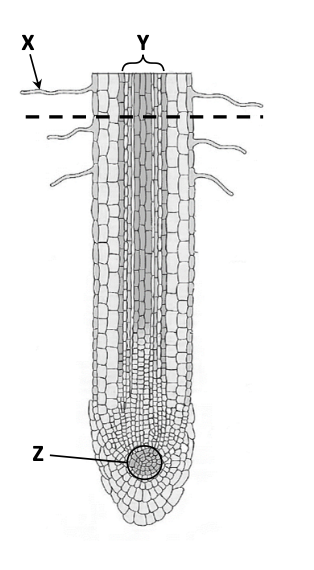
▸ Reveal marking-scheme answer
Question 2                                                                                20

(a) Name structure X and give its function.
    Name:      Root hair                                                                  3
    Function:  Absorption of water or minerals                                            3
(b) Name tissue type Y and give its function.
    Name:      Vascular (tissue)                                                          3
    Function:  Transport of a correct named substance                                     3
(c) Name the tissue at Z where rapid mitosis is occurring.
    Meristematic                                                                          3
(d) TS of root at the dashed line.
    Drawing:   circle with vascular tissue clearly visible in the centre                  3
Labels: dermal (tissue) / vascular (tissue) / ground (tissue) / root hair / examples Any two 2(1)3. Aerobic respiration is a two-stage process. Stage 2 occurs in the cell
organelle shown.
(a) Name the cell organelle shown.
(b) Name the cycle of reactions that occurs in stage 2 of aerobic respiration.
(c) ATP is produced in large quantities by aerobic respiration. What does
ATP stand for?
(d) NAD⁺ is an important molecule in respiration. Give the function of NAD⁺.
Anaerobic respiration may occur under certain conditions.
(e) Suggest a condition under which anaerobic respiration might occur.
(f) State where anaerobic respiration occurs in a cell.
(g) Name ONE main product of anaerobic respiration.
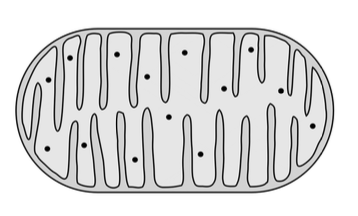
▸ Reveal marking-scheme answer
Question 3                                                                                20

(a) Name the cell organelle shown.
    Mitochondrion                                                                         2
(b) Cycle of reactions in stage 2 of aerobic respiration.
    Krebs                                                                                 3
(c) What does ATP stand for?
    Adenosine triphosphate                                                                3
(d) Function of NAD⁺.
    Carries (high energy) electrons AND protons                                           3
(e) Condition under which anaerobic respiration might occur.
    Lack of oxygen or described                                                           3
(f) Where anaerobic respiration occurs in a cell.
    Cytosol                                                                               3
(g) Name one main product of anaerobic respiration.
Lactic acid or ethanol 34. The diagram below shows part of the ultrastructure of a cell membrane.
(a) Name the parts labelled X and Y.
(b) Give a function of the cell membrane.
(c) (i) What term describes cells WITHOUT membrane-bound organelles?
(ii) What term describes cells WITH membrane-bound organelles?
(d) Plant cells have a cell wall in addition to a cell membrane.
(i) Sketch the basic structure of a plant cell, clearly labelling the
cell membrane AND the cell wall.
(ii) Give ONE function of a plant cell wall.
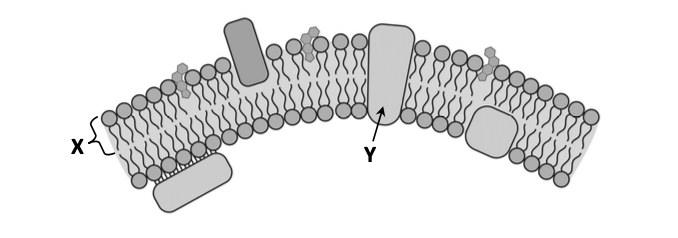
▸ Reveal marking-scheme answer
Question 4                                                                                20

(a) Name the parts labelled X and Y.
    X:  Phospholipid                                                                      2
    Y:  Protein                                                                           2
(b) Function of the cell membrane.
    Controls what substances pass through                                                 3
(c) (i)  Cells without membrane-bound organelles.
         Prokaryotic                                                                      3
    (ii) Cells with membrane-bound organelles.
         Eukaryotic                                                                       3
(d) (i)  Sketch a plant cell, label cell membrane AND cell wall.
         Correct sketch:  showing cell membrane AND cell wall                             3
         Labels:          Cell membrane                                                   1
                          Cell wall                                                       1
    (ii) One function of a plant cell wall.
Gives shape (to the cell) or protection 25. The image shows a piece of equipment that may be used in food processing.
Food processing is a type of bioprocessing involving enzymes and/or
microorganisms. The graph shows the population growth curve of a species
of bacteria in the piece of equipment shown.
(a) What is the common name given to this piece of equipment?
(b) Name TWO factors controlled by the equipment shown that could affect
the growth of bacteria, OTHER than nutrient availability.
(c) Name the TWO stages X and Y on the population growth curve.
(d) The equipment is keeping the population of bacteria steady in growth
phase Y. Which type of food processing technique is represented by the
growth curve shown?
(e) If the population of bacteria in the equipment above were to run out of
nutrients, draw on the graph to show how the line would continue.
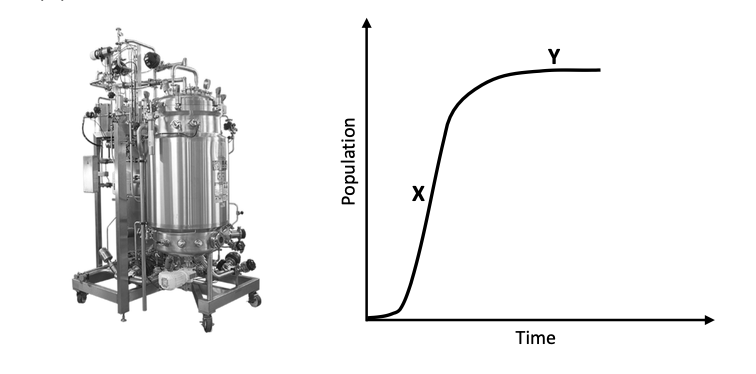
▸ Reveal marking-scheme answer
Question 5                                                                                20

(a) Common name for the equipment.
    Bioreactor                                                                            3
(b) Two factors (other than nutrients) controlled by the equipment.
    pH / temperature / pressure / oxygen…                          Any two            2(3)
(c) Name the two stages X and Y on the population growth curve.
    Stage X:  Log                                                                         3
    Stage Y:  Stationary                                                                  3
(d) Type of food processing technique represented.
    Continuous                                                                            3
(e) If bacteria run out of nutrients, how the line would continue.
Line drops 26. The diagram shows the human digestive system.
(a) Name the parts labelled A and B.
(b) Name AND describe briefly the method by which food travels through
structure A.
(c) How does the pH of the food material change as it travels from A to B?
(d) Name the enzyme produced in the pancreas which digests lipids.
(e) The villus is present in the small intestine. Draw AND label the internal
structure of a villus.
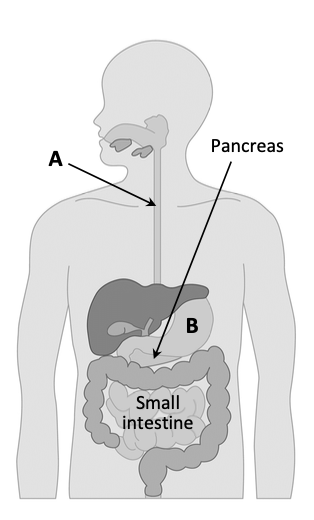
▸ Reveal marking-scheme answer
Question 6                                                                                20

(a) Name the parts labelled A and B.
    A:  Oesophagus                                                                        2
    B:  Stomach                                                                           2
(b) Method by which food travels through structure A.
    Name:        Peristalsis                                                              3
    Description: (involuntary) muscular contractions (that push food)                     3
(c) How does the pH of the food change from A to B?
    Lowers                                                                                2
(d) Pancreatic enzyme that digests lipids.
    Lipase                                                                                3
(e) Draw AND label the internal structure of a villus.
    Drawing:  villus / lacteal / blood vessels                       Any two              3
Labels: villus / lacteal / capillary (or blood vessel or named) Any two 2(1)7. Answer the following questions in relation to the scientific method.
(a) In the scientific method, a testable statement is known as a __________.
(b) How can this statement be tested?
(c) What is the function of a scientific control?
(d) Give TWO limitations of the scientific method.
(e) Where does a biologist normally publish their results?
(f) What is meant by the term theory?
▸ Reveal marking-scheme answer
Question 7                                                                                20

(a) Testable statement in the scientific method.
    Hypothesis                                                                            2
(b) How can this statement be tested?
    Conducting an experiment                                                              3
(c) Function of a scientific control.
    A comparison to the experiment                                                        3
(d) Two limitations of the scientific method.
    Accidental discovery / application to nature / (human) bias / human error /
    constrained by existing knowledge / constrained by existing technology /
    ability to interpret results / experimental design…                Any two        2(3)
(e) Where does a biologist normally publish their results?
    Scientific journal                                                                    3
(f) What is meant by the term theory?
    Supported (or tested) hypothesis                                                      3
2024 Section A — back-catalogue (Q1-Q7)
1.   Answer any FIVE of the following parts (a) to (f). Each part = 4 marks.
     (a)  Which THREE chemical elements are present in ALL lipids?
     (b)  How do fats and oils differ at room temperature?
     (c)  Give one way phospholipids differ from triglycerides.
     (d)  Give one metabolic role of lipids in cells.
     (e)  Give one structural role of lipids in cells.
     (f)  Name one fat-soluble vitamin.
▸ Reveal marking-scheme answer
Question 1                                  Best 5 of (a)-(f)                              20

(a) Three elements present in ALL lipids.
    Carbon, hydrogen, oxygen (or C, H, O)                                                 4
(b) How do fats and oils differ at room temperature?
    Fats are solid and oils are liquid                                                    4
(c) One way phospholipids differ from triglycerides.
    Phospholipids have phosphate and triglycerides do not OR
    Phospholipids have two fatty acids and triglycerides have three fatty acids           4
(d) One metabolic role of lipids in cells.
    Energy (storage) or hormone production or other correct                               4
(e) One structural role of lipids in cells.
    (Cell) membrane                                                                       4
(f) Name one fat-soluble vitamin.
A or D or E or K 42. (a) What is a hypothesis?
(b) State two principles of good experimentation.
(c) Outline the steps of the scientific method that follow the design of an experiment.
(d) State any one limitation of the scientific method.
▸ Reveal marking-scheme answer
Question 2                                                                            20

(a) What is a hypothesis?
    Proposed (or possible) explanation for an observation or other correct description   6(3)+2
(b) State two principles of good experimentation.
    Safety / random selection or no bias or fair test / large sample size /
    double-blind testing / control / replicates / repeatable / other correct  Any two
(c) Outline the steps of the scientific method that follow the design of an experiment.
    Carry out the procedure / gathering results (or data) / repeat / analyse (interpret)
    data / making conclusions / placement of conclusions in the context of existing
    knowledge / publish in a scientific journal / peer review / developing a theory /
    develop a law or principle                                Any three in a valid sequence
(d) State any one limitation of the scientific method.
    Extent of knowledge or basis of investigation or human error or experimental
    design or ability to interpret results or application to nature or accidental
discovery or bias3. The diagram shows part of the human digestive system. Refer to the
paper PDF for the labelled diagram (tube A above the stomach, organ B
attached to liver region, gland C below the stomach).
(a) Name tube A, organ B and gland C.
(b) Give one function of tube A.
(c) Give one function of organ B.
(d) Give one function of gland C in relation to the digestive system.
(e) State one structural feature of the small intestine that enables it to
carry out its function.
(f) Give two functions of symbiotic bacteria in the alimentary canal.
▸ Reveal marking-scheme answer
Question 3                                                                            20

(a) Name tube A, organ B and gland C.                                                  3(1)
    Tube A:    Oesophagus                                                              1
    Organ B:   Liver                                                                   1
    Gland C:   Pancreas                                                                1
(b) One function of tube A.                                                            5(3)+2
    Function:  Transport food to the stomach
(c) One function of organ B.
    Function:  Produce bile or stores vitamins or store minerals or stores glycogen
               or produces plasma proteins or detoxifies or other correct
(d) One function of gland C in relation to the digestive system.
    Function:  Produces pancreatic juice or correctly named substance or named enzyme
(e) One structural feature of the small intestine that enables it to carry out its function.
    Long or has villi or has a large network of capillaries or thin walls or other correct
(f) Two functions of symbiotic bacteria in the alimentary canal.
    Vitamin (B and K) production / compete with pathogens / reference to digestion /
other correct Any two4. The diagram shows a transverse section of a plant stem with scattered
vascular bundles. (See paper PDF for the labelled diagram.)
(a) Label any one structure on the diagram and draw an arrow.
(b) To which type of plant tissue do xylem and phloem belong?
(c) Give one function of xylem.
(d) Give one function of phloem.
(e) 1. Is this stem a monocotyledonous (monocot) stem or a
dicotyledonous (dicot) stem?
2. Justify your answer above.
(f) State the location of the tissue containing xylem and phloem in
a T.S of a root.
▸ Reveal marking-scheme answer
Question 4                                                                            20
                                          6(3) + 2
(a) Label any one structure on the diagram and draw an arrow.
    Correct label and correct arrow indicating structure
(b) To which type of plant tissue do xylem and phloem belong?
    Vascular
(c) One function of xylem.
    Transport water (or minerals or other correct) or support
(d) One function of phloem.
    Transport food
(e) 1. Monocot or dicot?      Monocot
    2. Justify.                (Vascular) bundles are scattered
(f) State the location of the tissue containing xylem and phloem in a T.S of a root.
Centre or described5. Indicate whether the following statements are TRUE or FALSE.
(a) Cell walls are only found in plant cells.
(b) A turgid cell has lost a lot of water.
(c) Fermentation does not use oxygen.
(d) DNA is only found in the nucleus.
(e) There are no hydrogen bonds in a molecule of DNA.
(f) Adenine and guanine are purine bases.
(g) Chromosomes are composed of DNA and protein.
▸ Reveal marking-scheme answer
Question 5                                  6(3) + 2                                  20

(a) Cell walls only in plant cells.                              FALSE  (also fungi/bacteria)
(b) Turgid cell has lost a lot of water.                         FALSE  (it is full of water)
(c) Fermentation does not use oxygen.                            TRUE   (anaerobic)
(d) DNA only in the nucleus.                                     FALSE  (also mitochondria/chloroplasts)
(e) No hydrogen bonds in DNA.                                    FALSE  (between paired bases)
(f) Adenine and guanine are purines.                             TRUE
(g) Chromosomes are composed of DNA and protein.                 TRUE   (DNA + histone proteins)
6.   Distinguish clearly between each member of the following pairs of terms.
     (a)  Ectotherm  vs  Endotherm
     (b)  Ligament   vs  Tendon
     (c)  Carpal     vs  Carpel
     (d)  Haploid    vs  Diploid
     (e)  Systole    vs  Diastole
▸ Reveal marking-scheme answer
Question 6                                  10(2)                                       20

(a) Ectotherm:   Animal whose (body) temperature varies with environmental temperature  2
    Endotherm:   Animal with a constant (body) temperature                              2
(b) Ligament:    Attaches (joins) bone to bone                                          2
    Tendon:      Attaches (joins) muscle to bone                                        2
(c) Carpal:      Bone in the wrist                                                      2
    Carpel:      Female part of the flower                                              2
(d) Haploid:     One set of chromosomes or one copy of each chromosome                  2
    Diploid:     Two sets of chromosomes or two copies of each chromosome               2
(e) Systole:     Heart muscle is contracting                                            2
Diastole: Heart muscle is relaxing 27. The diagram shows the stages of genetic engineering: X (cutting), Y
(insertion into vector / transformation), Z (expression). See paper PDF.
(a) Explain the term genetic engineering.
(b) Name each stage X, Y and Z.
(c) Give one application of genetic engineering for EACH of the
following organisms:
(i) Plant
(ii) Animal
(iii) Micro-organism
▸ Reveal marking-scheme answer
Question 7                                  6(3) + 2                                   20

(a) Explain the term genetic engineering.
    (Artificial) manipulation (or alteration) of a gene (or of DNA)
(b) Name each stage X, Y and Z.
    Stage X:    Cutting (accept restriction)
    Stage Y:    Transformation or introduction of base sequence changes
    Stage Z:    Expression
(c) Give one application of genetic engineering for each organism:
    (i)   Plant:        Any correct application (e.g. herbicide-resistant crop;
                        Bt cotton; golden rice with vitamin A)
    (ii)  Animal:       Any correct application (e.g. transgenic salmon; insulin-producing
                        pigs; mice carrying human disease genes for research)
    (iii) Micro-organism: Any correct application (e.g. E. coli engineered to produce
human insulin; yeast engineered to produce hepatitis-B vaccine)Solid stretch material for an H1. Each topic appeared in roughly two-thirds of audited papers.
Nervous System
14.   (a)    The nervous system is composed of a central nervous system (CNS) and a
             peripheral nervous system (PNS).
             (i)   Distinguish between the central nervous system and peripheral nervous
                   system.
             (ii)  Name one way in which the human central nervous system is protected.         (9)
      (b)    The eye and the ear are both sense organs that detect external stimuli.
             (i)   Describe the role of each of the following in the eye:
                   1.  Cornea     2.  Retina     3.  Optic nerve     4.  Lens.
             (ii)  The diagram shows two eyes (A and B). Which eye (A or B) is exposed
                   to low light levels? Justify your answer.
             (iii) Describe the role of each of the following in the ear:
                   1.  Ossicles     2.  Cochlea     3.  Eustachian tube.
             (iv)  Describe one corrective measure for one of the following: long
                   sightedness or short sightedness or a hearing defect.
                   In your answer, state clearly to which disorder you are referring.          (27)
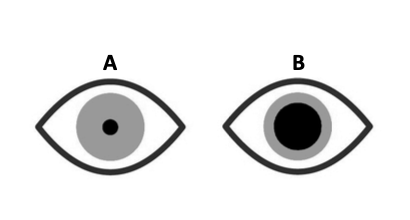
      (c)    Neurons are the functional unit of the nervous system.
             (i)   The diagrams show two neurons (X and Y).
                   1.  Which neuron (X or Y) is a motor neuron? Justify your answer.
                   2.  Which neuron (X or Y) is a sensory neuron? Justify your answer.
             (ii)  Neurotransmitters are found at position Z. Describe how neurotransmitters
                   work.
             (iii) Schwann cells are associated with both neurons. What is the function of
                   a Schwann cell?
             (iv)  In relation to Parkinson's disease or paralysis, give one possible cause
                   and one possible treatment.
                   In your answer, state clearly to which disorder you are referring.          (24)
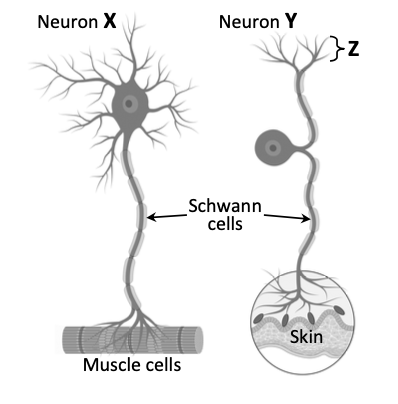
▸ Reveal marking-scheme answer
Question 14                                                                                  60
  (a) (i)      Distinguish between the central nervous system and peripheral nervous system.
               Central:        brain and spinal cord                                           3
               Peripheral:     nerves throughout body (and ganglia)                            3
        (ii)   Name one way in which the human nervous system is protected.
               Skull or spine or vertebrae or meninges……….                                     3
  (b) (i)      Describe the role of each of the following in the eye.
               1. Cornea
                    Allows light in or refracts light……..                                      3
               2. Retina
                    Convert light into nerve impulse                                           3
               3. Optic nerve
                    Carry (nerve) impulses to the brain                                        3
               4. Lens
                    Focus the light onto the retina                                            3
        (ii)   Which eye (A or B), is exposed to low light levels? Justify your answer.
               *B                                                                              1
               Justify:      The pupil is larger (dilated)                                     2
        (iii) Describe the role of each of the following in the ear:
               1. Ossicles
                    Transfer sound (vibrations) or amplify the sound                           3
               2. Cochlea
                    Convert the sound (stimulus) into nerve impulses                           3
               3. Eustachian tube
                    Equalise pressure (between the middle ear and the outside)                 3
        (iv)   Describe one corrective measure for one of the following: long sightedness or
               short sightedness or a hearing defect.
               In your answer, state clearly to which disorder you are referring.
               Matching corrective measure described.                                          3
  8         +1        +1

  (c) (i)      1. Which neuron (X or Y) is a motor neuron. Justify your answer.
                    *X                                                                               1
                    Justify: It is connected to a muscle cell or cell body position described        2
               2. Which neuron (X or Y) is a sensory neuron. Justify your answer.
                    *Y                                                                               1
                    Justify: It is connected to the skin (sensory structure) or cell body position
                             described                                                               2
        (ii)   Describe how neurotransmitters work.
               Impulse arrives at synaptic terminal /
               vesicles release neurotransmitter (or named example) /
               neurotransmitter crosses the cleft /
               attaches to receptors on the next neuron /
               impulse is created in the next neuron /
               neurotransmitter inactivated or described                                 Any three 3(3)
        (iii) What is the function of a Schwann cell?
               Produce myelin (sheath)                                                               3
        (iv)   In relation to Parkinson’s disease or paralysis, give one possible cause and one
               possible treatment.
               In your answer, state clearly to which disorder you are referring.
               Correct matching cause                                                                3
               Correct matching treatment                                                            3
  2         +2        +6
Excretion
15.   (a)    Excretion is an important process in homeostasis in living organisms.
             (i)   Explain the underlined terms.
             (ii) Name one excretory organ in plants.                                              (9)

      (b)    The diagrams below are of a human kidney and one of its nephrons.
             (PCT = proximal convoluted tubule; DCT = distal convoluted tubule)

                   A                                                              Glomerulus
                                                                                       DCT
                   B

                   C

                                                           PCT

                                                            Capillary

                                                              Loop of
                                                              Henle

             (i)   The kidneys are located in the abdomen surrounded by a thick layer of fat.
                   What is the function of this layer of fat?
             (ii) Identify the regions of the kidney labelled A, B and C.
             (iii) Identify the region in the kidney, by name or label, where the process of
                   filtration occurs.
             (iv) Explain the importance of blood entering the glomerulus under pressure.
             (v) State two reasons why there are many capillaries surrounding the proximal
                   convoluted tubule (PCT), loop of Henle and distal convoluted tubule (DCT) of the
                   nephron.
             (vi) Describe how ADH (anti-diuretic hormone) affects the volume of urine.
             (vii) Urine collects at the region labelled C on the diagram of the kidney and travels
                   on towards the bladder.
                   Name the structure through which urine travels to the bladder.                 (27)

      (c)    Plants require water for survival.
             (i)   By what process does water enter the root hairs?
             (ii) Draw a large diagram of a transverse section of a root and label the following
                   tissues:    dermal;     ground; vascular.
             (iii) Name the two Irish scientists who first described the upward movement of
                   water in plants.
             (iv) Describe in detail the upward movement of water in plants.                     (24)
▸ Reveal marking-scheme answer
Question 15                                                                                                                60
  (a) (i)       Explain the underlined terms.
                Excretion:   Removal of metabolic waste from a cell (or organism)                                            3
                Homeostasis: Maintaining a constant internal environment                                                     3
        (ii)    Name one excretory organ in plants.
                Leaf or stem or root          (accept stomata and lenticel)                                                  3
                                                           Number of correct responses    1       2       3
  3                                 Q15 (a) (i) – (ii)
                                                                      Mark                3       6       9

  (b) (i)       What is the function of the layer of fat around the kidney?
                Protection (accept insulation)                                                                               3
                                                              Number of correct responses         1
  1                                          Q15 (b) (i)
                                                                         Mark                     3

        (ii)    Identify the regions of the kidney labelled A, B, and C.
                A:   *Cortex                                                                                                 1
                B:   *Medulla (pyramid)                                                                                      1
                C:   *Pelvis                                                                                                 1
                                                            Number of correct responses       1       2       3
  3                               Q15 (b) (ii) Labels:
                                                                       Mark                   1       2       3

        (iii)   Identify the region in the kidney, by name or label, where the process of filtration occurs.
                *A or *cortex                                                                                                3
        (iv)    Explain the importance of blood entering the glomerulus under pressure.
                Force filtered (or ultrafiltration) or small molecules are forced out of the blood
                (or described)                                                                                               3
        (v)     State two reasons why there are many capillaries surrounding the PCT, loop of Henle and DCT.
                Reabsorption (or described)                                                                                  3
                Secretion (or described)                                                                                     3
        (vi)    Describe how ADH affects the volume of urine.

                (ADH) acts on collecting duct (or DCT) or makes walls more permeable or more
                water reabsorbed                                                                                             3
                (More ADH) leads to low volume of urine                                       (converse also accepted)       3
        (vii) Name the structure through which urine travels to the bladder.
              *Ureter                                                                                                        3
                                              Number of correct responses      1    2     3       4           5    6    7
  7                  Q15 (b) (iii) – (vii)
                                                         Mark                  3    6     9       12          15   18   21

  (c) (i)       By what process does water enter the root hairs?
                *Osmosis                                                                                           3
                                                               Number of correct responses       1
  1                                         Q15 (c) (i)
                                                                          Mark                   3
        (ii)    Drawing T.S of root:
                Dermal tissue + Vascular + Root hair                                                               3
                                                                 Number of correct responses         1
  1                                    Q15 (c) (ii) Drawing:
                                                                            Mark                     3
                Labels:
                Dermal                                                                                             1
                Ground                                                                                             1
                Vascular                                                                                           1
                                                          Number of correct responses        1       2   3
  3                               Q15 (c) (ii) Labels:
                                                                     Mark                    1       2   3

        (iii)   Name the two Irish scientists who first described the upward movement of water in plants
                (Henry) Dixon                                                                                      3
                (John) Joly                                                                                        3
        (iv)    Describe in detail the upward movement of water in plants.
                Root pressure pushes (water) / in xylem / cohesion or water molecules stick
                together / continuous column / due to H bonding / adhesion or water molecules
                stick to xylem walls / transpiration or evaporation / tension or pull   Any three 3(3)

                                                  Number of correct responses        1   2           3   4    5
  5                        Q15 (c) (iii) – (iv)
Mark 3 6 9 12 15Regular drillers — each appeared in 2-4 of the last 8 Section B papers. Strong second-pass material once Tier 1 is fluent.
Microscopy & cells
PRACTICAL: Use the light microscope to examine ONE animal cell and ONE plant cell, unstained and stained, at ×100 and ×400.

Describe:
  (i)   Source of each cell type (e.g. cheek swab; onion epidermis)
  (ii)  Why a stain is added
  (iii) How to switch from low to high power
  (iv)  Differences between plant and animal cells under the microscope
▸ Reveal marking-scheme answer
AIM
Use the light microscope to examine plant and animal cells.

APPARATUS
Light microscope · slide and coverslip · stain (methylene blue or iodine) · cells from cheek swab (animal) or onion (plant).

METHOD
1.  Transfer cells to a slide:
      Animal: gentle cheek swab.
      Plant:  onion epidermis peel.
2.  Add a stain (methylene blue or iodine — to make cells more visible / easier to see).
3.  Add a coverslip.
4.  View at low power (×100) using objective ×10 first.
5.  To view at ×400: select the high power (×40 objective) and use FINE focus only.

RESULT
Plant cells: cell wall, regular shape, all cells joined to each other, nucleus visible.
Animal cells: more irregular shape, no cell wall, nucleus visible.

CONTROL / PRECAUTION
Use fine focus on high power to avoid breaking the slide.
Enzymes
PRACTICAL: Prepare an immobilised enzyme (or yeast cells) and demonstrate its activity on a substrate.

Describe:
  (i)   Aim
  (ii)  How alginate beads are made
  (iii) How you test the beads for enzyme activity (named substrate, named test, expected result)
  (iv)  Control or comparison
  (v)   ONE advantage of immobilisation
▸ Reveal marking-scheme answer
AIM
Immobilise a named enzyme (or yeast cells) and demonstrate its activity on a substrate.

APPARATUS
Sodium alginate · calcium chloride · named enzyme or yeast cells · beakers · syringe or dropper · safety equipment.

METHOD
1.  Dissolve sodium alginate in water and add yeast (or named enzyme/cells).
2.  Drop the mixture into a solution of calcium chloride (forms gel beads).
3.  Beads harden; filter and rinse the beads.
4.  Apply the immobilised enzyme/cells to a matching substrate.
5.  Identify a named product or use a named test.
6.  Include a valid control or comparison; describe the result.

RESULT
Beads contain active immobilised enzyme/cells; matching test result shows product formation.

CONTROL / PRECAUTION
Reference to time duration; valid safety precaution.

ADVANTAGE OF IMMOBILISATION
Pure product · easily recovered · reusable.
PRACTICAL: Investigate the effect of pH on the rate of activity of a named enzyme (catalase or amylase).

Describe:
  (i)   Aim
  (ii)  Named enzyme + matching substrate
  (iii) How pH is held constant at each value
  (iv)  How rate is measured
  (v)   Expected graph (rate vs pH)
▸ Reveal marking-scheme answer
AIM
Investigate the effect of pH on the rate of activity of a named enzyme.

APPARATUS
Named enzyme (e.g. catalase from celery, or amylase from saliva) · matching substrate (hydrogen peroxide or starch) · pH buffers · pH meter · dropper · timer.

METHOD
1.  Add a small volume of enzyme using a dropper / pipette / syringe.
2.  Use a pH buffer to keep pH constant at each value.
3.  For catalase:  measure the volume or height of foam per minute.
    For amylase:   measure the time taken for the blue-black colour (with iodine) to disappear.
4.  Repeat at a range of pH values.

RESULT
Plot rate (y-axis) against pH (x-axis); curve rises sharply to optimum then falls sharply.

CONTROL / PRECAUTION
Buffer maintains pH; substrate must match enzyme.

SOURCES OF ERROR
pH change can denature the enzyme — alters active site shape.
Photosynthesis & respiration
PRACTICAL: Investigate the effect of light intensity (or CO2 concentration) on the rate of photosynthesis using Elodea.

Describe:
  (i)   Aim
  (ii)  Apparatus
  (iii) How rate is measured
  (iv)  How temperature is kept constant
  (v)   Expected graph shape and what happens at 60 °C
▸ Reveal marking-scheme answer
AIM
Investigate the effect of light intensity (or CO2 concentration) on the rate of photosynthesis.

APPARATUS
Elodea (pondweed) or other named photosynthetic organism · beaker · water bath · lamp · sodium hydrogen carbonate solution · timer.

METHOD
1.  Use Elodea — an aquatic plant; bubbles can be seen and gas volume measured.
2.  Keep all other factors constant for a FAIR test (so the rate depends only on the factor being changed).
3.  Maintain temperature using a water bath.
4.  Measure rate by counting the number of bubbles (or volume of gas) per minute over a set period.

RESULT
Rising line from zero, eventually levelling off at 25 °C.
At 60 °C the rate is on or very close to the x-axis (enzymes denatured).

CONTROL / PRECAUTION
Keep all variables other than the one tested constant; water bath for constant temperature.
PRACTICAL: Demonstrate the production of alcohol by yeast under anaerobic conditions.

Describe:
  (i)   Aim
  (ii)  How anaerobic conditions are maintained
  (iii) Why temperature matters
  (iv)  Why fermentation eventually stops
  (v)   The test for alcohol
▸ Reveal marking-scheme answer
AIM
Demonstrate the production of alcohol by yeast under anaerobic conditions.

APPARATUS
Flask or beaker · yeast · glucose solution · water bath · oil layer or anaerobic lock to exclude oxygen.

METHOD
1.  Set up a container with yeast and glucose solution.
2.  Maintain anaerobic conditions (oil on top OR anaerobic lock).
3.  Keep yeast cells at an optimum temperature using a water bath (allows enzymes to work at their best rate).

RESULT
Bubbles indicate fermentation.
The reaction stops when bubbles stop / when the solution settles.
Cause: yeast runs out of glucose (substrate) OR alcohol (waste) builds up to toxic levels.
Test for alcohol: iodoform test — final colour yellow.

CONTROL / PRECAUTION
Indication of anaerobic conditions essential (oil on top or anaerobic lock).
Plants — germination, transport, response
PRACTICAL: Use starch agar OR skim-milk agar to demonstrate digestive activity in germinating seeds.

Describe:
  (i)   Aim
  (ii)  Why seeds are soaked and sterilised
  (iii) How seeds are placed on the agar (and why)
  (iv)  Control (e.g. boiled seeds)
  (v)   How you test the agar at the end (iodine for starch agar; biuret for skim-milk)
  (vi)  Expected result
▸ Reveal marking-scheme answer
AIM
Show digestive activity in germinating seeds using starch agar (amylase) or skim-milk agar (protease).

APPARATUS
Starch agar (or skim-milk agar) plate · germinating seeds · sterile knife · iodine (or biuret) solution · control of boiled (dead) seeds.

METHOD
1.  Soak seeds (to start metabolic activity / activate enzymes / soften the testa).
2.  Sterilise seeds (to kill all microorganisms).
3.  Cut seeds in half; place cut (flat) side down on the agar (so the enzyme is in contact with the substrate).
4.  Leave for a suitable length of time at a suitable temperature.
5.  Use boiled seeds (or other suitable control).
6.  Flood plates with iodine (for starch agar) or biuret (for skim-milk agar).

RESULT
Agar underneath the test seeds remains clear — digestion has occurred.
Agar underneath the control (boiled) seeds gives the positive test result — no digestion (seeds dead / enzyme denatured).

CONTROL / PRECAUTION
Sterilise seeds to prevent microbial growth; care with cutting.
PRACTICAL: Demonstrate osmosis using a selectively permeable membrane (Visking tubing or a potato).

Describe:
  (i)   Aim
  (ii)  Apparatus
  (iii) How you set up the tubing/potato
  (iv)  Control
  (v)   Expected result (mass change)
▸ Reveal marking-scheme answer
AIM
Demonstrate osmosis using a selectively permeable membrane.

APPARATUS
Visking tubing (or potato) · salt or sugar solution · beaker · thread · balance · named piece of apparatus.

METHOD
1.  Prepare the tissue/membrane (e.g. fill Visking tubing with concentrated sugar/salt solution; tie ends; rinse).
2.  Place in a beaker of distilled water (or vice versa).
3.  Set up a control (e.g. tubing with water in water).
4.  Leave for a suitable time.
5.  Record initial and final mass.

RESULT
Increase in mass (or volume) of the more concentrated solution / solution inside the tubing.
Control shows no change.

CONTROL / PRECAUTION
Control named and set up; rinse tubing before weighing.
PRACTICAL: Investigate the effect of IAA growth regulator on a named plant tissue (root, shoot or seed).

Describe:
  (i)   Aim
  (ii)  Apparatus and at least three different IAA concentrations
  (iii) Control (no IAA)
  (iv)  How growth is measured
  (v)   Expected result for roots vs shoots
▸ Reveal marking-scheme answer
AIM
Investigate the effect of IAA on a named plant tissue (root, shoot or seed).

APPARATUS
Named plant tissue (root or shoot or seed) · IAA at different concentrations · petri dishes · ruler (or grid) · gloves / lab coat.

METHOD
1.  Use different concentrations of IAA.
2.  Use more than one seed or tissue per concentration (fair test, equal volumes added).
3.  Set up a control (no IAA).
4.  Leave for a suitable time.
5.  Measure lengths using a ruler (or grid) to measure growth.

RESULT
More root growth in low concentration.
More shoot growth in high concentration.

CONTROL / PRECAUTION
Use gloves, lab coat or mask — IAA may be harmful.
Ecology — abiotic measurement
PRACTICAL: Measure two named abiotic factors in a chosen ecosystem.

For each factor:
  · Name the factor
  · Name the matching instrument
  · Describe how the measurement is made
▸ Reveal marking-scheme answer
AIM
Measure two named abiotic factors in a chosen ecosystem.

APPARATUS  (matched to the factor)
Light intensity      → light meter
Temperature          → thermometer
pH                   → pH meter or universal indicator
Wind speed           → anemometer
Soil temperature     → soil thermometer
Water clarity        → secchi disc
Dissolved oxygen     → oxygen probe

METHOD
1.  Name each abiotic factor (e.g. light intensity, temperature, pH, dissolved oxygen, % water in soil, slope, salinity).
2.  Outline a matching method of measurement for each factor (correctly named instrument, used appropriately).
3.  Repeat measurements for reliability.

RESULT
Recorded value of each factor.

CONTROL / PRECAUTION
Repeat measurements; take readings at consistent times.
Lower-yield. Worth a skim once Tier 1 + Tier 2 are solid; not worth deep drill.
Plant Response
11.   (a)    Tropisms are important for plants.
             (i)   What is geotropism?
             (ii)  Name a part of a plant that responds positively to geotropism.
             (iii) How does this growth response benefit plants?                                (9)
      (b)    The diagram shows the arrangement of the cells and nuclei of a mature
             embryo sac in a flowering plant.

             (i)   Give the collective name for:
                   1.  The male reproductive parts of the flower.
                   2.  The female reproductive parts of the flower.
             (ii)  Name the specific part of the flower that holds the embryo sac.
             (iii) The embryo sac develops from a single diploid cell. Name this cell.
             (iv)  Name the parts labelled P and Q in the embryo sac that are involved in
                   double fertilisation.
             (v)   Explain why parts P and Q are genetically identical.
             (vi)  State what each of the parts P and Q develop into after double
                   fertilisation.                                                              (27)
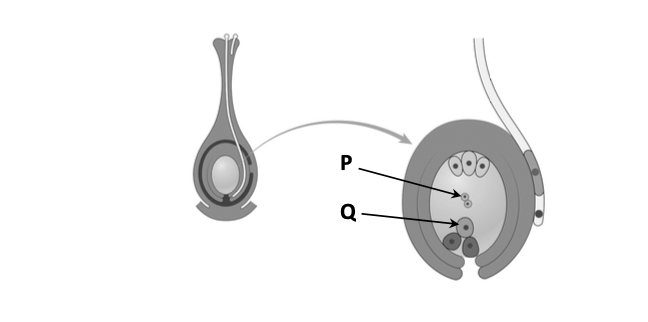
      (c)    Sexual reproduction results in seed formation followed by seed dispersal
             and dormancy.
             (i)   Name two methods by which seeds are dispersed.
             (ii)  Give two advantages of seed dispersal to a plant species.
             (iii) Give two advantages of dormancy to a plant species.
             (iv)  Some plants reproduce asexually by means of vegetative propagation.
                   1.  Give one example of a plant that reproduces asexually using leaves.
                   2.  Give one example of a plant that reproduces asexually using buds.       (24)
▸ Reveal marking-scheme answer
Question 11                                                                                    60
  (a) (i)      What is geotropism?
               Growth response (of a plant) to gravity.                                          3
        (ii)   Name a part of a plant that responds positively to geotropism.
               *Root                                                                             3
        (iii) How does this growth response benefit plants?
               Obtain (more) water or minerals or anchorage                                      3
  (b) (i)      Give the collective name for:
               1. The male reproductive parts of the flower.
                    *Stamen                                                                      3
               2. The female reproductive parts of the flower.
                    *Carpel                                                                      3
        (ii)   Name the specific part of the flower that holds the embryo sac.
               *Ovule (accept ovary)                                                             3
        (iii) The embryo sac develops from a single diploid cell. Name this cell.
               *Megaspore mother (cell)                                                          3
        (iv)   Name the parts labelled P and Q in the embryo sac that are involved in double
               fertilisation.
               P:   *Polar nucleus                                                               3
               Q:   *Egg (cell)                                                                  3
        (v)    Explain why parts P and Q are genetically identical.
               They were produced by mitosis                                                     3
        (vi)   State what each of the parts P and Q develop into after double fertilisation.
               P:   Endosperm                                                                    3
               Q:   Diploid zygote                                                               3

  (c) (i)      Name two methods by which seeds are dispersed.
               Wind / animal / water / self                                             Any two 2(3)
        (ii)   Give two advantages of seed dispersal to a plant species.
               Reduce competition /
               colonise new habitats /
               better chance of survival ……….                                         Any two 2(3)
        (iii) Give two advantages of dormancy to a plant species.
               Allows time for development of embryo /
               allows time for dispersal /
               allows survival in unfavourable conditions……….                           Any two 2(3)
        (iv)   1. Give one example of a plant that reproduces asexually using leaves.
                    Correct example given                                                        3
               2. Give one example of a plant that reproduces asexually using buds.
                    Correct example given                                                        3
Tissues
14.   (a)    Meristematic tissue is an important tissue in plants.
             (i)     What is the meristem?
             (ii)    Give two locations in plants where meristematic tissue may be found.
                                                                                                   (9)

      (b)    The diagram shows a typical animal-pollinated flower.

                                          Style                      A
                                                                             B
                            Filament

                                                                         C

                                       Ovule

             (i)     Name the structures A, B and C.
             (ii)    Give one function for each structure A and B.
             (iii)   Describe one way in which a wind-pollinated flower would differ from the
                     animal-pollinated flower.
             (iv)    Embryo sac development occurs in the ovule.
                     Describe embryo sac development in detail.
             (v)     What does the ovule develop into if fertilisation occurs?
                                                                                                 (27)

      (c)    Many plants can undergo vegetative propagation or horticulturists may carry out
             artificial propagation.
             (i)     What is meant by the term vegetative propagation?
             (ii)    Name any two methods of vegetative propagation used by plants and for each
                     named method, give one example of a plant that carries out that method of
                     vegetative propagation.
             (iii)   Name any three methods horticulturists may use to artificially propagate plants.
                                                                                                  (24)
▸ Reveal marking-scheme answer
Question 14                                                                                           60
                                                         3(3)
 (a)   (i)  What is the meristem?
            Region where mitosis can occur or region of (rapid) cell production or region of
            (active) cell division                                                            3
       (ii) Give two locations in plants where meristematic tissue may be found.
            Shoot tip / root tip / bud / seed / vascular bundles / other correct     Any two 2(3)
                                                  Number of correct responses 1 2 3
  3                          Q14 (a) (i) – (ii)
                                                                Mark               3 6 9

                                                         3(1)
 (b)   (i)   Name structures A, B and C.
             A: Stigma                                                                                 1
             B: Anther                                                                                 1
             C: Sepal                                                                                  1
                                                  Number of correct responses 1        2   3
  3                        Q14 (b) (i) Labels:
                                                                Mark               1   2   3

                                                   8(3)
       (ii) Give one function for each structure A and B.
             A: Trap pollen or described                                                          3
             B: Produce (or release) pollen                                                       3
       (iii) Describe one way in which a wind-pollinated flower would differ from the animal-
             pollinated flower.
             Anthers (or stigmas) outside of flower or petals green or not colourful or absent
             or no scent or no nectar                                                             3
       (iv) Describe embryo sac development in detail.
             Diploid / megaspore mother cell / divides by meiosis / to produce four haploid
             cells (or tetrad) / three degenerate / divides by mitosis 3 times / embryo sac
             containing 8 nuclei (cells) / one becomes egg (cell) / two polar nuclei (formed)
                                                                                        Any four 4(3)
       (v) What does the ovule develop into if fertilisation occurs?
             *Seed                                                                                3
                                    Number of correct responses 1          2   3   4   5   6   7   8
  8            Q14 (b) (ii) – (v)
                                                  Mark                 3   6   9   12 15 18 21 24

                                                   8(3)
 (c)   (i) What is meant by the term vegetative propagation?
             Asexual reproduction (in plants) or growing a new plant using non-reproductive
             parts (or named part)                                                                    3
       (ii) Name any two methods of vegetative propagation used by plants and for each named
             method, give one example of a plant that carries out that method of vegetative propagation.
             Methods: Stem / root / leaf / bud                                             Any two 2(3)
             Examples: Stem: e.g. strawberry (or other correct)
                          Root: e.g. dahlia (or other correct)
                          Leaf: e.g. kalanchoe (or other correct)
                          Bud: e.g. onion (or other correct)
                                                          (Two examples, must match methods) 2(3)
       (iii) Name any three examples of methods horticulturists may use to artificially
             propagate plants.
             Cutting / layering / grafting / micro propagation (tissue culture)          Any three 3(3)
                                    Number of correct responses 1   2   3   4    5    6    7    8
 8            Q14 (c) (i) – (iii)
                                              Mark             3    6   9   12 15 18 21 24
Digestion
14.   (a)    (i)     What is meant by the term digestion?
             (ii)    Why is digestion necessary in humans?
             (iii)   What name is given to the removal of undigested wastes from the human body?
                                                                                              (9)

      (b)    The diagram shows a longitudinal section (L.S.) of a villus from the human digestive
             system.

             (i)   Give the precise location where villi are        Epithelium
                   most abundant.
             (ii) What is the main function of villi?
             (iii) Name the part labelled X and state its role.
             (iv) Name the blood vessel that carries                        X
                   digested nutrients away from the digestive
                   system.                                          Blood
             (v) To what organ in the body are digested             capillary
                   nutrients first transported?
             (vi) Give one function of the organ you named
                   at part (v) above other than the storage of
                   nutrients.
             (vii) Name and explain the process of how food
                   is moved along the digestive system.
                                                                                                    (27)

      (c)    The ‘transpiration stream’ has an important role in the transport of water and minerals
             up, into and out of plant leaves. The water and minerals move through specialised
             vascular tissues.
             The stomatal density (number of stomata per mm2) from the leaves of three different
             plants was measured and the results shown in the table.

                                       Plant       Stomatal density
                                         A               43
                                         B               28
                                         C               68
             (i)     Which of the three plants would you expect to show the lowest rate of
                     transpiration? Explain your answer.
             (ii)    Indicate two other ways plants use to control transpiration.
             (iii)   Xylem and phloem are two vascular tissues in plants.
                     Give two structural differences between xylem and phloem.
             (iv)    Draw and label a longitudinal section (L.S.) of a xylem vessel.
                                                                                                    (24)
▸ Reveal marking-scheme answer
Question 14                                                                                                       60
  (a) (i)        What is meant by the term digestion?
                 The breakdown of food                                                                              3
        (ii)     Why is digestion necessary in humans?
                 To make nutrients (or food) soluble or for absorption of nutrients (or food) or for
                 transport of nutrients (or food)                                                                   3
        (iii)    What name is given to the removal of undigested wastes from the human body?
                 *Egestion                                                                                          3

                                                        Number of correct responses   1    2    3
                                    Q14 (a) (i - iii)
                                                                   Mark               3    6    9

  (b) (i)        Give the precise location in the where these villi are most abundant?
                 Small intestine or ileum or duodenum or jejunum                                                    3
        (ii)     What is the main function of villi in the human digestive system?
                 To increase surface area or for absorption (of nutrients)                                          3
        (iii)    Name the part labelled X and state its role:
                 Name:        *Lacteal                                                                              3
                 Role:        To absorb (digested) fats (or fatty acids)                                            3
        (iv)     Name the blood vessel that carries the digested nutrients:
                 *Hepatic portal vein                                                                               3
        (v)      To what organ in the body are these nutrients first transported?
                 *Liver                                                                                             3
        (vi)     Give one other function of the liver other than storage:
                 Detoxification or produces bile or breaks down red blood cells or deamination or
                 any other valid function                                                                           3
        (vii) Name the process and explain how food is moved along the digestive system:
              Name:    *Peristalsis                                                                                 3
              Explain: Muscular contractions                                                                        3
                                    Number of correct responses        1    2   3     4    5    6    7    8    9
                Q14 (b) (i - vii)
                                               Mark                    3    6   9     12   15   18   21   24   27

  (c) (i)       Which plant would you expect to show the lowest rate of transpiration?
                *B                                                                                                       3
                Explain your answer:
                Lowest number (or density) of stomata                                                                    3
        (ii)    Indicate two other methods plants use to control transpiration:
                Waxy cuticle / action of stomata / location of stomata / any other valid methods
                                                                                                              Any two   2(3)
        (iii)   Give two structural differences between xylem and phloem:
                Xylem has pits and phloem does not /
                Xylem has lignin and phloem does not /
                Phloem has companion cells and xylem does not /
                Phloem has nuclei and xylem does not /
                Phloem has sieve plates and xylem does not /
                Xylem is a continuous tube and phloem is not /
                Xylem has vessels or tracheids and phloem does not                                            Any two   2(3)

                                              Number of correct responses    1    2    3       4    5    6
                          Q14 (c) (i - iii)
                                                         Mark                3    6    9       12   15   18

        (iv)    Draw and label a detailed longitudinal section (L.S.) of a xylem vessel:
                Drawing: Continuous vessel(s) with lignin or pits                                                        3
                                                              Number of correct responses      1
                                       Q14 (c) (iv) Drawing
                                                                         Mark                  3

                Labels:        Pits / lignin / wall                                                                     3(1)

                                                         Number of correct responses       1   2    3
                                   Q14 (c) (iv) Labels
Mark 1 2 3On the syllabus but rarely a Section B Q in recent years. Keep them in your notes for Section A but don't over-rehearse.
Never tested in last 8 years (0 hits)
PRACTICAL (Tier 3 stub): Use any keys available to identify 5 flora and 5 fauna from a chosen ecosystem.

Outline how a dichotomous key works and name 5 plants + 5 animals you identified.
▸ Reveal syllabus stub
AIM
Use a dichotomous key to identify 5 plants and 5 animals from the chosen ecosystem.

METHOD
1.  Collect specimens (or photograph) of each organism.
2.  Read the first pair of statements in the key; choose the one that matches.
3.  Follow the instruction to the next numbered pair.
4.  Repeat until the organism is named.
5.  Record name + key features used.

EXAMPLES
Plants: dandelion, daisy, buttercup, plantain, clover.
Animals: woodlouse, earthworm, snail, spider, beetle.

NOTE
Not tested as a Section B long question in the last 8 years. Could appear in Sec A.
PRACTICAL (Tier 3 stub): Prepare ONE bacterial culture using aseptic technique.

List the steps of aseptic technique you would use.
▸ Reveal syllabus stub
ASEPTIC TECHNIQUE — same checklist as the leaf-yeast practical
- Wipe surface with disinfectant.
- Wash hands.
- Keep Bunsen lit nearby.
- Flame the neck of the bacterial culture bottle before and after pouring.
- Flame the inoculating loop until red-hot before and after use.
- Open the petri dish only enough to streak.
- Tape the lid; INVERT and incubate at 25 °C (not 37 °C, to avoid culturing pathogens).
- Dispose of plates by autoclaving OR soaking in disinfectant.

NOTE
Aseptic technique is examined indirectly via the leaf-yeast practical above. Not tested standalone in the last 8 years.
PRACTICAL (Tier 3 stub): Identify and name the parts of one wind-pollinated and one insect-pollinated flower.

List 4 contrasting features (petals, stigma, anthers, pollen, scent).
▸ Reveal syllabus stub
FEATURE             INSECT-POLLINATED        WIND-POLLINATED
Petals              Large, bright, scented   Small, dull, no scent
Stigma              Inside flower, sticky    Outside flower, feathery
Anthers             Inside flower            Outside flower, hanging
Pollen              Sticky, large, spiky     Smooth, light, abundant
Nectar              Present                  Absent

EXAMPLES
Insect: buttercup, wallflower, daffodil.
Wind:   grass, hazel catkin, plantain.

NOTE
Tested as Section C theory in several years; never as a Section B "describe how you examined" practical in the last 8 years.
Tested once in 8 years
PRACTICAL (Tier 3 stub): Investigate the effect of temperature on the rate of activity of a named enzyme. Include heat denaturation (a change you cannot reverse by cooling).
▸ Reveal syllabus stub
AIM
Investigate the effect of temperature on the rate of activity of a named enzyme (e.g. catalase).

METHOD
1.  Set up matching enzyme (catalase) + substrate (hydrogen peroxide).
2.  Use water baths at a range of temperatures (e.g. 0 °C, 20 °C, 40 °C, 60 °C, 80 °C).
3.  Measure rate (volume/height of foam per minute).
4.  Repeat at each temperature.

RESULT
Rate rises to optimum (~37 °C) then falls sharply. At 60 °C+ the rate is on the x-axis — enzyme is denatured.

HEAT DENATURATION
Heat the enzyme above its optimum, then cool back to the optimum and re-test.
Rate does NOT recover — proves denaturation is irreversible (active site shape changed permanently).
PRACTICAL (Tier 3 stub): Investigate the effect of water, oxygen and temperature on the germination of seeds.

Set up FOUR test tubes — three deny one factor each, one is the full positive control.
▸ Reveal syllabus stub
SET UP                       WATER   OXYGEN   TEMP    GERMINATES?
Tube 1: positive control     ✓       ✓        warm    YES
Tube 2: no water (dry)       ✗       ✓        warm    NO
Tube 3: no oxygen (boiled    ✓       ✗        warm    NO
        water + oil layer)
Tube 4: cold (fridge)        ✓       ✓        cold    NO

CONCLUSION
All three factors — water, oxygen and a suitable temperature — are needed for germination.

CONTROL
Tube 1 (all factors present) confirms the seeds themselves are viable.PRACTICAL (Tier 3 stub): Dissect, display and identify the parts of a mammalian (ox/sheep) heart. Name the chambers, blood vessels and valves you would identify.
▸ Reveal syllabus stub
METHOD
1.  Identify external features: apex (pointed bottom), base (flat top), atria (top), ventricles (bottom).
2.  Locate blood vessels:
       - Aorta (largest, leaves left ventricle)
       - Pulmonary artery (leaves right ventricle)
       - Vena cavae (enter right atrium)
       - Pulmonary veins (enter left atrium)
3.  Cut a longitudinal section through both ventricles.
4.  Identify chambers + walls (left ventricle wall ~3× thicker — pumps to whole body).
5.  Identify valves:
       - Bicuspid (mitral) valve — left atrium → left ventricle
       - Tricuspid valve — right atrium → right ventricle
       - Semilunar valves — at base of aorta and pulmonary artery
       - Chordae tendineae — anchor cusps to ventricle wall.

SAFETY
Disposable gloves; sharp dissecting tools handled away from body; dispose of tissue per school protocol.PRACTICAL (Tier 3 stub): Investigate the effect of exercise on the breathing rate (or pulse rate) of a human. Describe the procedure and how you ensure a fair test.
▸ Reveal syllabus stub
METHOD
1.  Subject sits at rest for 5 minutes.
2.  Measure resting pulse (carotid or wrist) for 1 minute, OR breathing rate (count chest rises) for 1 minute.
3.  Subject does a fixed amount of exercise (e.g. step-ups for 3 minutes).
4.  Immediately after exercise, measure pulse / breathing rate again for 1 minute.
5.  Continue measuring at 1-min intervals until rate returns to resting value.
6.  Repeat with several subjects; average results.

RESULT
Pulse and breathing rate increase sharply during exercise, peak straight after, then decline back to resting value over several minutes.

WHY
Working muscles need more O2 (and produce more CO2). Heart pumps faster to deliver O2; lungs ventilate faster to expel CO2.

FAIR TEST / CONTROL
Same exercise duration and intensity for every trial; same person OR same age/fitness range; rest at the start.