Type your answer, click Reveal marking-scheme answer to self-mark, or Check answer with AI for an instant DeepSeek grade. Auto-saves locally.
Section A — answer any 5 of 7 (20 marks each, 30 minutes)
1.   Answer any FIVE of the following parts (a) to (f).
     (a)  Name the THREE chemical elements that are present in ALL carbohydrates.
     (b)  Give the general formula for carbohydrates.
     (c)  Name the smallest unit of a carbohydrate.
     (d)  Name the type of carbohydrate formed when many of the smallest units of
          a carbohydrate bond together.
     (e)  Give ONE structural role of carbohydrates in living organisms.
     (f)  Carbohydrates are an important component of the diet.
          State ONE dietary source of carbohydrates.
▸ Reveal marking-scheme answer
Question 1                                  Best 5 of (a)-(f)        3(6) + 2(1)         20

(a) Three chemical elements in all carbohydrates.
    Carbon, hydrogen and oxygen                       (accept C, H and O)              6
(b) General formula for carbohydrates.
    Cx(H2O)y                                                                          6
(c) Smallest unit of a carbohydrate.
    Monosaccharide                                                                    6
(d) Type of carbohydrate formed when many smallest units bond together.
    Polysaccharide                                                                    6
(e) One structural role of carbohydrates in living organisms.
    Cell wall or other correct                                                        6
(f) One dietary source of carbohydrates.
    Bread or pasta or other correct dietary source                                    6
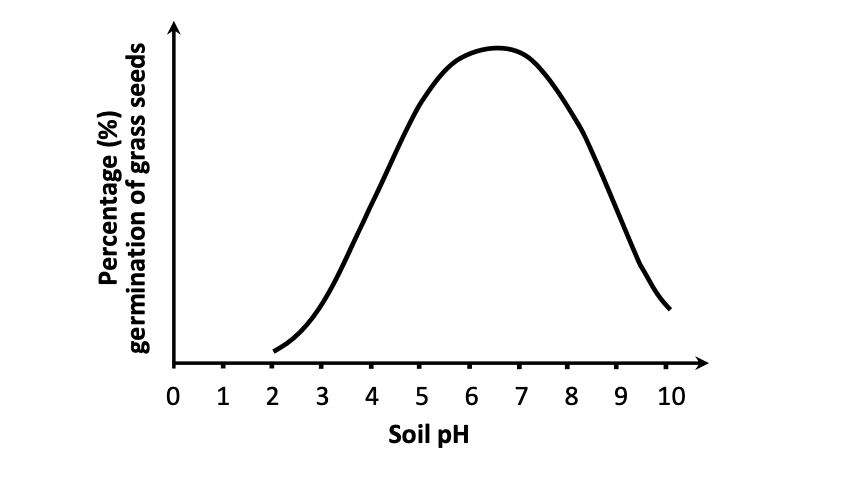
(Best 5 → marks: 6, 12, 18, 19, 20, 20)2. A horticulturist tested the hypothesis: "If soil pH is changed, then germination
of grass seeds is affected." The graph shows the results of the investigation.
(a) Draw a vertical line ON THE GRAPH that indicates a pH MOST suitable for
the germination of grass seeds.
(b) Explain the term hypothesis.
(c) State ONE variable from the investigation described above.
(d) Controls are often used in investigations. What is the function of a control?
(e) Where might the horticulturist first publish the results of their research?
(f) Give TWO limitations of the scientific method.
▸ Reveal marking-scheme answer
Question 2                                                       2(5) + 5(2)            20

(a) Vertical line on the graph through pH most suitable for germination.
    Correct vertical line drawn through peak                                            5
(b) Explain hypothesis.
    Proposed (or possible) explanation for an observation                               5
(c) One variable from the investigation.
    (Soil) pH or percentage germination                                                 2
(d) Function of a control.
    To act as a comparison to the test (or results or experiment)                       2
(e) Where might the horticulturist first publish their research?
    Scientific journal (or named)                                                       2
(f) Two limitations of the scientific method.
    Extent of knowledge / basis of investigation / human error / experimental design /
    ability to interpret results / application to nature / accidental discovery /
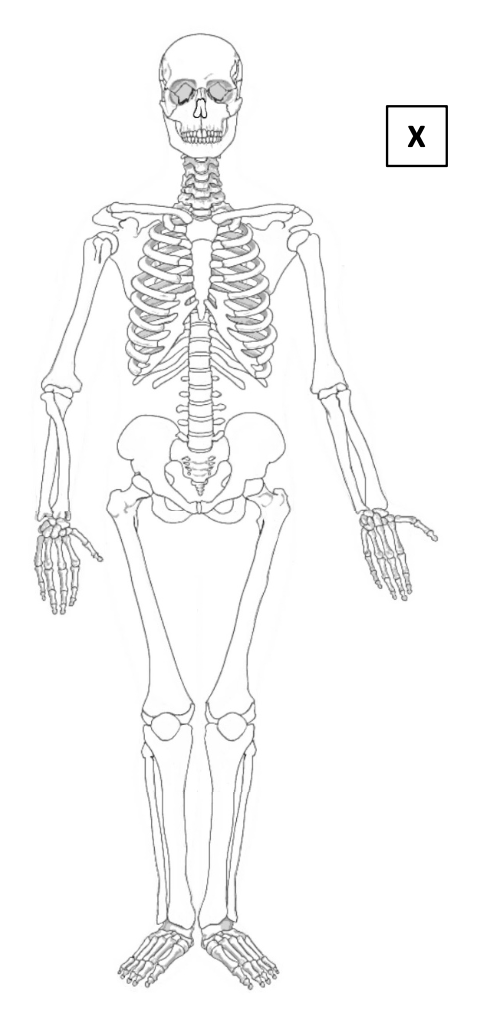
bias Any two 2 + 23. The diagram shows the human skeleton — structurally divided into the axial
skeleton AND the appendicular skeleton.
(a) Give TWO functions of the skeleton.
(b) Name any TWO bones of the axial skeleton.
(c) Cartilage is an important part of the skeleton. Name the biomolecule that
is the main component of cartilage.
(d) The innominate bones are part of the appendicular skeleton.
What are these bones more commonly known as?
(e) ON THE DIAGRAM, draw an arrow from the letter X to show the location of
a slightly movable joint.
▸ Reveal marking-scheme answer
Question 3                                                       2(5) + 5(2)            20

(a) Two functions of the skeleton.
    Protection / movement / support / blood cell production               Any two   5 + 5
(b) Two bones of the axial skeleton.
    Skull / vertebra / rib / sternum / mandible                           Any two   2 + 2
(c) Biomolecule that is the main component of cartilage.
    Protein                                                                              2
(d) What the innominate bones are more commonly known as.
    Pelvis or hip (bones)                                                                2
(e) Arrow from X to a slightly movable joint.
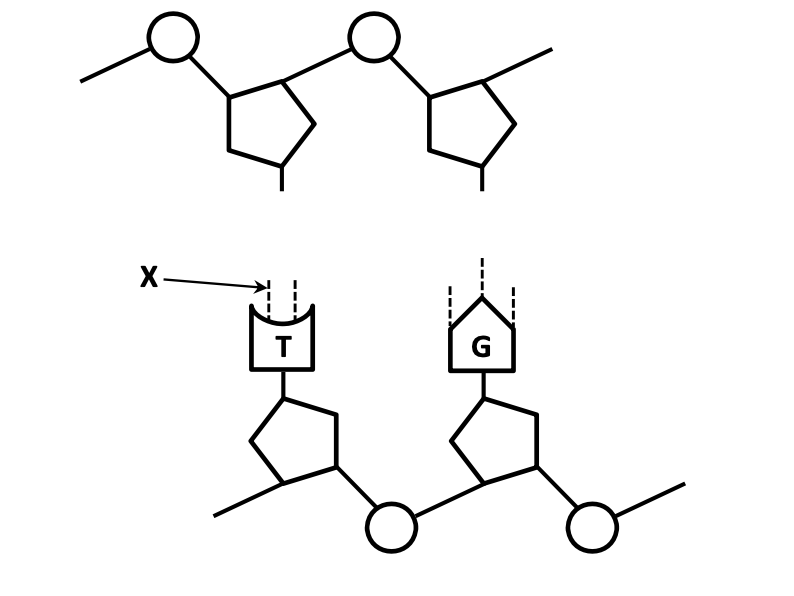
Correct arrow to a slightly movable joint 24. DNA is a complex biological molecule. The diagram shows part of a DNA molecule.
(a) Complete the diagram of the DNA molecule by drawing ON THE DIAGRAM ABOVE
and labelling the parts you draw.
(b) ON THE DIAGRAM ABOVE, draw a rectangle around any ONE DNA nucleotide.
(c) What does DNA stand for?
(d) What type of bonding is represented by the letter X on the diagram?
(e) T is a pyrimidine base. What type of base is G?
(f) Name ONE organelle in eukaryotic cells, OTHER than the nucleus, which
contains DNA.
(g) Name the base present in RNA that is NOT present in DNA.
▸ Reveal marking-scheme answer
Question 4                                                       2(5) + 5(2)            20

(a) Complete and label the diagram of the DNA molecule.
    A and C correctly drawn AND labelled                                                 5
(b) Draw a rectangle around any one DNA nucleotide.
    Rectangle correctly indicating one DNA nucleotide showing one phosphate, one
    deoxyribose AND one base                                                             5
(c) What does DNA stand for?
    Deoxyribonucleic acid                                                                2
(d) What type of bonding is represented by the letter X?
    Hydrogen or H (bonding)                                                              2
(e) T is a pyrimidine base. What type of base is G?
    Purine                                                                               2
(f) One organelle in eukaryotic cells, other than the nucleus, which contains DNA.
    Mitochondrion or chloroplast                                                         2
(g) Base present in RNA that is not present in DNA.
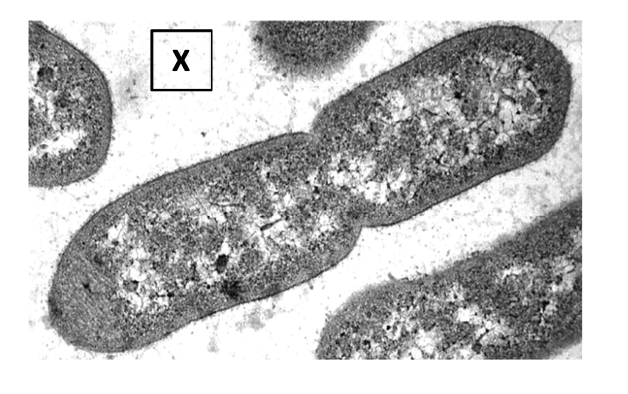
Uracil or U 25. The picture shows a transmission electron microscope image of a bacterial cell.
(a) There are three types of bacterial shapes. Which type represents the
bacterial cell in the picture?
(b) ON THE PICTURE, draw an arrow from the letter X to the location of the
bacterial cell wall.
(c) The bacterium in the picture is reproducing asexually. What term describes
how bacteria reproduce asexually?
(d) Give any ONE factor that affects the growth of bacteria.
(e) Name any ONE harmful bacterium.
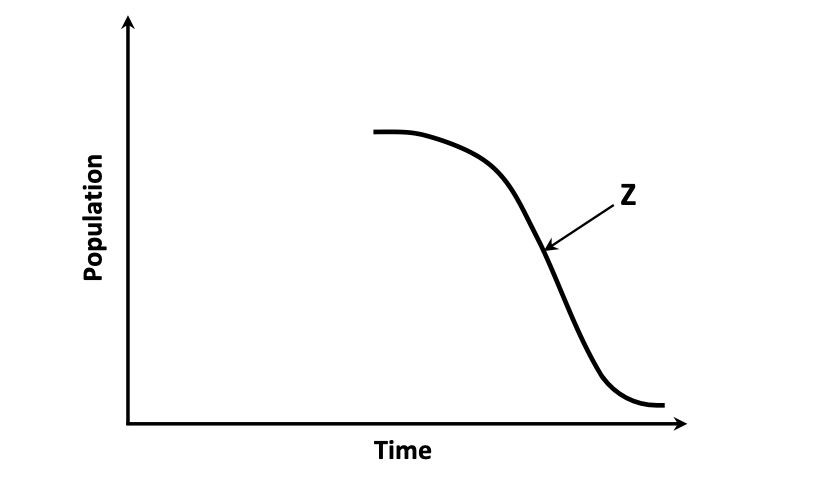
(f) The partially drawn graph below represents the microorganism growth curve.
(i) By drawing ON THE GRAPH, complete the first part of the curve.
(ii) Name the stage indicated by the letter Z.
▸ Reveal marking-scheme answer
Question 5                                                       2(5) + 5(2)            20

(a) Bacterial shape in the picture.
    Rod                                                                                  5
(b) Arrow from X to bacterial cell wall.
    Arrow drawn correctly to cell wall                                                   5
(c) Term for how bacteria reproduce asexually.
    Binary fission                                                                       2
(d) One factor that affects the growth of bacteria.
    Temperature or pH or oxygen or food or any correctly named factor                    2
(e) One harmful bacterium.
    Any named harmful bacterium                                                          2
(f) (i)  Complete first part of the growth curve.
         Curve showing both lag AND log phases                                           2
    (ii) Stage indicated by letter Z.
Decline or death 26. Give a brief biological explanation for EACH of the following:
(a) Food chains are limited in length.
(b) There is always competition between members of a species.
(c) Fruit formation by plants.
(d) Urine volume will be low if a person does not regularly drink fluids.
(e) Doctors do not prescribe antibiotics for viral infections.
(f) Meiosis halves the number of chromosomes in cells.
(g) The septum separates the two sides of the human heart.
▸ Reveal marking-scheme answer
Question 6                                                       2(5) + 5(2)            20

(a) Food chains are limited in length.
    Low amount of energy passed on (at each trophic level) or large amount of
    energy lost (at each trophic level)                                                  5
(b) There is always competition between members of a species.
    Resources are limited or need the same resources or overbreeding or high
    reproduction rates                                                                   5
(c) Fruit formation by plants.
    To protect seeds or to aid seed dispersal                                            2
(d) Urine volume will be low if a person does not regularly drink fluids.
    More water is reabsorbed or ADH increases permeability of collecting duct
    (or distal convoluted tubule)                                                        2
(e) Doctors do not prescribe antibiotics for viral infections.
    (Antibiotics) do not affect viruses or (antibiotics) only kill bacteria (or fungi)   2
(f) Meiosis halves the number of chromosomes in cells.
    To produce gametes (for sexual reproduction) or to allow for the diploid number
    following fertilisation or to restore chromosome number                              2
(g) The septum separates the two sides of the human heart.
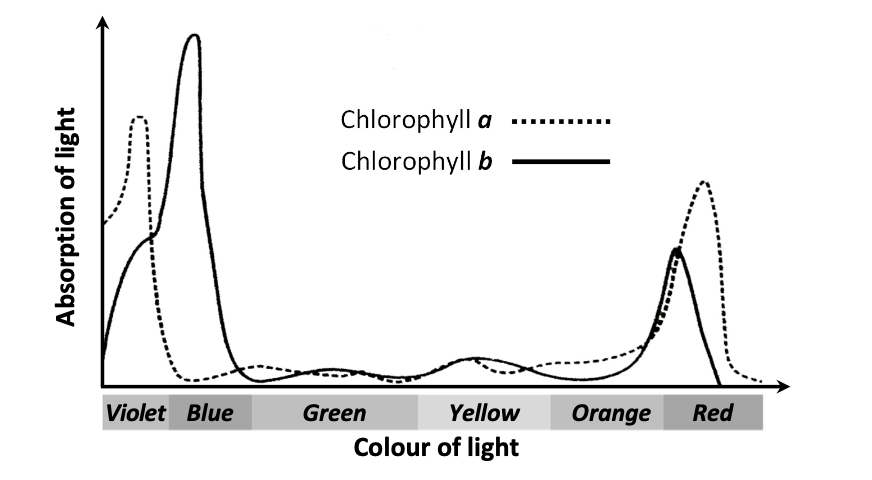
To prevent oxygenated AND deoxygenated blood from mixing 27. The graph shows how the absorption of light varies with the colour of light
being shone on chlorophyll a and b.
(a) (i) Which colour of light is absorbed MOST by chlorophyll a?
(ii) Which colour of light is absorbed MOST by chlorophyll b?
(iii) What happens to green and yellow light when they strike chlorophyll?
(b) The function of chlorophyll is to absorb sunlight energy and transfer this
energy to electrons which then leave chlorophyll. From your knowledge of
photosynthesis, give TWO possible fates of these energised electrons.
(c) Name another molecule which can provide electrons during photosynthesis.
(d) Identify a source of the molecule you named in part (c) above for
photosynthesis in the plant.
(e) Suggest ONE reason why horticulturists might use carbon dioxide enrichment
in a greenhouse.
▸ Reveal marking-scheme answer
Question 7                                                                                20

(a) (i)   Colour absorbed most by chlorophyll a.
          Violet                                                                          2
    (ii)  Colour absorbed most by chlorophyll b.
          Blue                                                                            2
    (iii) What happens to green and yellow light when they strike chlorophyll?
          It is reflected or not absorbed                                                 2
(b) Two possible fates of these energised electrons.
    Returns to chlorophyll or enters a cyclic pathway (or pathway 1) or pass to
    electron carriers (acceptors)                                                         4
    Transferred to NADP+ (accept NADP) or to make NADP- (or NADPH) or enters
    a non-cyclic pathway (or pathway 2) or added to CO2 to make carbohydrate (glucose)   4
(c) Name another molecule which can provide electrons during photosynthesis.
    Water                                                                                 2
(d) Source of the molecule named in part (c) for photosynthesis in the plant.
    Soil (or other correct)                                                               2
(e) One reason why horticulturists might use CO2 enrichment in a greenhouse.
    Improve (crop) yield or increased photosynthesis                                      2
Section C — answer any 4 (60 marks each, 90 minutes)
11.   (a)    Explain each of the following terms as used in ecology:
             (i)   Ecosystem
             (ii)  Habitat
             (iii) Niche                                                                   (9)
      (b)    Read the passage and answer the questions that follow.
             Ash dieback is a serious disease of ash trees caused by the invasive
             pathogen Hymenoscyphus fraxineus, which originates in Asia and was brought
             to Europe in the early 1990s. Ash dieback was first detected in the
             Republic of Ireland in October 2012. The disease is now prevalent throughout
             Ireland and is likely to cause the death of the majority of ash trees over
             the next two decades. This will also have an effect on organisms that feed
             on ash (such as moths) and other animals along the food chain (such as
             birds, e.g. the robin). Teagasc, the Irish agriculture development
             authority, is aiming to establish a gene bank composed of genotypes of ash
             trees that are tolerant or resistant to the deadly pathogen with the future
             aim of producing planting stocks for forests and hedgerows in Ireland.
                                            Adapted from Ash Dieback Disease, www.teagasc.ie

             (i)   Name the type of ecological relationship that exists between ash trees
                   and the pathogen that causes ash dieback.
             (ii)  From the passage, or otherwise, state a way that ecologists could
                   ensure the survival of ash trees in Ireland.
             (iii) Write down a food chain (with at least three trophic levels) based on
                   the information given in the passage above.
             (iv)  Sketch a pyramid of numbers based on the food chain you gave in part
                   (b)(iii) above.
             (v)   Suggest TWO possible effects on the ecosystem if all ash trees in
                   Ireland died.
             (vi)  1.  Name the type of ecological relationship that exists between the
                       robin and the moth.
                   2.  Explain the importance of this type of ecological relationship
                       in nature.                                                         (27)
      (c)    Describe the main events of EACH of the following:
             (i)   The nitrogen cycle
             (ii)  The carbon cycle.                                                      (24)
▸ Reveal marking-scheme answer
Question 11                                                                              60
 (a) (i)     Ecosystem
             Organisms and their environment                                              3
       (ii)  Habitat
             Place where an organism lives                                                3
       (iii) Niche
             Role of an organism                                                          3
 (b) (i)     Type of relationship between ash and pathogen.
             Parasitism                                                                   3
       (ii)  Way to ensure survival of ash trees.
             Establish a gene bank of resistant (or tolerant) trees or thinning or
             diversifying species                                                         3
       (iii) Food chain based on the passage.
             Ash → Moth → Robin                                                           3
       (iv) Pyramid of numbers.
             Correct order with Ash on the bottom                                         3
             Partially upright pyramid drawn                                              3
       (v) Two possible effects if all ash died.
             Moth (or other consumers of ash) population falls / robin (or other
             consumer of moths) population falls / other plant populations increase /
             soil erosion / any correct environmental effect                  Any two 2(3)
       (vi) 1. Relationship between robin and moth.
                Predation or predator-prey                                                3
             2. Importance in nature.
                Population control or described                                           3

 (c) (i)     Main events of the nitrogen cycle.
             Nitrogen (gas) to usable compounds / plant protein to animal protein /
             waste releasing N compounds / decomposition releases N compounds /
             ammonium to nitrite / nitrite to nitrate / nitrates to plant protein /
             nitrogen compounds to nitrogen gas / any one named process    Any four 4(3)
       (ii) Main events of the carbon cycle.
             Carbon dioxide is fixed into plant carbohydrate (or sugars) / plant
             carbohydrate to animal carbohydrate / living organisms releases carbon
             dioxide / decay of organisms releases carbon dioxide / combustion of
fossil fuels releases carbon dioxide / any one named process Any four 4(3)12. (a) (i) Explain the term metabolism.
(ii) Is the reaction shown below an anabolic reaction or a catabolic
reaction? Explain your answer.
A → B + C + Energy (9)
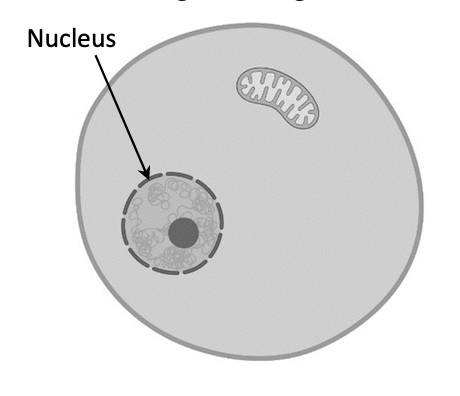
      (b)    Aerobic respiration is a metabolic reaction that occurs in two stages
             in living cells.
             (i)   Copy the diagram of the cell INTO YOUR ANSWERBOOK and indicate
                   clearly the specific locations of stage 1 AND stage 2.
             (ii)  What is the name given to stage 1?
             (iii) Stage 1 ends with the formation of a three-carbon compound.
                   Name this compound.
             (iv)  This three-carbon compound is converted into acetyl coenzyme A,
                   which passes into a series of reactions called Krebs cycle where
                   electrons are removed.
                   Describe in detail what happens to these electrons after they are
                   removed.
             (v)   ATP is produced during respiration. Copy the following word equation
                   INTO YOUR ANSWERBOOK and complete the missing parts of the equation.

                                ADP  +  ____  +  Energy  →  ATP  +  ____                  (27)
      (c)    Enzymes are important in all metabolic reactions.
             (i)   What is an enzyme?
             (ii)  Describe in detail the active site theory of enzyme action.
             (iii) Describe what happens to an enzyme if it is overheated.
             (iv)  Give ONE example of a catabolic enzyme AND ONE example of an
                   anabolic enzyme.                                                       (24)
▸ Reveal marking-scheme answer
Question 12                                                                              60
 (a) (i)     Explain the term metabolism.
             (All) chemical reactions in an organism (or in a cell)                       3
       (ii) Anabolic or catabolic? Explain.
             Catabolic                                                                    3
             Large molecule broken down into smaller molecules or energy released         3

 (b) (i)     Locations of stage 1 and stage 2 on the cell diagram.
             Stage 1 → cytosol (outside the mitochondrion)                                3
             Stage 2 → mitochondrion                                                      3
       (ii) Name given to stage 1.
             Glycolysis                                                                   3
       (iii) Name of three-carbon compound at the end of stage 1.
             Pyruvate or pyruvic acid                                                     3
       (iv) Fate of electrons after they are removed in Krebs cycle.
             Pass to NAD+ / to make NADH / pass to electron transport chain / lose
             energy / pass to oxygen / and to protons (H+ or hydrogen ions) / to
             make water                                                       Any three 3(3)
       (v) Complete equation:  ADP + P + Energy → ATP + H2O                          2(3)

 (c) (i)     What is an enzyme?
             Protein (or biological) catalyst                                             3
       (ii) Active site theory of enzyme action.
             Complementary shape to substrate / active site changes shape or induced
             fit / to accommodate substrate / enzyme substrate complex is formed /
             product formed / enzyme unchanged or active site changes back to original
             shape or enzyme can be reused                                    Any four 4(3)
       (iii) What happens to an enzyme if overheated.
             Loses shape or loses function or becomes denatured                           3
       (iv) Catabolic enzyme example AND anabolic enzyme example.
             Catabolic:  Amylase or any correct example                                   3
Anabolic: Polymerase or any correct example 313. (a) (i) Which famous scientist is regarded as the father of genetics?
(ii) State the Law of Segregation. (9)
      (b)    Haemochromatosis is an inherited condition where iron levels in the body
             slowly build up. Classic hereditary haemochromatosis is caused by a GENE
             mutation whereby two RECESSIVE alleles are inherited.
             (i)   Explain EACH of the underlined terms.
             (ii)  Give ONE possible cause of gene mutations.
             (iii) Name another type of mutation AND give a condition caused by this
                   type of mutation.
             (iv)  The letter H represents the dominant allele and the letter h represents
                   the recessive haemochromatosis allele.
                   Using a Punnett square, or a genetic cross, explain how it is possible
                   for two parents, BOTH without haemochromatosis, to have a child who
                   suffers from the condition.
             (v)   If the parents have a child without haemochromatosis, how might they
                   check to see if their child was a carrier?                              (27)
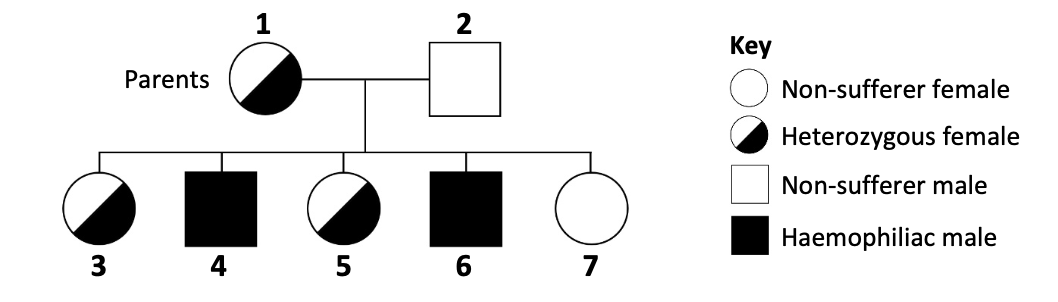
      (c)    Haemophilia is caused by a recessive allele (gene mutation) that inhibits
             the blood's ability to clot. This allele is only found on the X chromosome.
             The pedigree chart shows an example of the inheritance of this condition
             between parents and children.
             (i)   What term is used to describe an allele present on the X chromosome?
             (ii)  The letter N represents the dominant allele and the letter n represents
                   the recessive haemophilia allele.
                   Draw TWO fully labelled chromosome diagrams (one for each parent)
                   showing the positions of EACH allele. Indicate clearly which is female
                   and which is male.
             (iii) The pedigree chart shows that two of their male children (persons 4 and
                   6) suffer from haemophilia. Show, using a Punnett square or otherwise,
                   how it is possible for the parents to have a male child who does NOT
                   suffer from haemophilia.
             (iv)  Explain clearly why it would be almost impossible for person 7 to be
                   the parent of a child with haemophilia.                                (24)
▸ Reveal marking-scheme answer
Question 13                                                                              60
 (a) (i)     Father of genetics.
             (Gregor) Mendel                                                              3
       (ii) State the Law of Segregation.
             Each trait is controlled by a pair of factors / these factors separate
             during the formation of gametes / each gamete contains only one factor
             for each trait                                                  Any two 2(3)

 (b) (i)     Explain underlined terms.
             Gene:       Piece of DNA (or chromosome) that codes for a protein or unit
                         of inheritance                                                   3
             Recessive:  Allele masked by the dominant allele or explained               3
       (ii) One possible cause of gene mutations.
             Chemicals or radiation or named example                                      3
       (iii) Another type of mutation AND condition caused.
             Name:       Chromosome                                                       3
             Condition:  Down's syndrome (or other correctly named condition)             3
       (iv) Punnett square / cross — Hh × Hh.
             Parents:                Hh × Hh                                              3
             Allele passed on (from both parents in gametes):    h                        3
             Offspring:              hh AND sufferer indicated                            3
       (v) How parents check if child without haemochromatosis is a carrier.
             Genetic screening or described                                               3

 (c) (i)     Term for an allele present on the X chromosome.
             Sex linked or X-linked                                                       3
       (ii) Two fully labelled chromosome diagrams of parents.
             Chromosome diagrams showing XX and XY                                        3
             Correct alleles and loci for each parent                                     3
             Male and/or female correctly indicated                                       3
       (iii) Show how parents can have a son who does NOT suffer.
             Gametes from Parent 1:  XN                                                   3
             Gametes from Parent 2:  Y                                                    3
             Genotype of son:        XYN — genotype indicated as a non-sufferer           3
       (iv) Why person 7 almost impossible to parent a haemophiliac child.
Person 7 does not have the recessive allele or described 314. (a) Meristematic tissue is an important tissue in plants.
(i) What is the meristem?
(ii) Give TWO locations in plants where meristematic tissue may be found. (9)
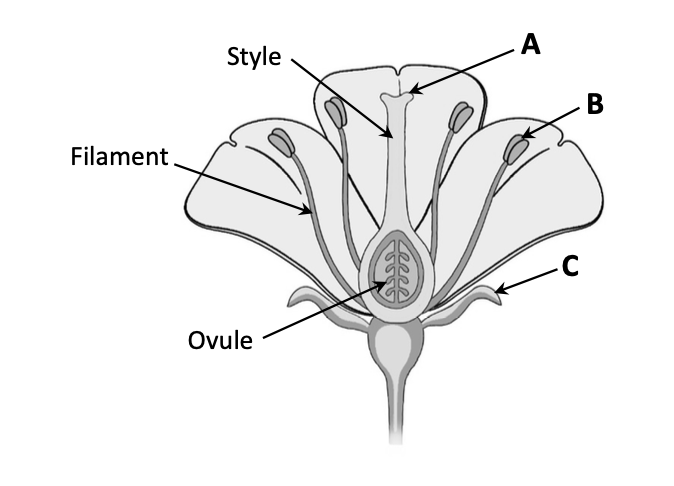
      (b)    The diagram shows a typical animal-pollinated flower.
             (i)   Name the structures A, B and C.
             (ii)  Give ONE function for EACH structure A and B.
             (iii) Describe ONE way in which a wind-pollinated flower would differ from
                   the animal-pollinated flower.
             (iv)  Embryo sac development occurs in the ovule.
                   Describe embryo sac development in detail.
             (v)   What does the ovule develop into if fertilisation occurs?              (27)
      (c)    Many plants can undergo vegetative propagation or horticulturists may
             carry out artificial propagation.
             (i)   What is meant by the term vegetative propagation?
             (ii)  Name any TWO methods of vegetative propagation used by plants AND for
                   EACH named method, give ONE example of a plant that carries out that
                   method of vegetative propagation.
             (iii) Name any THREE methods horticulturists may use to artificially
                   propagate plants.                                                      (24)
▸ Reveal marking-scheme answer
Question 14                                                                              60
 (a) (i)     What is the meristem?
             Region where mitosis can occur or region of (rapid) cell production or
             region of (active) cell division                                              3
       (ii) Two locations in plants where meristematic tissue may be found.
             Shoot tip / root tip / bud / seed / vascular bundles            Any two 2(3)

 (b) (i)     Name structures A, B and C.
             A: Stigma                                                                     1
             B: Anther                                                                     1
             C: Sepal                                                                      1
       (ii) One function for each structure A and B.
             A: Trap pollen or described                                                   3
             B: Produce (or release) pollen                                                3
       (iii) One way wind-pollinated flower differs from animal-pollinated.
             Anthers (or stigmas) outside of flower or petals green or not colourful or
             absent or no scent or no nectar                                              3
       (iv) Embryo sac development.
             Diploid / megaspore mother cell / divides by meiosis / to produce four
             haploid cells (or tetrad) / three degenerate / divides by mitosis 3 times /
             embryo sac containing 8 nuclei (cells) / one becomes egg (cell) / two
             polar nuclei (formed)                                            Any four 4(3)
       (v) What does the ovule develop into if fertilisation occurs?
             Seed                                                                         3

 (c) (i)     What is meant by vegetative propagation?
             Asexual reproduction (in plants) or growing a new plant using
             non-reproductive parts (or named part)                                        3
       (ii) Two methods of vegetative propagation + an example for each.
             Methods:    Stem / root / leaf / bud                            Any two 2(3)
             Examples:   Stem: e.g. strawberry / Root: e.g. dahlia / Leaf: e.g.
                         kalanchoe / Bud: e.g. onion (or other correct)
                         (Two examples, must match methods)                       2(3)
       (iii) Three methods horticulturists may use to artificially propagate plants.
             Cutting / layering / grafting / micro propagation (tissue culture)
Any three 3(3)15. (a) (i) What is meant by the term secondary sexual characteristics?
(ii) Give TWO examples of secondary sexual characteristics present
in males. (9)
      (b)    (i)   Draw a large diagram of the human male reproductive system, labelling
                   the following parts:
                   testis · sperm duct · prostate gland · epididymis · penis · scrotum
             (ii)  Give ONE function for EACH of the following parts:
                   1.  Prostate gland
                   2.  Epididymis
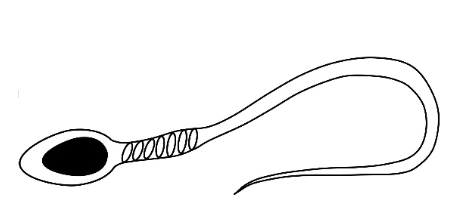
             (iii) The diagram shows a human sperm cell.
                   1.  How many chromosomes are found in the nucleus of a typical human
                       sperm cell?
                   2.  Copy out the diagram of the human sperm cell INTO YOUR ANSWERBOOK
                       and indicate on it the location of the mitochondria.
                   3.  In relation to the structure of the sperm cell, or otherwise,
                       suggest ONE possible cause of male infertility.                    (27)
                   (Note: paper labels this section "16(i-iii)" — it is part of Q15(b).)
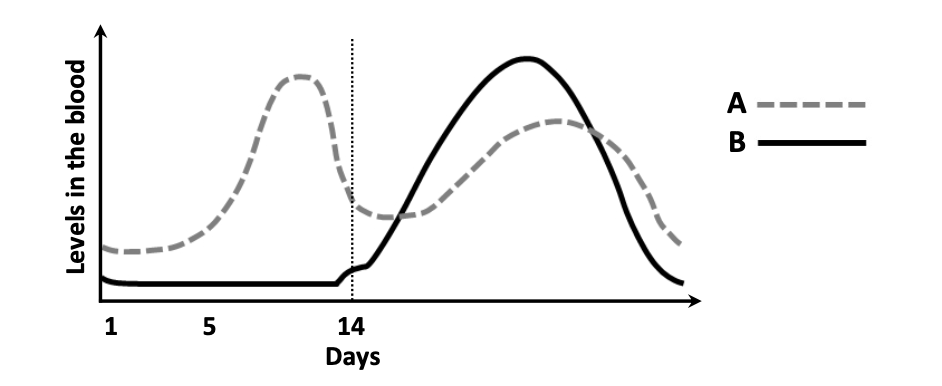
      (c)    The graphs show the levels of female reproductive hormones (A and B) in
             the blood at various stages during one typical menstrual cycle. These
             hormones are released by the female reproductive system.
             (i)   How long is the typical menstrual cycle in a human female?
             (ii)  Name EACH of the hormones A and B.
             (iii) There are low levels of hormone A and hormone B during the first
                   few days of the menstrual cycle. Describe ONE effect on the female
                   reproductive system of the low levels of hormones A and B.
             (iv)  Explain why hormone A levels increase after approximately day 5.
             (v)   What event occurs around day 14 of the menstrual cycle?
             (vi)  The event you named in part (c)(v) above is caused by a surge in a
                   hormone released from the pituitary. Name this hormone.
             (vii) Explain why hormone B levels increase in the days after day 14.       (24)
             (Note: paper labels this section "16(c)" — it is part of Q15(c).)
▸ Reveal marking-scheme answer
Question 15                                                                              60
 (a) (i)     What is meant by secondary sexual characteristics?
             Features that distinguish male from female other than sex organs or
             features that emerge at puberty                                              3
       (ii) Two examples of secondary sexual characteristics in males.
             Deep voice / enlarged muscles / wide shoulders / body hair (or named) /
             enlargement of penis                                            Any two 2(3)

 (b) (i)     Diagram of male reproductive system.
             Diagram:  Penis, testis, urethra AND sperm duct       (Any one missing 3)  3+3
             Labels:   Testis / sperm duct / prostate gland / epididymis / penis /
                       scrotum                                              Any six   6(1)
       (ii) Function of:
             Prostate gland: To produce seminal fluid or described                        3
             Epididymis:     To store sperm or to allow sperm mature or to transport
                             sperm from testes to sperm duct                              3
       (iii) 1. Number of chromosomes in nucleus of human sperm cell.
                23                                                                        3
             2. Indicate location of mitochondria on sperm diagram.
                Mitochondria located in midpiece                                          3
             3. One possible cause of male infertility.
                Low sperm count or low sperm mobility or low testosterone levels or
                blockage                                                                  3

 (c) (i)     Length of typical menstrual cycle.
             28 – 31 days                              (Accept one month)                3
       (ii) Name hormones A and B.
             A: Oestrogen                                                                 3
             B: Progesterone                                                              3
       (iii) Effect on female reproductive system of low A and B at start of cycle.
             Menstruation or FSH produced or new follicle starts developing               3
       (iv) Why hormone A levels increase after approximately day 5.
             Follicle secretes (more) oestrogen or FSH stimulates production of oestrogen 3
       (v) Event around day 14.
             Ovulation or release of egg (from the ovary)                                 3
       (vi) Pituitary hormone causing the surge.
             LH (or luteinising hormone)                                                  3
       (vii) Why hormone B levels increase in days after day 14.
             Corpus luteum secretes progesterone or LH stimulates production of
             progesterone                                                                 3
T1 exam tip: Pick 2 of 4 sub-parts in each. Q16: do (a) osmosis + (b) genetic engineering. Skip (c) viruses, (d) mushrooms. Q17: do (a) endocrine + (c) circulatory/breathing. Skip (b) synapse, (d) plant tissues.
16.   Answer any two of (a), (b), (c), (d).                                              (30, 30)

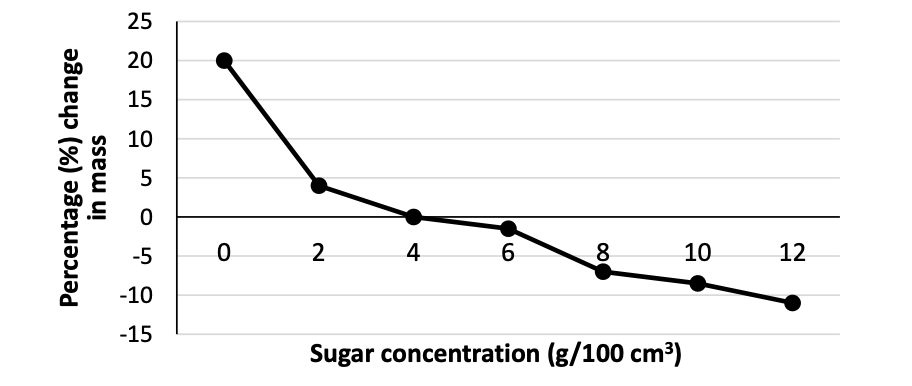
      (a)    The graph shows the changes in mass of plant tissue when placed in
             solutions of different sugar concentrations.
             (i)   Name the substance that causes the change in mass of the plant tissue.
             (ii)  What term is given to the movement in and out of the plant tissue of
                   the substance you named in part (a)(i) above?
             (iii) At what sugar concentration is there NO change in the mass of the
                   plant tissue?
             (iv)  Explain in detail why there is no change in mass at the sugar
                   concentration you have given in part (a)(iii) above.
             (v)   1.  What term is used to describe the condition of the plant cells
                       that have been soaked in the 0 g/100 cm³ sugar solution?
                   2.  Explain how plant cells maintain the condition you named in
                       part (a)(v)1. above.
             (vi)  Explain in detail why the mass of the plant cells reduces in the
                   12 g/100 cm³ sugar solution.
             (vii) What do you think would happen to an animal cell in the 0 g/100 cm³
                   sugar solution?
      (b)    Genetic engineering is an important biological technique.
             (i)   What is meant by the term genetic engineering?
             (ii)  Describe the process of genetic engineering up to the point of
                   expression of the gene of interest.
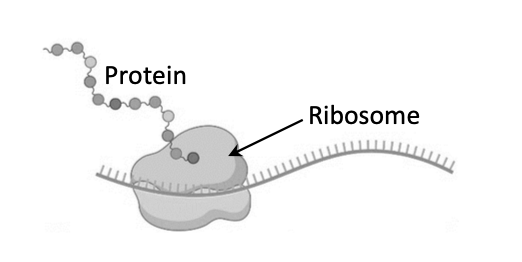
             (iii) The final part of genetic engineering, gene expression, involves the
                   formation of a protein. Protein synthesis occurs on ribosomes, as
                   shown in the diagram. Ribosomes are composed of rRNA subunits.
                   Name the OTHER TWO types of RNA involved in protein synthesis.
             (iv)  State ONE application of genetic engineering for EACH of the following:
                   1.  Animals
                   2.  Microorganisms
                   3.  Plants.
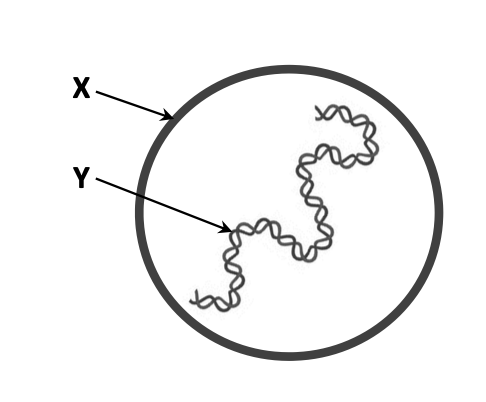
      (c)    Viruses are found in all habitats in nature.
             (i)   The diagram shows a typical spherical-shaped virus. Name the
                   structures X and Y.
             (ii)  Explain the difficulty in describing viruses as living.
             (iii) Name TWO harmful viruses.
             (iv)  Give ONE way in which viruses can be beneficial to humans.

             The human body can defend itself against viruses using two defence systems:
             the general defence system and the specific defence system.
             (v)   Give TWO ways in which the general defence system works to defend
                   against viruses AND TWO ways in which the specific defence system
                   defends against viruses.
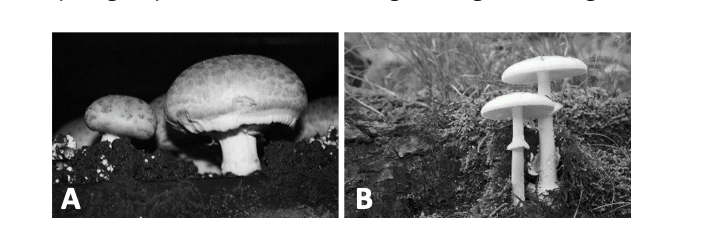
      (d)    The photographs show some edible mushrooms (image A) and some poisonous
             mushrooms (image B). Mushrooms belong to kingdom Fungi.
             (i)   Suggest ONE way in which you could distinguish between edible and
                   poisonous mushrooms.
             (ii)  Name any ONE example of an edible mushroom.
             (iii) Name any ONE example of a poisonous mushroom.

             Another member of kingdom Fungi is Rhizopus (or common bread mould).
             (iv)  Draw a diagram showing the basic structure of Rhizopus, labelling
                   the following parts: stolon, rhizoid, sporangium.
             (v)   Give ONE function for EACH of the following parts:
                   1.  Stolon  2.  Rhizoid  3.  Sporangium
             (vi)  Name the mode of nutrition used by Rhizopus.
17.   Answer any two of (a), (b), (c), (d).                                              (30, 30)

      (a)    (i)   Give ONE difference between endocrine and exocrine glands.
             (ii)  Name a gland that has BOTH an endocrine function AND an exocrine
                   function. Name its endocrine product AND its exocrine product.
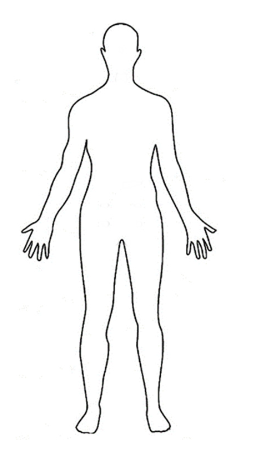
             (iii) Copy the outline of the human body INTO YOUR ANSWERBOOK.
                   Draw in EACH of the following endocrine glands labelling them in
                   their correct locations:
                   1.  Pituitary gland   2.  Thyroid gland   3.  Adrenal glands
             (iv)  For EACH of the following endocrine glands, name a hormone it
                   secretes AND give its corresponding function:
                                thyroid;       adrenals
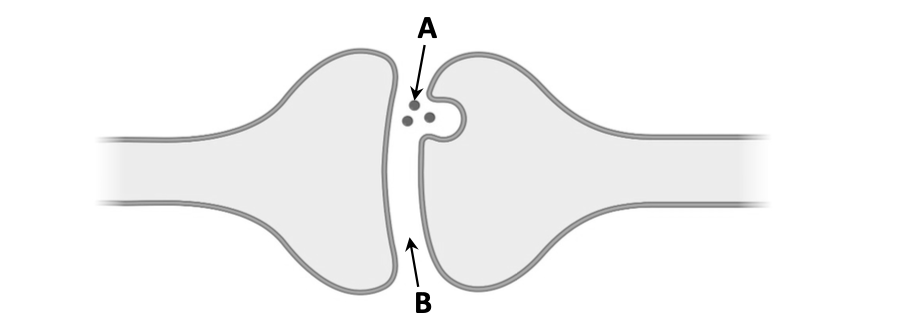
      (b)    The diagram shows two separate neurons in close contact. Chemical A is
             produced by one of the neurons to allow the transfer of nerve impulses.
             (i)   What term describes the region where two neurons come into close
                   contact?
             (ii)  What is the name given to the gap between two neurons, indicated by
                   the letter B?
             (iii) What is the general name given to the chemical A in the diagram?
             (iv)  Where in a neuron is chemical A made?
             (v)   Describe in detail how nerve impulses travel between two neurons in
                   close contact.
             (vi)  Interneurons are one type of neuron found within the central nervous
                   system. Give the names of the OTHER TWO types of neuron found in
                   the human nervous system.
             (vii) Describe ONE possible treatment for EITHER of the following nervous
                   system disorders: paralysis OR Parkinson's disease.
      (c)    Answer the following in relation to the human circulatory and breathing
             systems.
             (i)   In each of the following, name the vein that best matches:
                   1.  Carries blood richest in oxygen.
                   2.  Carries blood between the intestine and the liver.
                   3.  Carries blood lowest in metabolic wastes.
                   4.  Carries blood into the right atrium of the heart.
             (ii)  IN YOUR ANSWERBOOK, sketch the structure of an alveolus and its
                   associated blood supply.
                   ON YOUR DIAGRAM, clearly indicate the overall directions in which
                   oxygen AND carbon dioxide are moving.
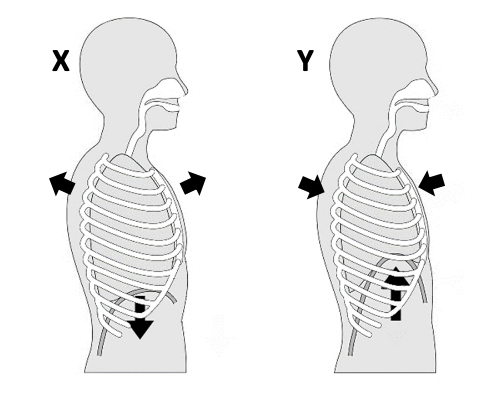
             (iii) The diagrams (X and Y) show the two stages of breathing with the
                   arrows representing the body movements involved in breathing.
                   1.  State which diagram (X or Y) represents inhalation.
                   2.  Explain in detail how you know inhalation is occurring in this
                       diagram.
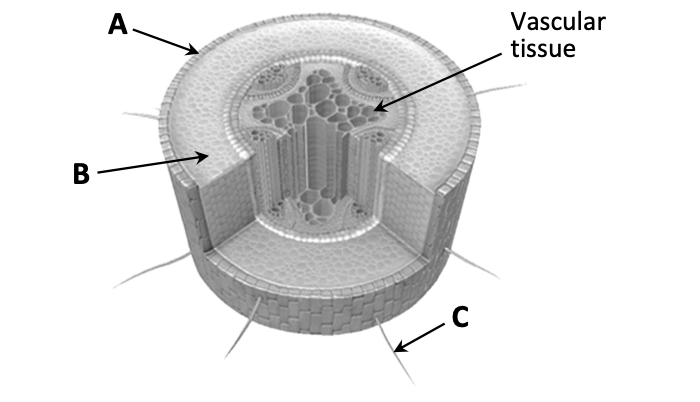
      (d)    The diagram shows part of a plant organ composed of various tissues.
             (i)   Identify the plant organ.
             (ii)  Name tissues A and B and the structure labelled C.
             (iii) Give ONE function for EACH part A, B and C.
             (iv)  Give ONE function of vascular tissue in plants.
             (v)   Name the TWO types of vascular tissue present in plants.
             (vi)  Draw AND label a longitudinal section (L.S.) of EITHER type of
                   vascular tissue you named in part (d)(v) above.
▸ Reveal marking-scheme answer
Question 16                            Any two of (a), (b), (c), (d)                    30, 30

  Question 16 (a)                                                                            30
  (i)   Substance that causes change in mass of plant tissue.            Water              3
  (ii)  Term for movement in and out of the tissue.                      Osmosis            3
  (iii) Sugar concentration where no change in mass.                     4 g/100 cm³        3
  (iv)  Why there is no change in mass at that concentration.
        Movement of water into the cells equals movement of water out of the cells          3
        Due to the sugar concentration inside the cells (cytoplasm) being the same as
        the sugar concentration outside the cells                                           3
  (v)   1. Term for cells soaked in 0 g/100 cm³ solution.                Turgid             3
        2. How plant cells maintain that condition.
           (Presence of) the cell wall or (presence of) the vacuole or by taking in as
           much water as they lose                                                           3
  (vi)  Why the mass of plant cells reduces in 12 g/100 cm³ solution.
        Water has moved out of the cells (by osmosis)                                       3
        From a region of high water concentration (inside the cell) to a region of low
        water concentration (outside the cell) or due to high sugar concentration outside  3
  (vii) What would happen to an animal cell in 0 g/100 cm³ solution.
        Increase in size or swell or burst                                                  3

  Question 16 (b)                                                                             30
  (i)   What is meant by genetic engineering?
        (Artificial) manipulation of a gene (or DNA) or alteration of a gene (or DNA)       3
  (ii)  Process of genetic engineering up to expression.
        Isolation of DNA (from cells) / cutting of gene (from chromosome) / using
        restriction enzymes / ligation of gene with vector or host DNA / introduction of
        base sequence changes to host cell or transformation of host cell occurs or
        recombinant DNA enters host cell / transformed cells grown (in nutrient medium)
                                                                              Any four 4(3)
  (iii) Two other types of RNA involved in protein synthesis.
        Messenger RNA (mRNA)                                                                3
        Transfer RNA (tRNA)                                                                 3
  (iv)  One application of genetic engineering for each:
        Animals:        Any correct application                                             3
        Microorganisms: Any correct application                                             3
        Plants:         Any correct application                                             3

  Question 16 (c)                                                                            30
  (i)   Name structures X and Y.
        X: Protein (coat) or capsid                                                         3
        Y: Nucleic acid or DNA or RNA                                                       3
  (ii)  Difficulty in describing viruses as living.
        Non-cellular or no metabolism                                                       3
  (iii) Two harmful viruses.
        Common cold virus or coronavirus or HIV or hepatitis virus                     2(3)
  (iv)  One way viruses can be beneficial to humans.
        Can be used (as a vector) in genetic engineering or to treat bacterial infection
        or vaccine production                                                               3
  (v)   General defence (any two) AND specific defence (any two) against viruses.
        General:  Skin acts as a barrier / mucus traps pathogens / phagocytes engulf /
                  infected cells release chemicals / white blood cells release chemicals
                  / stomach acid kills pathogens / tears keep eyes free of pathogens /
                  blood clotting / fever                                       Any two 2(3)
        Specific: (B cells) produce antibodies / memory cells recognise virus / T cells
                  coordinate the immune response / killer T cells kill infected cells /
                  regulatory (or suppressor) T cells control the response     Any two 2(3)

  Question 16 (d)                                                                            30
  (i)   One way to distinguish between edible and poisonous mushrooms.
        Using a key or other correct method                                                 3
  (ii)  One example of an edible mushroom.
        Field or Chestnut or other correct                                                  3
  (iii) One example of a poisonous mushroom.
        Death cap or destroying angel or other correct                                      3
  (iv)  Diagram of Rhizopus.
        Diagram:  stolon AND rhizoid AND sporangiophore AND sporangium
                  (Any one missing only 3 marks)                                       3+3
        Labels:   stolon / rhizoid / sporangium                            Any three 3(1)
  (v)   One function for each:
        Stolon:      spread (out) or growth or reproduction or colonisation                 3
        Rhizoid:     anchorage or secretion or absorption (of nutrients)                    3
        Sporangium:  asexual reproduction or to produce (release) spores                    3
  (vi)  Mode of nutrition used by Rhizopus.
        Saprophytic or heterotrophic or decomposition                                       3


  Question 17                            Any two of (a), (b), (c), (d)                    30, 30

  Question 17 (a)                                                                            30
  (i)   One difference between endocrine and exocrine glands.
        Endocrine glands do not have ducts AND exocrine glands do have ducts
        or Endocrine glands secrete products into the blood AND exocrine secrete into ducts 3
  (ii)  A gland with both an endocrine and an exocrine function.
        Name:              Any correct gland (e.g. pancreas or testes or kidney)            3
        Endocrine product: Correct matching product                                         3
        Exocrine product:  Correct matching product                                         3
  (iii) Draw and label endocrine glands on body outline.
        Pituitary, Thyroid, Adrenals — correctly located                              3(2)
  (iv)  For each gland, name a hormone AND its function:
        Thyroid:  Hormone:  thyroxine                                                       3
                  Function: (stimulates) metabolism                                         3
        Adrenals: Hormone:  adrenaline                                                      3
                  Function: 'fight or flight' (response)                                    3

  Question 17 (b)                                                                            30
  (i)   Region where two neurons come into close contact.       Synapse                    3
  (ii)  Gap between two neurons (letter B).                     (Synaptic) cleft           3
  (iii) General name of chemical A.                             Neurotransmitter           3
  (iv)  Where in a neuron is chemical A made.                   Cell body                  3
  (v)   How nerve impulses travel between two neurons in close contact.
        Impulse arrives (at axon terminal) / neurotransmitter (or named) released /
        diffuses across gap / binds to receptors / impulse starts in next neuron /
        enzymes break down neurotransmitter or recycled / mention of pre/postsynaptic
                                                                            Any three 3(3)
  (vi)  Other two types of neuron in the human nervous system.
        Sensory                                                                             3
        Motor                                                                               3
  (vii) One treatment for paralysis OR Parkinson's disease.
        Physiotherapy or surgery or other correct                                           3

  Question 17 (c)                                                                            30
  (i)   Vein matching each description:
        1. Richest in oxygen:                  Pulmonary (vein)                             3
        2. Between intestine and liver:        Hepatic portal (vein)                        3
        3. Lowest in metabolic wastes:         Renal (vein)                                 3
        4. Carries blood into right atrium:    Vena cava                                    3
  (ii)  Sketch alveolus and associated blood supply, indicate gas movements.
        Sketch:  Alveolus and capillary                                                     3
        Oxygen from alveolus to blood                                                       3
        Carbon dioxide from blood to alveolus                                               3
  (iii) 1. Which diagram (X or Y) represents inhalation.    X                              3
        2. How you know inhalation is occurring.
           Ribs are moving outwards (and upward) / volume of chest increasing /
           diaphragm is moving downwards                                       Any two 2(3)

  Question 17 (d)                                                                            30
  (i)   Identify the plant organ.                              Root                         3
  (ii)  Name tissues A and B and structure C.
        A: Dermal                                                                           1
        B: Ground                                                                           1
        C: Root Hair                                                                        1
  (iii) One function for each part A, B and C.
        A: Protection                                                                       3
        B: Storage or support                                                               3
        C: Absorption                                                                       3
  (iv)  One function of vascular tissue in plants.
        Transport or support                                                                3
  (v)   Two types of vascular tissue.
        Xylem                                                                               3
        Phloem                                                                              3
  (vi)  Draw AND label LS of either xylem or phloem.
        Drawing:  Xylem:  Continuous vessel (or tracheid) with either lignin or pits
                  or
                  Phloem: Tube with sieve plates AND companion cell                         3
        Labels:   Xylem:  pits / lignin / wall / lumen                          Any three
                  or
                  Phloem: sieve plate / sieve tube / companion cell / cytoplasm Any three  3(1)