Type your answer, click Reveal marking-scheme answer to self-mark, or Check answer with AI for an instant DeepSeek grade. Auto-saves locally.
Section A — answer any 5 of 7 (20 marks each, 30 minutes)
1.   Answer any FIVE of the following parts (a) to (f). Each part = 4 marks.
     (a)  Which THREE chemical elements are present in ALL lipids?
     (b)  How do fats and oils differ at room temperature?
     (c)  Give ONE way phospholipids differ from triglycerides.
     (d)  Give ONE metabolic role of lipids in cells.
     (e)  Give ONE structural role of lipids in cells.
     (f)  Name ONE fat-soluble vitamin.
▸ Reveal marking-scheme answer
Question 1                                  Best 5 of (a)-(f)                              20

(a) Three chemical elements in all lipids.
    Carbon, hydrogen, oxygen (or C, H, O)                                                 4
(b) How do fats and oils differ at room temperature?
    Fats are solid and oils are liquid                                                    4
(c) One way phospholipids differ from triglycerides.
    Phospholipids have phosphate and triglycerides do not   or
    Phospholipids have two fatty acids and triglycerides have three fatty acids           4
(d) One metabolic role of lipids in cells.
    Energy (storage) or hormone production or other correct                               4
(e) One structural role of lipids in cells.
    (Cell) membrane                                                                       4
(f) Name one fat-soluble vitamin.
A or D or E or K 42. Answer the following questions based on your knowledge of the scientific method.
(a) After making an observation, a biologist often develops a hypothesis.
What is a hypothesis?
(b) A biologist tests their hypothesis by designing an experiment.
State TWO principles of good experimentation.
(c) Outline the steps of the scientific method that follow the design
of an experiment.
(d) The scientific method also has limitations.
State any ONE limitation of the scientific method.
▸ Reveal marking-scheme answer
Question 2                                                                                20

(a) What is a hypothesis?
    Proposed (or possible) explanation for an observation                                 3
(b) Two principles of good experimentation.
    Safety / random selection or no bias or fair test / large sample size /
    double-blind testing / control / replicates / repeatable…              Any two    2(3)
(c) Steps of the scientific method that follow the design of an experiment.
    Carry out the procedure / gathering results (or data) / repeat /
    analyse (interpret) data / making conclusions / placement of conclusions
    in context of existing knowledge / publish in scientific journal / peer review /
    developing a theory / develop a law or principle    Any three in a valid sequence 3(3)
(d) One limitation of the scientific method.
    Extent of knowledge or basis of investigation or human error or
    experimental design or ability to interpret results or application to nature or
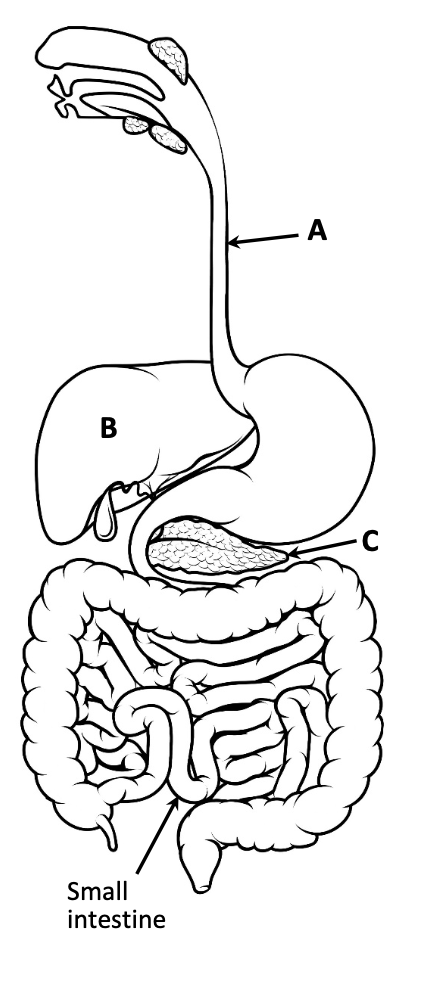
accidental discovery or bias 33. The diagram shows the human alimentary canal.
(a) Name tube A, organ B and gland C.
(b) Give ONE function of tube A.
(c) Give ONE function of organ B.
(d) Give ONE function of gland C in relation to the digestive system.
(e) State ONE structural feature of the small intestine that enables it
to carry out its function.
(f) Symbiotic bacteria are present in the alimentary canal.
Give TWO functions of these symbiotic bacteria.
▸ Reveal marking-scheme answer
Question 3                                                                                20

(a) Name tube A, organ B and gland C.
    Tube A:    Oesophagus                                                                 1
    Organ B:   Liver                                                                      1
    Gland C:   Pancreas                                                                   1
(b) One function of tube A.
    Transport food to the stomach                                                         3
(c) One function of organ B.
    Produce bile or stores vitamins or store minerals or stores glycogen or
    produces plasma proteins or detoxifies                                                3
(d) One function of gland C in relation to the digestive system.
    Produces pancreatic juice or correctly named substance or named enzyme                3
(e) One structural feature of the small intestine.
    Long or has villi or has a large network of capillaries or thin walls                 3
(f) Two functions of symbiotic bacteria in the alimentary canal.
    Vitamin (B and K) production / compete with pathogens /
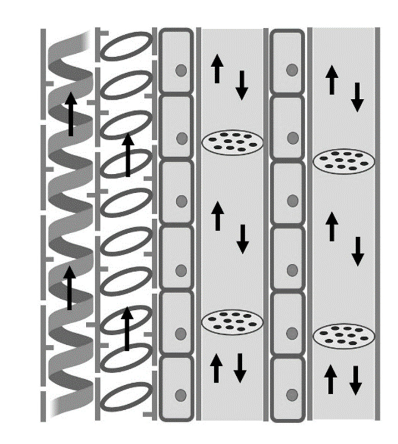
reference to digestion Any two 2(3)4. The diagram shows a longitudinal view of xylem vessels AND phloem in plants.
(a) Label any ONE structure on the diagram by writing in the box provided
AND draw an arrow from the box to the named structure.
(b) To which type of plant tissue do xylem and phloem belong?
(c) Give ONE function of xylem.
(d) Give ONE function of phloem.
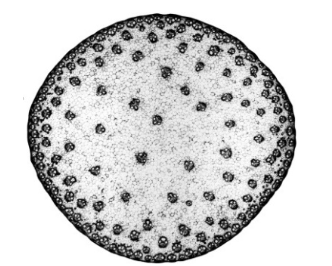
(e) The image shows how the tissue containing xylem and phloem is arranged
in a transverse section (TS) of a stem.
(i) Is this stem a monocotyledonous (monocot) stem or a
dicotyledonous (dicot) stem?
(ii) Justify your answer above.
(f) State the location of the tissue containing xylem and phloem in a
transverse section of a root.
▸ Reveal marking-scheme answer
Question 4                                                                                20

(a) Label one structure on the diagram and draw an arrow.
    Correct label and correct arrow indicating structure                                  3
(b) Type of plant tissue.
    Vascular                                                                              3
(c) One function of xylem.
    Transport water (or minerals) or support                                              3
(d) One function of phloem.
    Transport food                                                                        3
(e) (i)  Monocot or dicot stem?
         Monocot                                                                          3
    (ii) Justify.
         (Vascular) bundles are scattered                                                 3
(f) Location of xylem and phloem in a TS of a root.
Centre or described 25. Indicate whether the following statements are TRUE or FALSE.
(a) Cell walls are only found in plant cells.
(b) A turgid cell has lost a lot of water.
(c) Fermentation does not use oxygen.
(d) DNA is only found in the nucleus.
(e) There are no hydrogen bonds in a molecule of DNA.
(f) Adenine and guanine are purine bases.
(g) Chromosomes are composed of DNA and protein.
▸ Reveal marking-scheme answer
Question 5                                                                                20

(a) Cell walls are only found in plant cells.            FALSE
(b) A turgid cell has lost a lot of water.               FALSE
(c) Fermentation does not use oxygen.                    TRUE
(d) DNA is only found in the nucleus.                    FALSE
(e) There are no hydrogen bonds in a molecule of DNA.    FALSE
(f) Adenine and guanine are purine bases.                TRUE
(g) Chromosomes are composed of DNA and protein.         TRUE
Best 6 of 7 — 6(3) + 26. Distinguish clearly between EACH member of the following pairs of terms.
(a) Ectotherm and endotherm
(b) Ligament and tendon
(c) Carpal and carpel
(d) Haploid and diploid
(e) Systole and diastole
▸ Reveal marking-scheme answer
Question 6                                                                                20

(a) Ectotherm:  Animal whose (body) temperature varies with environmental temperature   2
    Endotherm:  Animal with a constant (body) temperature                               2
(b) Ligament:   Attaches (joins) bone to bone                                           2
    Tendon:     Attaches (joins) muscle to bone                                         2
(c) Carpal:     Bone in the wrist                                                       2
    Carpel:     Female part of the flower                                               2
(d) Haploid:    One set of chromosomes or one copy of each chromosome                   2
    Diploid:    Two sets of chromosomes or two copies of each chromosome                2
(e) Systole:    Heart muscle is contracting                                             2
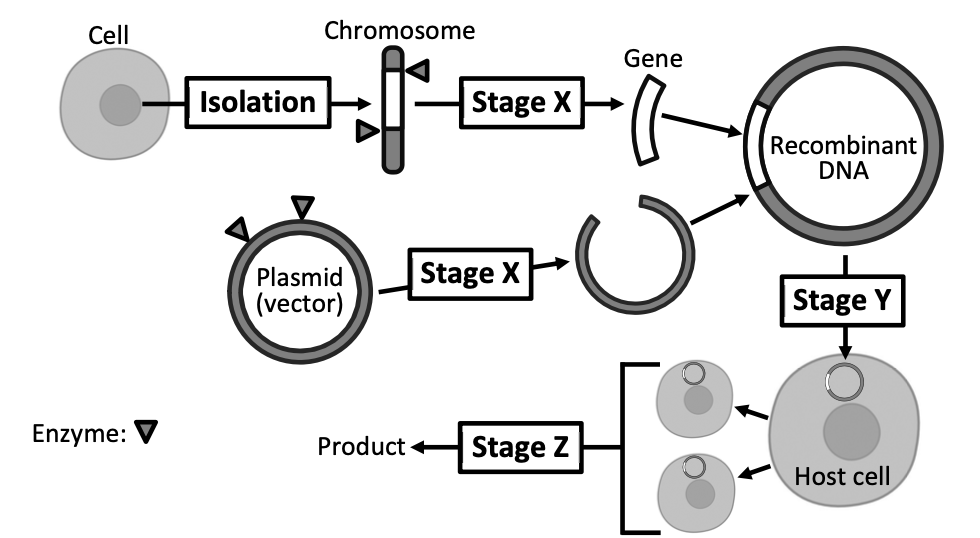
Diastole: Heart muscle is relaxing 27. Isolation of DNA is the first stage of genetic engineering. Three of the
OTHER stages are labelled Stage X, Stage Y and Stage Z in the diagram.
(a) Explain the term genetic engineering.
(b) Name each stage X, Y and Z.
(c) Give ONE application of genetic engineering for each of the following:
(i) Plant
(ii) Animal
(iii) Micro-organism
▸ Reveal marking-scheme answer
Question 7                                                                                20

(a) Explain the term genetic engineering.
    (Artificial) manipulation (or alteration) of a gene (or of DNA)                       3
(b) Name each stage X, Y and Z.
    Stage X:   Cutting (accept restriction)                                               3
    Stage Y:   Transformation or introduction of base sequence changes                    3
    Stage Z:   Expression                                                                 3
(c) One application of genetic engineering for each of the following:
    (i)   Plant:         Any correct application given                                    3
    (ii)  Animal:        Any correct application given                                    3
    (iii) Micro-organism: Any correct application given                                   3
Section C — answer any 4 (60 marks each, 90 minutes)
11.   (a)    (i)   What is meant by the term pollination?
             (ii)  Distinguish between self-pollination AND cross-pollination by writing
                   a sentence on EACH type of pollination.                                  (9)
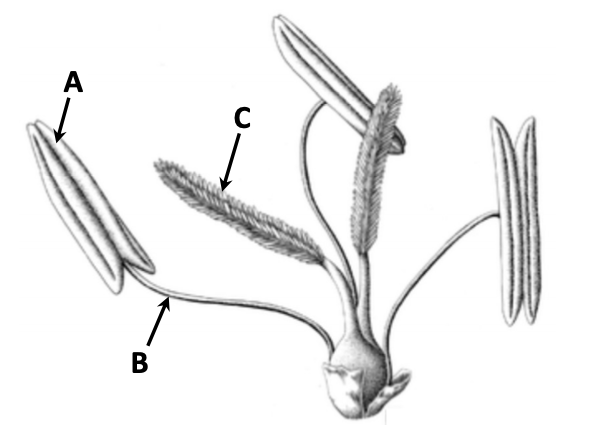
      (b)    The diagram shows a wind-pollinated flower.
             (i)   Name the parts of the flower labelled A, B and C.
             (ii)  Give ONE adaptation of this flower (visible or otherwise) that
                   shows it is wind-pollinated.
             (iii) In which of the labelled parts is pollen formed?
             (iv)  Describe the main events of pollen grain development.
             (v)   Two fertilisations occur during sexual reproduction in flowering plants.
                   Describe what happens during BOTH of these fertilisations.              (27)
      (c)    Seeds can have either one or two cotyledons (monocot or dicot).
             (i)   1.  What is a cotyledon?
                   2.  Give ONE function of the cotyledon.
             (ii)  Other parts of a seed include the testa, plumule and radicle.
                   Give ONE function for EACH part.
             (iii) Fruit formation often follows seed formation. Dispersal of fruit
                   and seeds then occurs.
                   1.  Give any TWO methods of fruit and seed dispersal.
                   2.  Give ONE reason why fruit and seed dispersal are of benefit
                       to plants.                                                          (24)
▸ Reveal marking-scheme answer
Question 11                                                                                       60
  (a) (i)      What is meant by the term pollination?
               Transfer of pollen from anther to stigma                                                3
        (ii)   Distinguish self-pollination and cross-pollination.
               Self:    (Pollination) within the same plant                                            3
               Cross:   (Pollination) between different plants                                         3
  (b) (i)      Name parts A, B and C.
               A:   *Anther                                                                            1
               B:   *Filament                                                                          1
               C:   *Stigma                                                                            1
        (ii)   One adaptation that shows it is wind-pollinated.
               Large (or long) stamen or large (or feathery) stigmas or stamen exposed or
               stigma exposed or small or light pollen                                                 3
        (iii) In which labelled part is pollen formed?
               *A or anther                                                                            3
        (iv) Main events of pollen grain development.
               Diploid (2n) (microspore) mother cell / divides by meiosis / forms tetrad (or four)
               of haploid (n) cells / (nucleus of) each divides by mitosis / forms two nuclei /
               a generative nucleus / a tube nucleus                                       Any four 4(3)
        (v) Describe what happens during BOTH fertilisations.
               1st fertilisation:   one (male) nucleus fuses with the egg (cell) or forms a
                                    diploid zygote                                                     3
               2nd fertilisation:   one (male) nucleus fuses with the two polar nuclei or
                                    forms a triploid endosperm                                         3

  (c) (i)      1. What is a cotyledon?
                  A seed leaf                                                                         3
               2. One function of the cotyledon.
                  Store food or supplies nutrients to embryo or absorbs food from endosperm           3
        (ii)   One function for each part.
               Testa:       Protects the seed                                                         3
               Plumule:     Develops into the (young) shoot                                           3
               Radicle:     Develops into the (young) root                                            3
        (iii) 1. Two methods of fruit and seed dispersal.
                  Animal / wind / water / self                                            Any two 2(3)
               2. One reason fruit and seed dispersal are of benefit to plants.
                  Allows plant to colonise new habitats or increases chance of survival or
prevents (reduces) competition with the parent plant or avoids overcrowding 312. (a) Define EACH of the following terms: ecology; biosphere; conservation. (9)
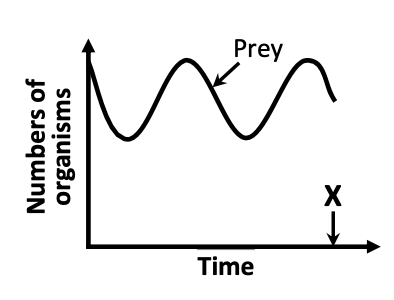
      (b)    The graph shows the fluctuating numbers of prey over time in a habitat.
             (i)   Copy the graph into your answerbook. Then, using a dashed line
                   (- - - -), show how the population of the prey's main predator
                   species varies over the same time period.
             (ii)  Give a detailed explanation of the graph that you have drawn for
                   the PREDATOR species.
             (iii) If a disease affected the predator at time X, what would you expect
                   to happen to the graph showing the prey? Explain your answer.
             (iv)  Give a role for predation in the overall scheme of nature.
             (v)   Human population numbers do not follow a similar pattern to the
                   one shown in the graph. Suggest TWO reasons for this.                   (27)
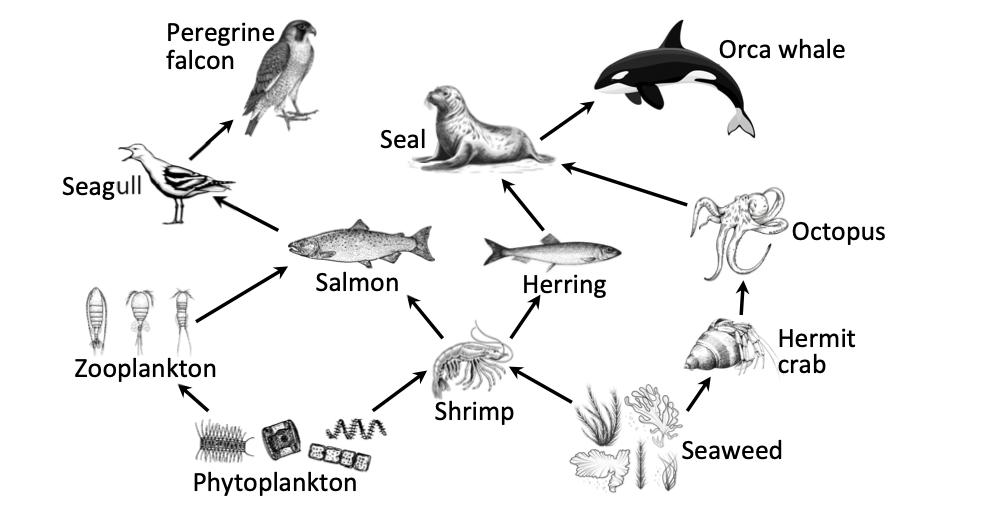
      (c)    The diagram shows a food web from a marine ecosystem.
             (i)   Give ONE example of EACH from the food web shown:
                   1.  A producer
                   2.  A secondary consumer
                   3.  A top consumer (top carnivore)
             (ii)  What is meant by the term producer?
             (iii) Write out a complete food chain from this food web.
             (iv)  How many trophic levels are in the food chain you wrote in (c) (iii) above?
             (v)   What is meant by the term trophic?
             (vi)  Explain why food chains have a limited number of trophic levels.
             (vii) Name the type of diagram an ecologist may draw to indicate the
                   relative sizes of the populations at different trophic levels.          (24)
▸ Reveal marking-scheme answer
Question 12                                                                                       60
  (a) Define each of the following terms.
        Ecology:        The study of (interactions between) organisms and their environment           3
        Biosphere:      Where life can exist on Earth                                                  3
        Conservation:   Management (or preservation or protection) of organisms (or species
                        or their habitats or environments or ecosystems)                              3
  (b) (i)      Show how the population of the predator species varies over the same time period.
               Dashed line lower peaks than prey                                                       2
               Dashed line out of sync compared to prey                                                2
        (ii)   Detailed explanation of the predator graph.
               Line:    Increases due to food (prey) availability or decreases due to lack of food    2
               Number:  Lower number due to loss of energy or reference to size (predators
                        usually larger in size)                                                        2
               Time:    Delay in increase (in predator numbers) due to time taken to breed             2
        (iii) Disease affecting predator at time X — what happens to prey graph?
               Prey (population) increases                                                             3
               Less predators or greater chance of survival                                            3
        (iv) Role for predation in nature.
               Population control or described                                                         3
        (v) Two reasons human population does not follow this pattern.
               Healthcare / food supply / lack of predators                                Any two 2(4)

  (c) (i)      Examples from the food web.
               1. Producer:               Phytoplankton or seaweed                                     3
               2. Secondary consumer:     Salmon or herring or octopus                                 3
               3. Top consumer:           Peregrine falcon or orca whale                               3
        (ii)   What is meant by producer?
               Organism that makes its own food                                                        3
        (iii) Write out a complete food chain.
               Any correct food chain from the food web                                                3
        (iv) How many trophic levels in your food chain?
               5                                                                                       3
        (v) What is meant by trophic?
               Feeding or nutrition                                                                    2
        (vi) Why food chains have a limited number of trophic levels.
               Large amount of energy is lost between (trophic) levels or little energy passed on      2
        (vii) Type of diagram for relative population sizes at different trophic levels.
Pyramid of numbers or ecological pyramid 213. (a) Photosynthesis and respiration are metabolic reactions.
(i) Explain the term metabolism.
(ii) Distinguish between the terms anabolic and catabolic. (9)
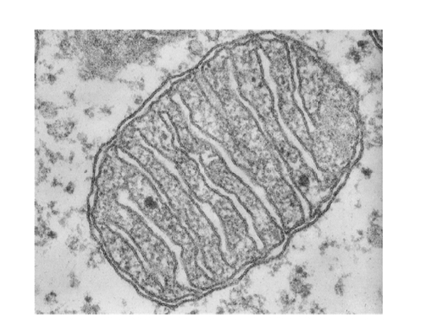
      (b)    The image shows a transverse section (TS) through a cell organelle
             involved in aerobic respiration.
             (i)   Identify the cell organelle shown in the image.
             (ii)  Write out the balanced chemical equation for aerobic respiration.
             (iii) Aerobic respiration involves two stages (stage 1 and stage 2).
                   1.  What is the name given to stage 1?
                   2.  Describe the events in stage 1.
                   3.  Stage 2 involves the Krebs cycle and the electron transport chain.
                       Describe the role of the energy carrier NAD in stage 2.            (27)
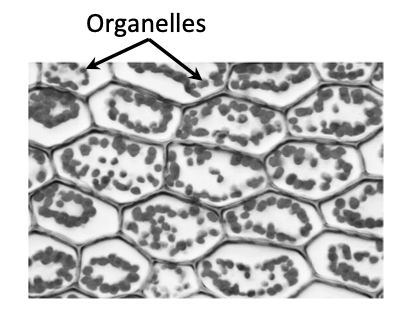
      (c)    The image shows leaf cells under the light microscope. The cell organelles
             indicated are responsible for photosynthesis, which occurs in two stages —
             the light stage and the light-independent stage. During the light stage,
             energised electrons enter two pathways known as pathway 1 and pathway 2.
             (i)   Name these cell organelles which are responsible for photosynthesis.
             (ii)  Where do the energised electrons come from?
             (iii) Briefly describe what happens to these energised electrons in pathway 1.
             (iv)  What is another name for the light-independent stage?
             (v)   Compounds of the general formula Cx(H2O)y are formed during the
                   light-independent stage of photosynthesis.
                   1.  What name is given to the group of compounds described by this
                       general formula?
                   2.  Name the simple molecule from which a plant obtains the protons
                       (H+ ions) used to make these compounds.
                   3.  Name another simple molecule from which plants obtain the carbon
                       (C) used to make these compounds.                                  (24)
▸ Reveal marking-scheme answer
Question 13                                                                                     60
 (a) (i)     Explain the term metabolism.
             (All) chemical reactions in a cell (or organism)                                         3
       (ii) Distinguish between anabolic and catabolic.
             Anabolic:    building up large molecules from small molecules or (a reaction)
                          using energy                                                                3
             Catabolic:   breaking down large molecules to small molecules or (a reaction)
                          releasing energy                                                            3
 (b) (i)     Identify the cell organelle.
             *Mitochondrion                                                                           3
       (ii) Balanced chemical equation for aerobic respiration.
             C6H12O6 + 6O2 → 6CO2 + 6H2O    First point: formulae; second point: balancing       2(3)
       (iii) 1. Name given to stage 1.
                *Glycolysis                                                                           3
             2. Describe events in stage 1.
                Glucose is broken down into (2) pyruvic acid / energy released / ATP is
                produced from ADP and P / NADH is formed / from NAD+ and electrons
                and protons                                                              Any three 3(3)
             3. Role of NAD in stage 2.
                Picks up electrons (e−) and protons (or H+ or hydrogen ions) / to form NADH /
                these (electrons and protons) combine with O2 / to make water              Any two 2(3)

 (c) (i)     Name organelles responsible for photosynthesis.
             *Chloroplasts                                                                            3
       (ii) Where do the energised electrons come from?
             *Chlorophyll                                                                             3
       (iii) What happens to these electrons in pathway 1.
             Picked up by (electron) acceptor or transferred from carrier to carrier / energy
             released / ATP produced from ADP and P / (electron) returns to chlorophyll
                                                                                          Any two 2(3)
       (iv) Another name for light-independent stage.
             *Dark                                                                                    3
       (v) 1. Name given to the group of compounds (Cx(H2O)y).
                *Carbohydrates                                                                        3
             2. Simple molecule from which plant obtains the protons (H+).
                *Water (H2O)                                                                          3
             3. Simple molecule from which plants obtain the carbon (C).
*Carbon dioxide (CO2) 315. (a) (i) What is meant by the term species?
(ii) Give TWO causes of variation within a species. (9)
      (b)    In snapdragon plants, the ALLELE for tallness is dominant over the allele
             for dwarfness. However, the allele for red flower shows incomplete
             dominance with the allele for white flower. Pink flower is the phenotype
             that results in the HETEROZYGOUS condition. The two genes are not linked.
             (i)   Explain the underlined terms.
             (ii)  A homozygous tall, red snapdragon plant is crossed with a dwarf,
                   pink snapdragon plant.
                   Using suitable letters, give the genotypes of BOTH plants in the
                   above cross.
             (iii) Using a Punnett square, or otherwise, show the possible genotypes
                   AND matching phenotypes of the offspring of the cross described above.
             (iv)  What percentage of the offspring of the cross have pink flowers?       (27)
      (c)    Two famous biologists independently developed the theory of evolution
             by natural selection.
             (i)   Name these TWO famous biologists.
             (ii)  What is meant by the term evolution?
             (iii) Describe the main points of the theory of natural selection.
             (iv)  Give ONE piece of evidence that supports the theory of natural
                   selection.                                                              (24)
▸ Reveal marking-scheme answer
Question 15                                                                                     60
 (a) (i)     What is meant by the term species?
             Group of organisms that can reproduce together (or interbreed) to produce
             fertile offspring                                                                        3
       (ii) Give two causes of variation within a species.
             Mutation / sexual reproduction                                                Any two 2(3)
 (b) (i)     Explain the underlined terms.
             Allele:          form of a gene                                                          3
             Heterozygous:    two different alleles (of a gene)                                       3
       (ii) Genotypes of both plants in the cross.
             *TTRR                                                                                    3
             *ttRr                              Allow alternative letters for Rr e.g. RW              3
       (iii) Punnett square / possible genotypes and matching phenotypes of offspring.
             Genotype:    *TtRR                                                                       3
             Phenotype:   *Tall and Red flowered                                                      3
             Genotype:    *TtRr                                                                       3
             Phenotype:   *Tall and Pink flowered                                                     3
       (iv) Percentage of offspring with pink flowers.
             *50%                                                                                     3

 (c) (i)     Name the two famous biologists.
             *(Charles) Darwin                                                                        3
             *(Alfred Russell) Wallace                                                                3
       (ii) What is meant by the term evolution?
             Genetic (inheritable) changes in a population (or species)                               3
             over a period of time or in response to a change in the environment                      3
       (iii) Describe the main points of the theory of natural selection.
             High reproductive rates (or overbreeding) /
             competition (or struggle for survival) /
             better adapted survive (or survival of the fittest) /
             the survivors reproduce (or breed) /
             others die out /
             the genes of the most successful are passed on (to the next generation) /
             organisms with beneficial characteristics will dominate                       Any three 3(3)
       (iv) One source of evidence that supports the theory of natural selection.
             Fossils or comparative anatomy or comparative embryology                                 3
T1 exam tip: Pick 2 of 4 sub-parts in each. Q16: do (a) male reproductive + (b) endocrine glands. Skip (c) phototropism, (d) immune. Q17: do (a) enzymes + (d) mitosis. Skip (b) Rhizopus, (c) nephron.
16.   Answer any two of (a), (b), (c), (d).                                              (30, 30)

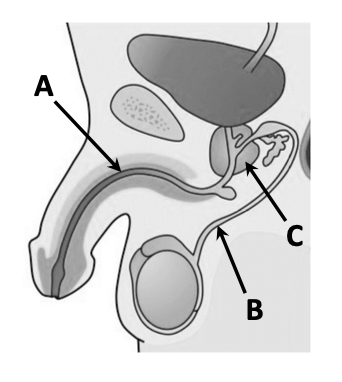
      (a)    The diagram shows the human male reproductive system.
             (i)   1.  Give the names of tubes A and B and the name of gland C.
                   2.  Give ONE function for EACH structure labelled A, B and C.
             (ii)  In which part of the male reproductive system does meiosis occur?
             (iii) Which part of the male reproductive system is directly involved
                   in copulation?
             (iv)  Give ONE cause of male infertility AND a corrective measure.
             (v)   Give any TWO methods of contraception.
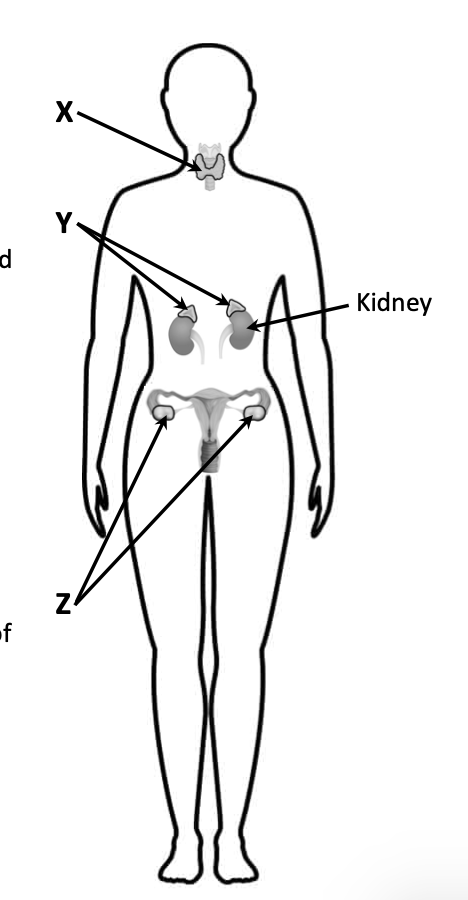
      (b)    The diagram shows an outline of the human female body. Three important
             endocrine glands are indicated by the letters X, Y and Z.
             (i)   Name glands X, Y and Z.
             (ii)  Name ONE hormone secreted by EACH gland AND give ONE function
                   for EACH named hormone.
             (iii) For any NAMED human (male or female) hormone, give:
                   1.  a symptom of its deficiency.
                   2.  a symptom of its excess.
                   3.  a corrective measure for EITHER its deficiency OR excess.
             (iv)  Briefly describe the feedback mechanism of any ONE human hormone.
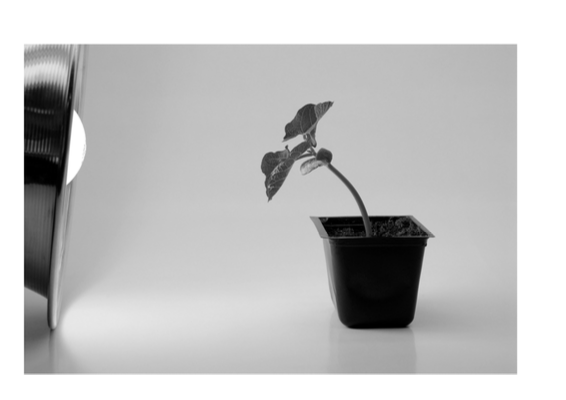
      (c)    The photograph shows a plant growing towards light.
             (i)   What name is given to the growth response of plants to light?
             (ii)  How does this growth response benefit plants?
             (iii) Name any OTHER type of growth response in plants.
             (iv)  Growth regulators are important in plants. Explain the term
                   growth regulator.
             (v)   Describe the mechanism of any ONE plant growth response to an
                   external stimulus.
             (vi)  Give ONE example of the use of plant growth regulators, e.g. by
                   horticulturists.
             (vii) Plants have adaptations that help in protection. Give any TWO methods
                   plants use to protect themselves.
      (d)    Answer the following questions in relation to the human defence system.
             (i)   The human defence system can be categorised as the general defence
                   system AND the specific defence system (immune system).
                   1.  Name any TWO methods used by the general defence system.
                   2.  Name any ONE organ that is specific to the immune system.
             (ii)  The organs of the immune system have lymphocytes that take part in
                   an antigen-antibody response.
                   1.  Distinguish between the terms antigen AND antibody by writing
                       a sentence on EACH term.
                   2.  T cells are one type of lymphocyte. Name the OTHER type of
                       lymphocyte.
                   3.  There are four types of T cells in the human immune system.
                       Name any TWO types AND give ONE function for EACH named type.
17.   Answer any two of (a), (b), (c), (d).                                              (30, 30)

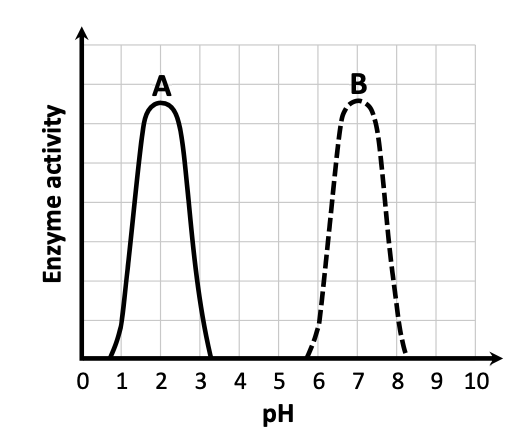
      (a)    The graph below shows how the rate of activity of two human digestive
             enzymes (A and B) changes with pH.
             (i)   1.  What is the optimal pH of enzyme A?
                   2.  What is the optimal pH of enzyme B?
             (ii)  Which of these enzymes (A or B) is most likely to be found in the
                   stomach? Justify your answer.
             (iii) Describe the active site theory of enzyme action to explain enzyme
                   function and specificity.
             (iv)  Amylase, lipase and protease are three enzymes found in the human
                   digestive system. Amylase acts on starch, lipase acts on lipids, and
                   protease acts on proteins. Give the product(s) of EACH enzyme.
      (b)    Fungi can be classified into saprophytic and parasitic forms.
             (i)   Explain the terms saprophytic AND parasitic.
             (ii)  Rhizopus is an example of a fungus.
                   Draw a large labelled diagram of Rhizopus during asexual reproduction.
                   Indicate clearly ON YOUR DIAGRAM which part is involved in asexual
                   reproduction.
             (iii) Answer the following in relation to the life cycle of Rhizopus:
                   1.  Sexual reproduction in Rhizopus results in the formation of a
                       thick-walled, dormant structure that can survive a long time in
                       unsuitable conditions. What is the name of this structure?
                   2.  What happens to the structure you named in part (b)(iii)1. above
                       if suitable conditions return?
             (iv)  Fungi can be beneficial. Give any TWO examples of beneficial fungi.
      (c)    Answer the following questions in relation to the kidneys and urine
             formation.
             (i)   The kidneys are important in maintaining a constant internal
                   environment within the body. What term describes the maintenance
                   of a constant internal environment within the body?
             (ii)  The nephron is the functional unit of the kidney. Draw a large
                   labelled diagram of the human nephron AND its associated blood supply.
             (iii) Give ONE way in which the composition of blood is different to the
                   composition of glomerular filtrate.
             (iv)  Large amounts of water are reabsorbed into the blood during urine
                   formation.
                   1.  Name any TWO parts of the nephron that reabsorb water.
                   2.  Name any TWO OTHER substances that are reabsorbed during urine
                       formation.
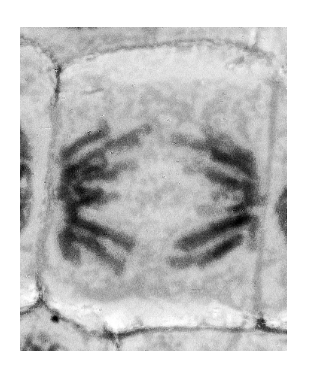
      (d)    The image shows a stage of mitosis in an onion cell.
             Mitosis is a stage of the cell cycle.
             (i)   What name is given to the stage of the cell cycle when the cell is
                   in a state of non-division?
             (ii)  Give any TWO cell activities that occur during the state of non-division.
             (iii) 1.  What name is given to the stage of mitosis shown in the image?
                   2.  Explain how you know it is this stage.
             (iv)  What stage of mitosis occurs immediately before the stage you named
                   in (d)(iii)1. above?
             (v)   Sketch a diagram of a cell with a diploid number of 4 (i.e. 2n = 4)
                   that is at the stage of mitosis you named at part (d)(iv) above.
             (vi)  What is the function of mitosis in multicellular organisms such as
                   the onion?
             (vii) What name is given to the group of disorders where a cell loses control
                   of mitosis and the number of cell divisions?
▸ Reveal marking-scheme answer
Question 16 Any two of (a), (b), (c), (d) 30, 30
Question 16 (a) 30
(i) 1. Names of tubes A and B and gland C.
A: *Urethra 1
B: *Sperm duct (or vas deferens) 1
C: *Prostate (gland) 1
2. One function for each structure.
A: Release semen or release urine 1
B: Carries sperm from testes to urethra (or penis) 1
C: Produces seminal fluid 1
(ii) In which part does meiosis occur?
*Testes 4
(iii) Which part is directly involved in copulation?
*Penis 4
(iv) One cause of male infertility AND a corrective measure.
Cause: Low sperm count or low sperm mobility or low testosterone
levels or blockage 4
Corrective measure: IVF or other correct 4
(v) Two methods of contraception.
Mechanical / surgical / natural / chemical / named examples Any two 2(4)
Question 16 (b) 30
(i) Name glands X, Y and Z.
X: *Thyroid 2
Y: *Adrenal 2
Z: *Ovary 2
(ii) One hormone secreted by each gland and one function for each.
Thyroid: Hormone: Thyroxine 2
Function: Controls the rate of metabolism Must match 2
Adrenal: Hormone: Adrenaline 2
Function: Fight or flight response Must match 2
Ovary: Hormone: Oestrogen 2
Function: Secondary sexual characteristics Must match 2
(iii) For any named human hormone:
1. A symptom of its deficiency. Match hormone named 2
2. A symptom of its excess. Match hormone named 2
3. Corrective measure for either symptom. 2
(iv) Feedback mechanism of any one human hormone.
The concentration (or secretion) of one (named) hormone 3
Inhibits or stimulates the concentration (or secretion) of another (named)
hormone or itself 3
Question 16 (c) 30
(i) Growth response of plants to light.
*Phototropism 3
(ii) How does this growth response benefit plants?
Get more light or more photosynthesis or more food produced 3
(iii) Name any other type of growth response in plants.
Geotropism or thigmotropism or chemotropism or hydrotropism 3
(iv) Explain the term growth regulator.
Chemical that controls (or influences) growth (in plants) 3
(v) Mechanism of any one plant growth response to an external stimulus.
Where regulator produced / Movement of regulator / Unequal distribution of
growth regulator / How growth affected / Result on growth Any three 3(3)
(vi) One example of the use of plant growth regulators.
Seedless fruits or rooting powder or tissue culturing or fruit ripening or
(selective) herbicide 3
(vii) Two methods plants use to protect themselves.
Bark / cuticle / guard cells / thorns / chemicals Any two 2(3)
Question 16 (d) 30
(i) 1. Two methods used by the general defence system.
Barrier (e.g. skin) / phagocytosis / chemicals (e.g. sebum, sweat,
interferon) / fever / (stomach) acid / tears / blood clotting Any two 2(3)
2. One organ specific to the immune system.
Spleen or thymus or lymph node or tonsils 3
(ii) 1. Distinguish between antigen and antibody.
Antigen: chemical (or molecule) that stimulates the production of antibodies 3
Antibody: protein produced in response to an antigen or protein produced
by lymphocytes or protein which inactivates an antigen 3
2. Other type of lymphocyte (besides T).
*B 3
3. Two types of T cell and one function each.
Suppressor (or regulatory) / helper / killer (cytotoxic) / memory Any two 2(3)
Matching functions Any two 2(3)
Question 17 Any two of (a), (b), (c), (d) 30, 30
Question 17 (a) 30
(i) 1. Optimal pH of enzyme A.
*2 4
2. Optimal pH of enzyme B.
*7 4
(ii) Which enzyme is found in the stomach? Justify.
Enzyme: *A 4
Justify: pH in the stomach is low or acidic environment in the stomach 3
(iii) Active site theory of enzyme action.
Active site has a complementary shape to only one substrate / active site changes
shape (or induced fit) to accommodate substrate / enzyme substrate complex
is formed / product formed / enzyme unchanged or active site changes back to
original shape or enzyme can be reused Any three 3(3)
(iv) Products of each enzyme.
Amylase: *Maltose 2
Lipase: *Glycerol and fatty acids 2
Protease: *Amino acids or peptides 2
Question 17 (b) 30
(i) Explain saprophytic and parasitic.
Saprophytic: (organism that) feeds on dead organic matter 3
Parasitic: (organism that) feeds on another living organism causing it harm 3
(ii) Large labelled diagram of Rhizopus during asexual reproduction.
Diagram: sporangiophore and sporangium 3
stolon or rhizoid 3
Labels: stolon / rhizoid / sporangiophore / sporangium / spore / hypha /
mycelium / apophysis / columella Any three 3(1)
Indicate part involved in asexual reproduction.
Spores or sporangium indicated 3
(iii) 1. Name of dormant structure formed by sexual reproduction.
*Zygospore 3
2. What happens to the structure if suitable conditions return?
Germinates or described 3
(iv) Two examples of beneficial fungi.
Named edible mushrooms / yeast Any two 2(3)
Question 17 (c) 30
(i) Term for maintenance of a constant internal environment.
*Homeostasis 3
(ii) Large labelled diagram of the human nephron and its associated blood supply.
Diagram: Bowman's capsule and (proximal or distal) convoluted tubule and
loop of Henle 3
Glomerulus or other blood supply 3
Labels: Any six correct labels e.g. glomerulus / Bowman's capsule / proximal
convoluted tubule / loop of Henle / distal convoluted tubule / collecting
duct / afferent arteriole / efferent arteriole / renal venule / renal
arteriole / capillary Any six 6(1)
(iii) One way blood differs in composition from glomerular filtrate.
Blood contains blood cells, glomerular filtrate does not or
Blood contains (large, plasma) proteins, glomerular filtrate does not or
Other correctly described difference 3
(iv) 1. Two parts of the nephron that reabsorb water.
Proximal convoluted tubule / loop of Henle / distal convoluted tubule /
collecting duct Any two 2(3)
2. Two other substances reabsorbed during urine formation.
Glucose / amino acids / minerals / salts / ions Any two 2(3)
Question 17 (d) 30
(i) Stage of the cell cycle when the cell is in a state of non-division.
*Interphase 3
(ii) Two cell activities during the state of non-division.
Photosynthesis / respiration / DNA replication / protein synthesis Any two 2(3)
(iii) 1. Name of the stage of mitosis shown in the image.
*Anaphase 3
2. How you know it is this stage.
Chromosomes are being pulled apart or spindles contracting (shortening) 3
(iv) Stage of mitosis immediately before the stage above.
*Metaphase 3
(v) Sketch of a cell with diploid number of 4 (2n = 4) at the stage above (metaphase).
Diagram: Cell with 4 duplicated chromosomes on the equator of the cell 3
Spindle fibres from chromosomes to the ends (poles) of the cell 3
(vi) Function of mitosis in multicellular organisms.
Growth or repair (of tissue) 3
(vii) Group of disorders where a cell loses control of mitosis.
*Cancer 3