Type your answer, click Reveal marking-scheme answer to self-mark, or Check answer with AI for an instant DeepSeek grade. Auto-saves locally.
Section A — answer any 5 of 7 (20 marks each, 30 minutes)
1.   Answer any FIVE of the following parts (a) to (f). Each part = 4 marks.
     (a)  Write the general formula for carbohydrates.
     (b)  Give the FOUR chemical elements found in ALL proteins.
     (c)  State ONE structural role of proteins in the body.
     (d)  Name the small subunits that make protein.
     (e)  Name ONE water-soluble vitamin.
     (f)  Give ONE example of a trace element found in food.
▸ Reveal marking-scheme answer
Question 1                                  Best 5 of (a)-(f)                              20

(a) General formula for carbohydrates.
    Cx(H2O)y                                                                              4
(b) Four elements present in ALL proteins.
    Carbon (or C) and hydrogen (or H) and oxygen (or O) and nitrogen (or N)               4
(c) One structural role of proteins in the body.
    (To form) muscles or tendons or ligament or hair or skin or nails…                    4
(d) Name the small subunits that make protein.
    Amino acids                                                                           4
(e) Name one water-soluble vitamin.
    B (or named B vitamin) or C (or named)                                                4
(f) Name one trace element found in food.
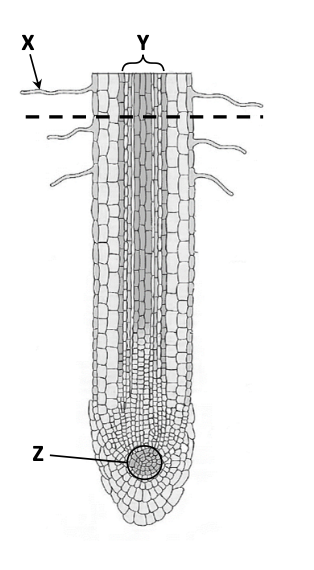
Copper (or Cu) or iron (or Fe) or zinc (or Zn)… 42. The diagram shows a longitudinal section through the root of a plant.
(a) Name the structure indicated by letter X AND give its function.
(b) Name the tissue type indicated by letter Y AND give its function.
(c) Name the tissue indicated by letter Z where rapid mitosis is occurring.
(d) Draw AND label a transverse section of the root as it would appear if
cut at the dashed line in the diagram above.
▸ Reveal marking-scheme answer
Question 2                                                                                20

(a) Name structure X and give its function.
    Name:      Root hair                                                                  3
    Function:  Absorption of water or minerals                                            3
(b) Name tissue type Y and give its function.
    Name:      Vascular (tissue)                                                          3
    Function:  Transport of a correct named substance                                     3
(c) Name the tissue at Z where rapid mitosis is occurring.
    Meristematic                                                                          3
(d) TS of root at the dashed line.
    Drawing:   circle with vascular tissue clearly visible in the centre                  3
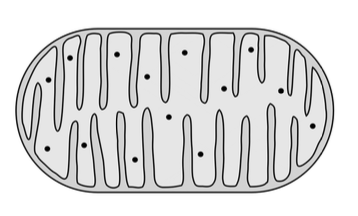
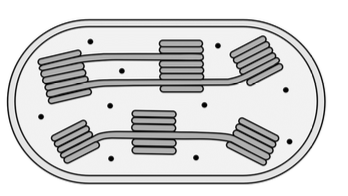
Labels: dermal (tissue) / vascular (tissue) / ground (tissue) / root hair / examples Any two 2(1)3. Aerobic respiration is a two-stage process. Stage 2 occurs in the cell
organelle shown.
(a) Name the cell organelle shown.
(b) Name the cycle of reactions that occurs in stage 2 of aerobic respiration.
(c) ATP is produced in large quantities by aerobic respiration. What does
ATP stand for?
(d) NAD⁺ is an important molecule in respiration. Give the function of NAD⁺.
Anaerobic respiration may occur under certain conditions.
(e) Suggest a condition under which anaerobic respiration might occur.
(f) State where anaerobic respiration occurs in a cell.
(g) Name ONE main product of anaerobic respiration.
▸ Reveal marking-scheme answer
Question 3                                                                                20

(a) Name the cell organelle shown.
    Mitochondrion                                                                         2
(b) Cycle of reactions in stage 2 of aerobic respiration.
    Krebs                                                                                 3
(c) What does ATP stand for?
    Adenosine triphosphate                                                                3
(d) Function of NAD⁺.
    Carries (high energy) electrons AND protons                                           3
(e) Condition under which anaerobic respiration might occur.
    Lack of oxygen or described                                                           3
(f) Where anaerobic respiration occurs in a cell.
    Cytosol                                                                               3
(g) Name one main product of anaerobic respiration.
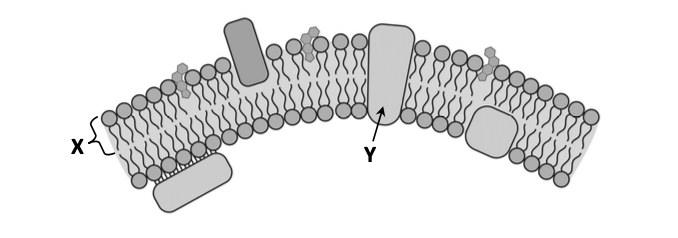
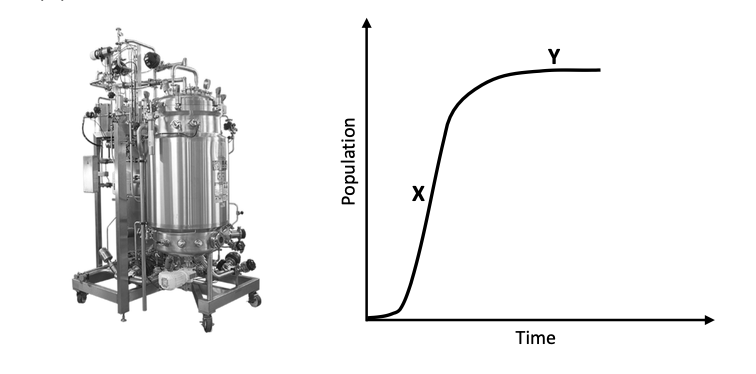
Lactic acid or ethanol 34. The diagram below shows part of the ultrastructure of a cell membrane.
(a) Name the parts labelled X and Y.
(b) Give a function of the cell membrane.
(c) (i) What term describes cells WITHOUT membrane-bound organelles?
(ii) What term describes cells WITH membrane-bound organelles?
(d) Plant cells have a cell wall in addition to a cell membrane.
(i) Sketch the basic structure of a plant cell, clearly labelling the
cell membrane AND the cell wall.
(ii) Give ONE function of a plant cell wall.
▸ Reveal marking-scheme answer
Question 4                                                                                20

(a) Name the parts labelled X and Y.
    X:  Phospholipid                                                                      2
    Y:  Protein                                                                           2
(b) Function of the cell membrane.
    Controls what substances pass through                                                 3
(c) (i)  Cells without membrane-bound organelles.
         Prokaryotic                                                                      3
    (ii) Cells with membrane-bound organelles.
         Eukaryotic                                                                       3
(d) (i)  Sketch a plant cell, label cell membrane AND cell wall.
         Correct sketch:  showing cell membrane AND cell wall                             3
         Labels:          Cell membrane                                                   1
                          Cell wall                                                       1
    (ii) One function of a plant cell wall.
Gives shape (to the cell) or protection 25. The image shows a piece of equipment that may be used in food processing.
Food processing is a type of bioprocessing involving enzymes and/or
microorganisms. The graph shows the population growth curve of a species
of bacteria in the piece of equipment shown.
(a) What is the common name given to this piece of equipment?
(b) Name TWO factors controlled by the equipment shown that could affect
the growth of bacteria, OTHER than nutrient availability.
(c) Name the TWO stages X and Y on the population growth curve.
(d) The equipment is keeping the population of bacteria steady in growth
phase Y. Which type of food processing technique is represented by the
growth curve shown?
(e) If the population of bacteria in the equipment above were to run out of
nutrients, draw on the graph to show how the line would continue.
▸ Reveal marking-scheme answer
Question 5                                                                                20

(a) Common name for the equipment.
    Bioreactor                                                                            3
(b) Two factors (other than nutrients) controlled by the equipment.
    pH / temperature / pressure / oxygen…                          Any two            2(3)
(c) Name the two stages X and Y on the population growth curve.
    Stage X:  Log                                                                         3
    Stage Y:  Stationary                                                                  3
(d) Type of food processing technique represented.
    Continuous                                                                            3
(e) If bacteria run out of nutrients, how the line would continue.
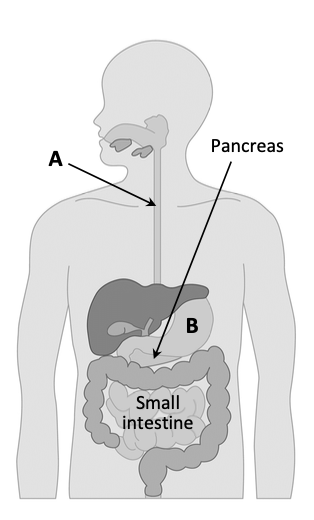
Line drops 26. The diagram shows the human digestive system.
(a) Name the parts labelled A and B.
(b) Name AND describe briefly the method by which food travels through
structure A.
(c) How does the pH of the food material change as it travels from A to B?
(d) Name the enzyme produced in the pancreas which digests lipids.
(e) The villus is present in the small intestine. Draw AND label the internal
structure of a villus.
▸ Reveal marking-scheme answer
Question 6                                                                                20

(a) Name the parts labelled A and B.
    A:  Oesophagus                                                                        2
    B:  Stomach                                                                           2
(b) Method by which food travels through structure A.
    Name:        Peristalsis                                                              3
    Description: (involuntary) muscular contractions (that push food)                     3
(c) How does the pH of the food change from A to B?
    Lowers                                                                                2
(d) Pancreatic enzyme that digests lipids.
    Lipase                                                                                3
(e) Draw AND label the internal structure of a villus.
    Drawing:  villus / lacteal / blood vessels                       Any two              3
Labels: villus / lacteal / capillary (or blood vessel or named) Any two 2(1)7. Answer the following questions in relation to the scientific method.
(a) In the scientific method, a testable statement is known as a __________.
(b) How can this statement be tested?
(c) What is the function of a scientific control?
(d) Give TWO limitations of the scientific method.
(e) Where does a biologist normally publish their results?
(f) What is meant by the term theory?
▸ Reveal marking-scheme answer
Question 7                                                                                20

(a) Testable statement in the scientific method.
    Hypothesis                                                                            2
(b) How can this statement be tested?
    Conducting an experiment                                                              3
(c) Function of a scientific control.
    A comparison to the experiment                                                        3
(d) Two limitations of the scientific method.
    Accidental discovery / application to nature / (human) bias / human error /
    constrained by existing knowledge / constrained by existing technology /
    ability to interpret results / experimental design…                Any two        2(3)
(e) Where does a biologist normally publish their results?
    Scientific journal                                                                    3
(f) What is meant by the term theory?
    Supported (or tested) hypothesis                                                      3
Section C — answer all 4 (60 marks each, 90 minutes)
12.   (a)    (i)   Explain the term mutation.
             (ii)  Give two causes of mutations.                                                (9)
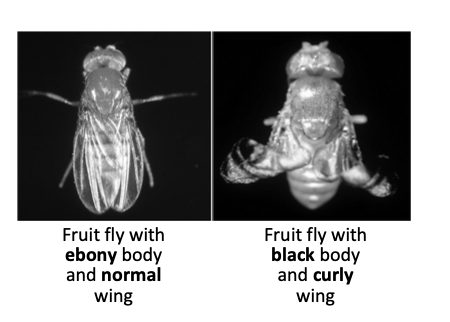
      (b)    In fruit flies, the genes for body colour and wing type are located on
             different chromosomes.
             The allele for ebony body (E) is dominant over the allele for black body (e)
             and the allele for normal wing (N) is dominant over the allele for curly
             wing (n).
             (i)   Distinguish between the terms, gene and allele.
             (ii)  1.  Using the letters mentioned above, give the genotype of a fruit fly
                       with ebony body and normal wing, heterozygous for both
                       characteristics.
                   2.  Give the genotype of a fruit fly with a black body and curly wings.
                   3.  Give all the possible genotypes and matching phenotypes of the
                       offspring of a cross between the two flies described in (ii) 1. and
                       2. above.
             (iii) What term is used for genes found on the same chromosome?                   (27)
      (c)    (i)   DNA contains a pattern of bases which stores hereditary information
                   inside the cell. What do the letters DNA stand for?
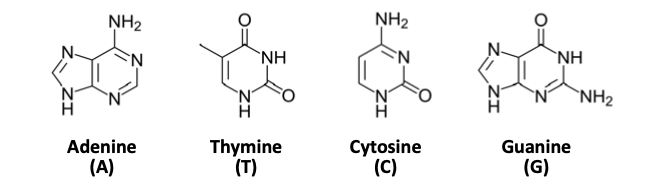
             (ii)  Adenine, thymine, cytosine and guanine are the four DNA bases shown
                   in the diagram. State which two are purines and which two are
                   pyrimidines.
             (iii) Human cells contain both DNA and RNA. State any one structural
                   difference between DNA and RNA.
             (iv)  DNA profiling can be used to identify DNA left behind at a crime scene.
                   Describe the four main steps in creating a DNA profile.                     (24)
▸ Reveal marking-scheme answer
Question 12                                                                                       60
  (a) (i)      Explain the term mutation.
               Change in the structure (or sequence) of DNA (or of a chromosome)                    3
        (ii)   Give two causes of mutations.
               Radiation / chemicals / viruses……….                                         Any two 2(3)
  (b) (i)      Distinguish between the terms, gene and allele.
               Gene: region of a chromosome (or DNA) that contains (genetic) code for (the
                     production of) a protein.                                                      3
               Allele: form of a gene                                                               3
        (ii)   1.   Using the letters mentioned above, give the genotype of a fruit fly with
                    ebony body and normal wing, heterozygous for both characteristics.
                    *EeNn                                                                           3
               2.   Give the genotype for a fruit fly with a black body and curly wings.
                    *eenn                                                                           3
               3.   Give all the possible genotypes and matching phenotypes of the offspring of
                    a cross between the two flies described in (ii) 1. and 2. above.
                    *EeNn and ebony, normal                                                         3
                    *Eenn and ebony, curly                                                          3
                    *eeNn and black, normal                                                         3
                    *eenn and black, curly                                                          3
                    If phenotype not matched to correct genotype then 2 marks for each
                    correct genotype
        (iii) What term is used for genes found on the same chromosome?
               *Linked                                                                              3
  9         or (4          +5    ) or (3       +6        ) or (2      +7       ) or (1         +8    )

  (c) (i)      What do the letters DNA stand for?
               *Deoxyribonucleic acid                                         3
        (ii)   State which two are purines and which two are pyrimidines.
               Purines:       *Adenine (or A) and *guanine (or G)             3
               Pyrimidines:   *Cytosine (or C) and *thymine (or T)            3
        (iii) State any one structural difference between DNA and RNA.
               DNA is double stranded and RNA is single stranded
               or
               DNA has the sugar, deoxyribose and RNA has the sugar, ribose
               or
               DNA has thymine and RNA has uracil                             3
        (iv) Describe the four main steps in creating a DNA profile.
               Cells are broken down to release DNA                           3
               DNA is cut into fragments using enzymes                        3
               The (DNA) fragments are separated based on size                3
               A pattern of fragments is analysed                             3
T1 exam tip: Answer (a) and (b) only. Skip (c) Enzymes — that's Tier 2.
13.   (a)    Metabolic reactions can be classified as anabolic or catabolic.
             (i)   Explain why photosynthesis is an example of an anabolic reaction.
             (ii)  Write a balanced chemical equation to represent photosynthesis.              (9)
      (b)    During photosynthesis chlorophyll absorbs light energy.
             (i)   Name the cell organelle shown in the diagram in which chlorophyll is
                   located.
             (ii)  Name the energised particles released by chlorophyll.
             (iii) These particles can enter one of two pathways which are known as
                   pathway 1 and pathway 2. State the difference between each of these
                   two pathways in terms of energised particle movement only.
             (iv)  Two products of the light-dependent stage enter the light-independent
                   stage. Name the two products and describe each of their roles.
             (v)   Name the two products of the light-independent stage that are
                   regenerated and used in the light-dependent stage.                          (27)
      (c)    Enzymes control metabolic reactions, such as respiration and photosynthesis.
             (i)   Briefly describe enzymes under the following headings:
                   1.  Biochemical nature
                   2.  Shape.
             (ii)  Based on the biochemical nature of enzymes, name the cell component
                   where enzymes are made.
             (iii) Enzymes can be denatured. Explain the underlined term and state one
                   way in which an enzyme can be denatured.
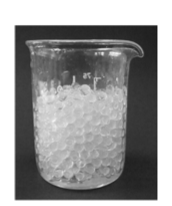
             (iv)  Enzymes can be immobilised, an example of which is shown in the image.
                   Describe a method of enzyme immobilisation.                                 (24)
▸ Reveal marking-scheme answer
Question 13 60
(a) (i) Explain why photosynthesis is an example of an anabolic reaction.
It involves the building up of large molecules using small molecules or requires
energy 3
(ii) Write a balanced chemical equation to represent photosynthesis.
6CO2 + 6H2O C6H12O6 + 6O2 First point: formulae; second point: balancing 2(3)
(b) (i) Name the cell organelle shown in the diagram in which chlorophyll is located.
*Chloroplast 3
(ii) Name the energised particles released by chlorophyll.
*Electrons 3
(iii) State the difference between each of these two pathways in terms of energised
particle movement only.
In pathway 1 electron returns to chlorophyll and in pathway 2 electron does not
return to chlorophyll or a different electron returns to chlorophyll 3
(iv) Two products of the light-dependent stage enter the light-independent stage.
Name the two products and describe each of their roles.
Name 1: *ATP or adenosine triphosphate 3
Role: Supplies energy (for the production of glucose) 3
Name 2: *NADPH 3
Role: Supplies electrons and protons (for the production of glucose) 3
(v) Name the two products of the light-independent stage that are regenerated and
used in the light-dependent stage.
*ADP (+P) or adenosine diphosphate 3
*NADP+ 3
(c) (i) Briefly describe enzymes under the following headings:
1. Biochemical nature
*Protein 3
2. Shape
Folded or described 3
(ii) Based on the biochemical nature of enzymes, name the cell component where
enzymes are made.
*Ribosome 3
(iii) Explain the underlined term and state one way in which an enzyme can be
denatured.
(An enzyme) that has lost its shape or is no longer functional 3
By pH changes or extreme heat or by agitation………. 3
(iv) Describe a method of enzyme immobilisation.
Two correct and relevant named chemicals 3
First correct physical procedural step described 3
Second correct physical procedural step described 315. (a) Explain the following three ecological terms:
(i) Biosphere
(ii) Niche
(iii) Competition (9)
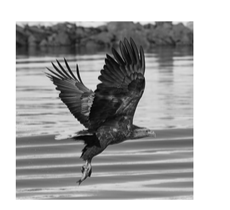
      (b)    White-tailed sea eagles were once widespread on the island of Ireland, but
             numbers diminished as a result of hunting by humans. One hundred
             white-tailed eagle chicks were brought from Norway and released into
             Killarney National Park in County Kerry as part of a rewilding project.
             However, experts say the birds still face many challenges in terms of
             repopulation. These include poisonings, bird flu and even wind turbines.
             White-tailed sea eagles have well-developed and powerful flexor muscles in
             their legs and large sharp talons (claws) to capture prey. They hunt marine
             and freshwater fish (such as salmon), seabirds (such as gulls), hares and
             other small mammals.
                          Adapted from White-tailed eagles breed…., breakingnews.ie 27 Sept 2024

             (i)   Distinguish between the terms, predator and prey.
             (ii)  Name an adaptation useful for the survival of the white-tailed sea eagle.
             (iii) Name one human activity that impacts on the population of
                   white-tailed sea eagles.
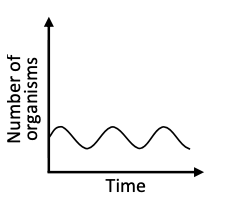
             (iv)  1.  The graph shows the periodic changes in the number of white-tailed
                       sea eagles over time in a habitat. Copy the graph into your
                       answerbook. Then, using a dashed line (- - - -), draw a graph to
                       show how the number of any one of its prey would vary over the
                       same time period.
                   2.  Give a detailed explanation of the graph that you have drawn for
                       the prey species.
             (v)   Explain why food chains, such as those involving the white-tailed sea
                   eagle, are limited in length.                                                (27)
      (c)    (i)   The following processes occur in the nitrogen cycle. Outline what is
                   occurring during each process.
                   1.  Nitrogen fixation
                   2.  Decomposition
                   3.  Nitrification
                   4.  Denitrification
             (ii)  Pollution can affect the nitrogen cycle. What is pollution?
             (iii) Name and state the effect of one pollutant from one of the following
                   areas: agriculture or industry or domestic.
             (iv)  Describe how the pollutant you have named in part (iii) above may be
                   controlled.                                                                  (24)
▸ Reveal marking-scheme answer
Question 15                                                                                     60
 (a) Explain the following three ecological terms:
       (i)   Biosphere
             Part of the Earth where life exists                                                  3
       (ii) Niche
             (Functional) role of an organism                                                     3
       (iii) Competition
             Struggle between organisms for a limited resource                                    3
 (b) (i)     Distinguish between the terms, predator and prey.
             Predator:     an organism that kills and eats another organism                       3
             Prey:         an organism that is killed and eaten by another organism               3
       (ii) Name an adaptation useful for the survival of the white-tailed sea eagle.
             Powerful (or flexor) muscles or large (or sharp) talons……….                          3
       (iii) Name one human activity that impacts on the population of white-tailed sea eagles.
             Poisoning or wind turbine or releasing chicks……….                                    3
       (iv) 1. Then, using a dashed line (- - - -), draw a graph to show how the number of
               any one of its prey would vary over the same time period.
                  Dashed line higher peaks than predator                                          3
                  Dashed line out of sync with predator                                           3
             2. Give a detailed explanation of the graph that you have drawn for the prey
                species.
                  Line:      Increases due to lower predator numbers or decreases due to
                             higher predator numbers                                              2
                  Number: Higher number due to food availability or reference to size (prey
                          are usually smaller in size)                                            2
                  Time:      Delay in increase (in prey numbers) due to time taken to breed       2
       (v) Explain why food chains, such as those involving the white-tailed eagle, are limited
           in length.
             Large loss in energy between trophic levels                                          3
 7           +3

 (c) (i)     Outline what is occurring during each process.
             1. Nitrogen fixation
                  Nitrogen gas or atmospheric nitrogen converted to ammonia or ammonium or
                  nitrite or nitrate                                                             3
             2. Decomposition
                  Breakdown of (dead) organic matter (into usable compounds)                     3
             3. Nitrification
                  Conversion of ammonium (or ammonia or urea) into nitrates (or nitrites)        3
             4. Denitrification
                  Conversion of ammonia or ammonium or nitrite or nitrate or into nitrogen gas
                  or atmospheric nitrogen                                                        3
       (ii) What is pollution?
             Harmful addition to the environment                                                 3
       (iii) Name and state the effect of one pollutant from one of the following areas:
             agriculture or industry or domestic.
             Name:         correctly named pollutant                                             3
             Effect:       correct matching effect                                               3
       (iv) Describe how the pollutant you have named in part (iii) above may be controlled.
             Correct matching control measure described                                          3
T1 exam tip: Pick 2 of 4 sub-parts. Choose (a) Rhizopus and (b) Gas exchange. Skip (c) Cell cycle and (d) Immune — Tier 2.
16.   Answer any two of (a), (b), (c), (d).                                              (30, 30)

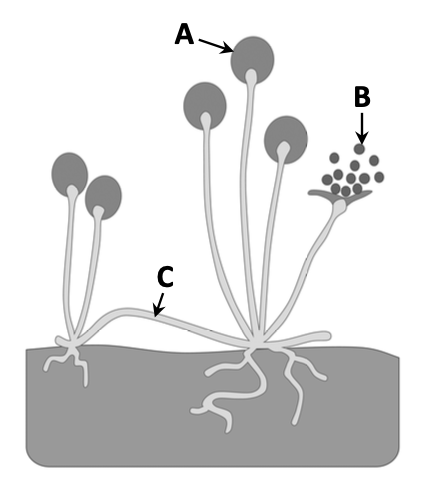
      (a)    The diagram shows Rhizopus.
             (i)   Name the structures A, B and C.
             (ii)  Give one function of structure C.
             (iii) Name the method of nutrition used by Rhizopus.
             (iv)  Rhizopus can reproduce sexually and asexually.
                   1.  The Rhizopus shown in the diagram is reproducing asexually.
                       What evidence is there in the diagram to support this statement?
                   2.  Describe the process of sexual reproduction in Rhizopus.
             (v)   Name a beneficial use and a harmful effect of fungi.
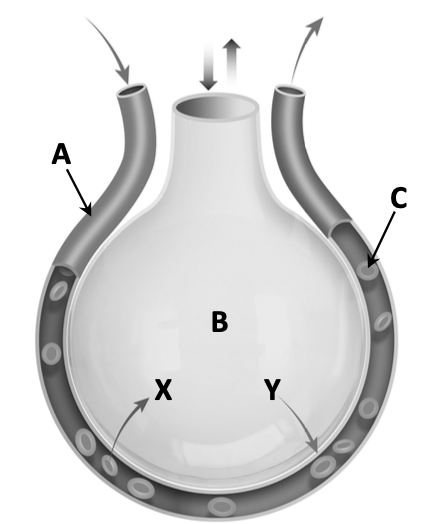
      (b)    The diagram shows gases X and Y and their main directions of movement at
             the site of gas exchange in the lungs.
             (i)   Name the structures A and B, and the type of blood cell labelled C, that
                   transports a gas around the body.
             (ii)  Give one way structure B is adapted for its function in gas exchange.
             (iii) 1.  Oxygen and carbon dioxide are two gases that are exchanged between
                       structures A and B. Match each gas to the letters X and Y, based on
                       their main directions of movement.
                   2.  What term describes the movement of these gases?
             (iv)  Name two muscles that are directly involved in inhalation.
             (v)   Describe the changes that occur in the chest during exhalation.
             (vi)  Give one treatment for one of the following breathing disorders:
                   bronchitis or asthma.
                   In your answer, state clearly to which disorder you are referring.
      (c)    The cell cycle involves interphase and mitosis.
             (i)   What is interphase?
             (ii)  Name a cell activity that occurs during interphase.
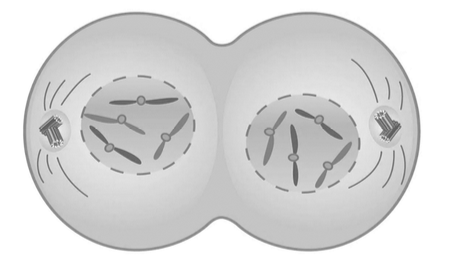
             (iii) The diagram shows a stage of mitosis.
                   1.  Name the stage shown.
                   2.  What is the diploid number of this cell?
                   3.  Draw a series of labelled diagrams of this cell as it would appear
                       during the other three stages of mitosis.
             (iv)  Meiosis is another type of cell division. Give two ways in which meiosis
                   is different to mitosis.
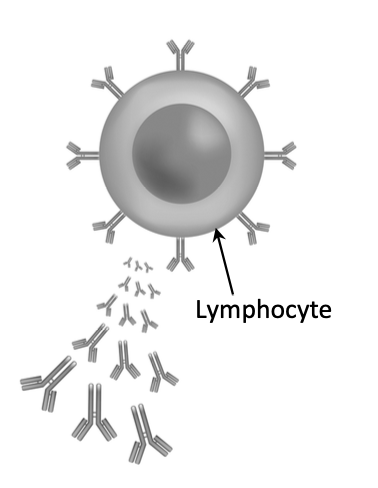
      (d)    (i)   Lymphocytes, such as the one shown in the diagram, mature in the
                   lymphatic system, which is part of the human defence system.
                   1.  Name two organs of the lymphatic system.
                   2.  Other than maturation of lymphocytes, give two functions of the
                       lymphatic system.
             (ii)  Lymphocytes play a role in the specific defence system. State the precise
                   location in the body where lymphocytes are produced.
             (iii) Name two types of lymphocyte and describe the role of each.
             (iv)  Explain the term vaccination.
17.   Answer any two of (a), (b), (c), (d).                                              (30, 30)

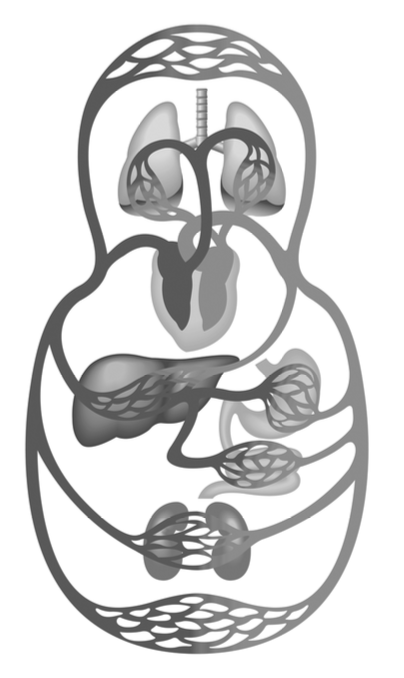
      (a)    (i)   Using the diagram as an aid, answer the following questions:
                   1.  The human circulatory system has two circuits. Name both circuits.
                   2.  Which of these circuits receives blood from the left ventricle?
                   3.  Name the blood vessel that is carrying blood highest in oxygen.
                   4.  Name the blood vessel that is carrying blood highest in nutrients.
             (ii)  State the precise function of the following in the heart:
                   1.  Sino-atrial (SA) node     2.  Septum
             (iii) What term is used to describe the period of time during which the heart
                   muscle is contracting?
             (iv)  Give two structural differences between arteries and veins.
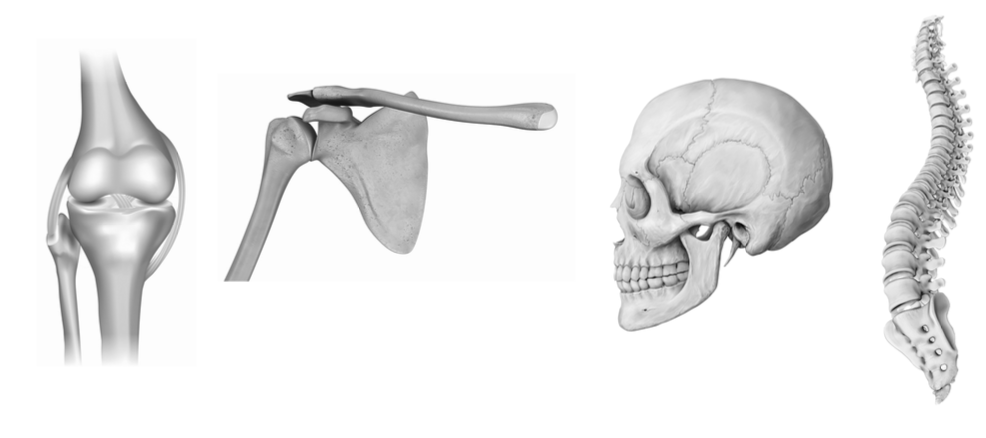
      (b)    The diagrams show some types of joints of the human skeleton.
             (i)   Name any three types of joint found in the human skeleton and give a
                   matching precise location for each type.
             (ii)  Antagonistic muscle pairs are associated with the skeleton.
                   Name any one antagonistic muscle pair and describe how it functions
                   in creating movement.
             (iii) Sketch the internal structure of a long bone and label at least three parts.
      (c)    Homeostasis is an important process in living organisms.
             (i)   Explain the underlined term.
             (ii)  ADH (anti-diuretic hormone) is an important hormone in homeostasis.
                   Name the endocrine gland that secretes ADH.
             (iii) Name one specific part of the nephron (functional unit of the kidney)
                   that ADH affects.
             (iv)  What effect does increased ADH have on the volume of urine produced by
                   the kidneys?

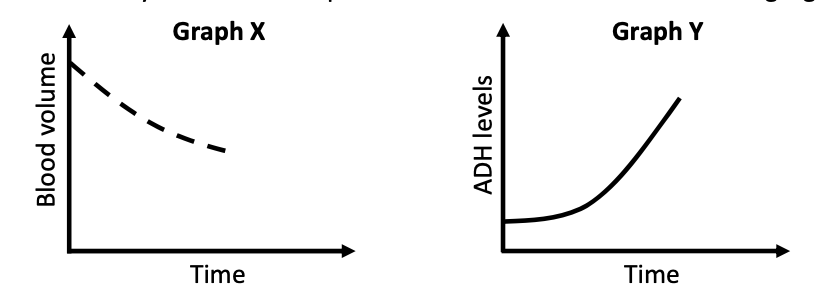
             The graphs (X and Y) show the relationship between blood volume and ADH
             levels in an athlete's body over the same period of time. The athlete is
             exercising vigourously.

             (v)   Using the information given in the description above and from analysing
                   the graphs, answer the following questions.
                   1.  State the relationship between blood volume and ADH levels in this case.
                   2.  Suggest how the athlete might increase their blood volume back to
                       normal.
                   3.  Copy graph Y into your answerbook and continue the line to show
                       how ADH levels would change if the athlete brought their blood
                       volume back to normal after exercising.

             The skin of the athlete is also involved in homeostasis during vigourous exercise.
             (vi)  State two ways the skin can help the athlete's homeostasis.
      (d)    (i)   Draw the structure of the human male reproductive system and label at
                   least three parts. On your diagram, write the letters X, Y and Z to
                   indicate where each of the following occurs:
                   1.  Sperm production (X)     2.  Sperm storage (Y)     3.  Seminal fluid production (Z)
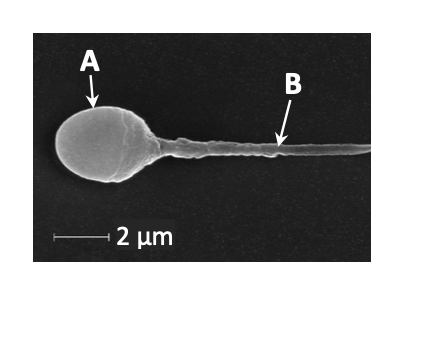
             (ii)  The image shows an electron micrograph of a sperm cell. Name parts A
                   and B and give one role for each part.
             (iii) What is the approximate survival time for sperm cells following copulation?
             (iv)  Where does fertilisation usually occur in the female?
             (v)   Give one cause of infertility and describe a corrective measure.
▸ Reveal marking-scheme answer
Question 16 Any two of (a), (b), (c), (d) 30, 30
Question 16 (a) 30
(i) Name the structures A, B and C.
A: *Sporangium 1
B: *Spore 1
C: *Stolon 1
(ii) Give one function of structure C.
Spread the fungus 3
(iii) Name the method of nutrition used by Rhizopus.
Saprophytic or heterotrophic 3
(iv) 1. The Rhizopus shown in the diagram is reproducing asexually.
What evidence is there in the diagram to support this statement?
Spores (are being released) or presence of sporangium or sporangiophore 3
2. Describe the process of sexual reproduction in Rhizopus.
+ and – strains grow close together /
swellings form (opposite each other) /
progametangia are formed /
gametangium formed /
fertilisations of haploid nuclei occur /
diploid nuclei formed /
zygospore formed /
survives adverse conditions /
germinates by meiosis when suitable conditions are present Any four 4(3)
(v) Name a beneficial use and a harmful effect of fungi.
Correct beneficial effect named 3
Correct harmful effect named 3
3 +9
Question 16 (b) 30
(i) Name the structures A and B, and the type of blood cell labelled C, that transports a
gas around the body.
A: *Capillary 1
B: *Alveolus 1
C: *Red (blood cell) 1
(ii) Give one way structure B is adapted for its function in gas exchange.
Moist (internal) surface or thin walled or covered in capillaries or large surface area 3
(iii) 1. Match each gas to the letters X and Y, based on their main directions of
movement.
X: *Carbon dioxide (or CO2) and Y: *Oxygen (or O2) 3
2. What term describes the movement of these gases?
*Diffusion 3
(iv) Name two muscles that are directly involved in inhalation.
*Intercostals 3
*Diaphragm 3
(v) Describe the changes that occur in the chest during exhalation.
Muscles or named relax /
rib cage moves down and inwards /
diaphragm moves up /
volume decreases /
(air) pressure increases /
air moves out (of the lungs) Any three 3(3)
(vi) Give one treatment for one of the following breathing disorders: bronchitis or asthma.
In your answer, state clearly to which disorder you are referring.
Correct matching treatment 3
3 +9
Question 16 (c) 30
(i) What is interphase?
State of non-division in a cell 3
(ii) Name a cell activity that occurs during interphase.
Respiration or photosynthesis or protein synthesis………. 3
(iii) The diagram shows a stage of mitosis.
1. Name the stage shown.
*Telophase 3
2. What is the diploid number of this cell?
*4 3
3. Draw a series of labelled diagrams of this cell as it would appear during the other
three stages of mitosis.
Diagram of prophase: Nuclear membrane disappearing and chromosomes
visible 3
Diagram of metaphase: Four duplicated chromosomes are lined up on the
equator of the cell and spindle fibres are shown 3
Diagram of anaphase: Four chromosomes pulled to each pole by spindle 3
Any three correct labels on the any of the three diagrams 3(1)
(iv) Give two ways in which meiosis is different to mitosis.
Meiosis halves the chromosome number and mitosis maintains the chromosome
number /
Meiosis produces 4 cells and mitosis produces 2 cells /
Meiosis produces genetically different cells and mitosis produces genetically identical
cells Any two 2(3)
9 +3
Question 16 (d) 30
(i) 1. Name two organs of the lymphatic system.
Lymph vessel / lymph node / thymus / adenoid / tonsil / spleen Any two 2(3)
2. Other than maturation of lymphocytes, give two functions of the lymphatic system.
Return (excess tissue) fluid to the blood /
transport fats /
fight infection………. Any two 2(3)
(ii) State the precise location in the body where lymphocytes are produced?
*Bone marrow 3
(iii) Name two types of lymphocyte and describe the role of each.
Name of lymphocyte 1 3
Correct matching role of lymphocyte 1 3
Name of lymphocyte 2 3
Correct matching role of lymphocyte 2 3
(iv) Explain the term vaccination.
Administration of an attenuated pathogen (or antigen) (that stimulates active
immunity) 3
Question 17 Any two of (a), (b), (c), (d) 30, 30
Question 17 (a) 30
(i) Using the diagram as an aid, answer the following questions.
1. Name both circuits.
*Pulmonary 3
*Systemic 3
2. Which of these circuits receives blood from the left ventricle?
*Systemic 3
3. Name the blood vessel that is carrying blood highest in oxygen.
*Pulmonary vein 3
4. Name the blood vessel that is carrying blood highest in nutrients.
*Hepatic portal vein 3
(ii) State the precise function of the following in the heart:
1. Sino-atrial (SA) node
Sends impulse to the atria (to cause contraction) or sends impulse to AV node or
controls the rate of contractions (of atria) or pacemaker 3
2. Septum
Separates oxygenated and deoxygenated bloods or separates blood in the left
side from the right side 3
(iii) What term is used to describe the period of time during which the heart muscle is
contracting?
*Systole 3
(iv) Give two structural differences between arteries and veins.
Arteries have thick walls and veins have thin walls /
arteries have no valves and veins have valves /
arteries have a narrow lumen and veins have a wide lumen Any two 2(3)
Question 17 (b) 30
(i) Name any three types of joint found in the human skeleton and give a matching
precise location for each type.
Three correctly named joint types 3(2)
Matching locations stated correctly 3(2)
(ii) Name any one antagonistic muscle pair and describe how it functions in creating
movement.
Correctly named antagonistic muscle pair 3
First movement: when one (named) muscle contracts and the joint moves in a
particular direction 3
Second movement: when the other (named) muscle contracts and the joint moves
in the opposite direction to the first movement 3
(iii) Sketch the internal structure of a long bone and label at least three parts.
Diagram: Epiphysis and diaphysis and medullary cavity [Any one missing = 3] 6, 3, 0
Labels: Medullary cavity / cartilage / compact bone / spongy bone / epiphysis /
diaphysis………. Any three 3(1)
6 +5 +3
Question 17 (c) 30
(i) Explain the underlined term.
(Homeostasis is) the maintenance of a constant internal environment 3
(ii) Name the endocrine gland that secretes ADH.
*Pituitary 3
(iii) Name one specific part of the nephron (functional unit of the kidney) that ADH
affects.
Distal convoluted tubule or collecting duct 3
(iv) What effect does increased ADH have on the volume of urine produced by the kidneys?
Lowers (the volume) 3
(v) 1. State the relationship between blood volume and ADH levels in this case.
Blood volume decreases and ADH levels increases. 3
2. Suggest how the athlete might increase their blood volume back to normal.
Intake fluids 3
3. Copy graph Y into your answerbook and continue the line to show how ADH
levels would change if the athlete brought their blood volume back to normal
after exercising.
Line reducing 3
Line levels off at the same level as the start 3
(vi) State two ways the skin can help the athlete’s homeostasis.
Sweating / vasodilation / vasoconstriction / piloerection Any two 2(3)
Question 17 (d) 30
(i) Draw the structure of the male reproductive system and label at least three parts.
Diagram: Penis and testes and sperm duct and urethra [Any one missing = 3] 6, 3, 0
Labels: Penis / testes / urethra / sperm duct / epididymis / prostate / seminal
vesicles / scrotum………. Any three 3(1)
On your diagram, write the letters, X, Y and Z to indicate the specific locations
where each of the following occurs:
1. Sperm production (X)
X located in the testes 1
2. Sperm storage (Y)
Y located in the epididymis 1
3. Seminal fluid production (Z)
Z located on the prostate or seminal vesicles 1
(ii) Name parts A and B and give one role for each part.
A: Head 1
Function of A: Holds the nucleus (or DNA or genes) 2
B: Tail 1
Function of B: Movement 2
(iii) What is the approximate survival time for sperm cells following copulation?
Up to 7 days 3
(iv) Where does fertilisation usually occur in the female?
*Fallopian tube 3
(v) Give one cause of infertility and describe a corrective measure.
Correct cause given 3
Corrective measure given 3
6 +8 +2